
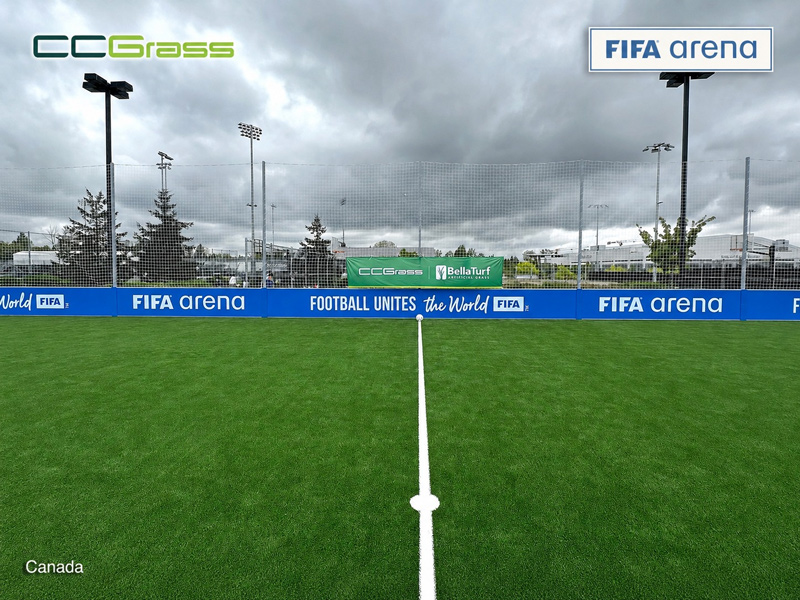
CCGrass, as an official supplier of the FIFA Arena Project, supports the completion of the first FIFA Arena pitch in Canada. Located in the Township of Langley, British Columbia, the new pitch opens as the nation experiences record-high football participation and prepares to co-host the FIFA World Cup 2026™.
CCGrass, FIFA Arena Project, Canada (1)

To address the increasing demand for quality sports infrastructure, the new mini-pitch is set to provide immediate benefits to the local community. It will directly serve 600 students at Ewart Middle School and over 2,500 children from surrounding schools. By offering a safe and accessible environment, the project empowers the next generation of players to develop their skills, build confidence, and fuel their passion for the game.
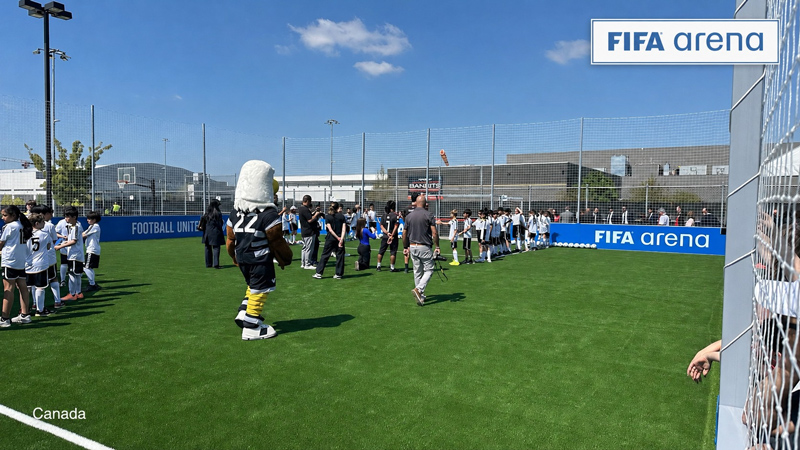
CCGrass, FIFA Arena Project, Canada (2)

The new facility is equipped with CCGrass’s innovative LEAP non-infill turf system, developed to combine high-level performance with long-term sustainability. By eliminating the need for rubber and sand infill, the LEAP system provides a cleaner and safer playing environment while significantly reducing maintenance requirements.

Its advanced structure combines durable straight yarns with double-layered curly yarns to deliver excellent surface stability and consistent ball performance. This makes it a reliable solution for high-traffic community pitches that require both durability and sustainability.

With FIFA Arena installations now spanning multiple regions worldwide, CCGrass continues to support FIFA’s mission of growing the game globally through innovative and sustainable turf solutions. As the FIFA Arena initiative continues toward its goal of installing 1,000 mini-pitches worldwide by 2031, CCGrass remains committed to helping more communities access safe and inclusive spaces for football.
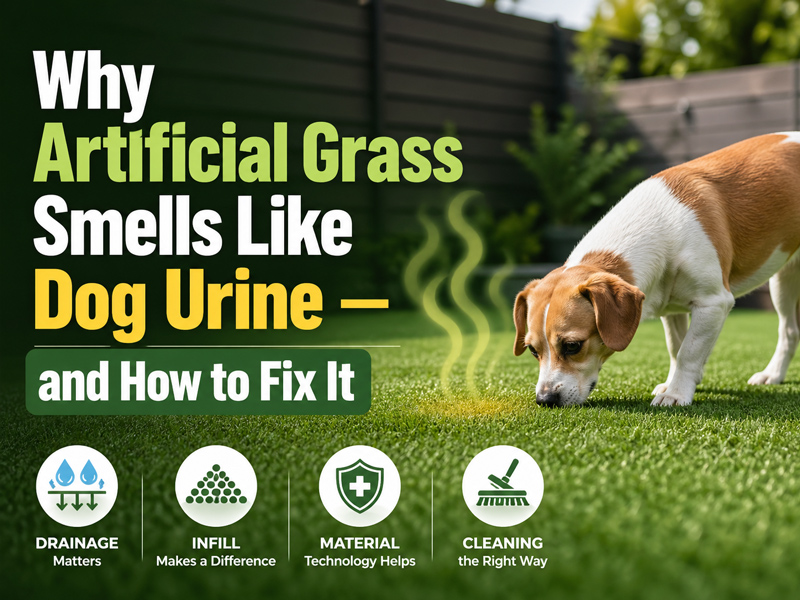
Artificial grass is widely used in pet-friendly spaces because it’s durable, low-maintenance, and easy to clean. In many cases, a simple rinse is enough to keep it in good condition—even with regular dog use.

However, odor can develop over time, especially in areas where dogs repeatedly use the same spot. When that happens, surface cleaning may help, but not always for long.

To deal with it effectively, it helps to understand why the smell occurs—and what actually makes a difference.

Why Artificial Grass Smells Like Dog Urine and How to Fix It

Does Artificial Grass Smell with Dogs

Yes, artificial grass can develop odor with dogs—primarily due to dog urine rather than the grass itself.

The main cause is urea, a natural waste compound in urine. As it breaks down, it releases ammonia, which is responsible for the characteristic smell.

On natural grass, soil and microorganisms help dilute and process these compounds. Artificial turf works differently. Liquids pass through the surface into the layers below rather than being absorbed.

If drainage is fast and complete, odor is usually minimal. But when small amounts of urine residue remain—especially in frequently used areas—those compounds can build up over time and gradually release odor.

What Most People Do First (And Why It Usually Works)

When odor appears, cleaning is the first and most logical step.

  • Rinse with water to flush fresh urine
  • Use a vinegar solution to help neutralize surface ammonia
  • Apply enzyme-based cleaners to break down odor-causing compounds

For many households, especially with light to moderate use, these methods are effective and may be all that’s needed to keep odor under control.

But when the smell keeps returning, it usually points to something beyond surface-level cleaning.

Why the Smell Keeps Coming Back

If cleaning is done properly but odor still returns, the issue is usually not the method—it’s what remains in the system over time.

Liquids move through the turf into the infill and base layers. If drainage is not fast or consistent enough, small amounts of residue can remain and accumulate.

Material choices also play a role. For example:

  • Sand infill can trap moisture and urine residue between particles, especially in high-use areas
  • Turf systems with limited permeability (such as perforated backing with fewer drainage points) can restrict water flow, preventing liquids from flushing through quickly

In simple terms, odor tends to return when moisture and residue are not fully flushed out of the system.

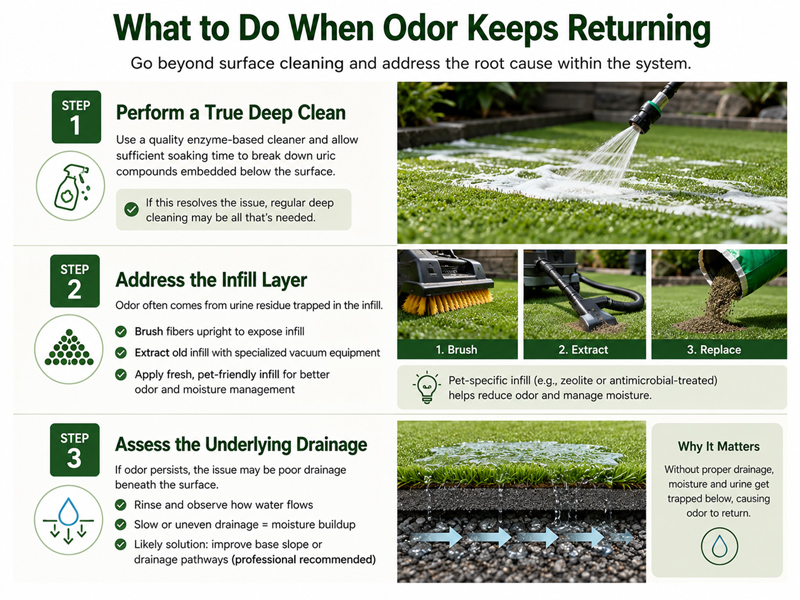
What to Do When Odor Keeps Returning

When odor keeps coming back, the solution usually involves going beyond surface cleaning and addressing what’s happening within the system.

Step 1: Perform a true deep clean

Before considering more intensive measures, start with a proper deep clean—not just a quick rinse. Use a quality enzyme-based cleaner and allow sufficient soaking time so it can penetrate the turf and break down uric compounds embedded below the surface.

If this resolves the issue, regular deep cleaning may be all that’s needed to maintain your lawn.

Step 2: Address the infill layer

If deep cleaning only provides temporary relief, the source of the odor is often within the infill layer, where urine residue can accumulate over time.

In these cases, the most effective solution is to remove and replace the contaminated infill. This is typically a professional process that requires the right equipment:

  • The turf fibers are brushed upright (often using a power broom) to expose the infill
  • The old material is then extracted using specialized vacuum equipment
  • Fresh infill is applied to restore performance

When replacing infill, material choice matters. While standard sand infill is widely used, in pet-heavy areas it may not perform as well over time.
Specialized pet infill (such as zeolite-based or antimicrobial-treated options) can better manage moisture and help reduce odor buildup.

Step 3: Assess the underlying drainage

If a full infill replacement still doesn’t resolve the issue, it usually indicates a limitation in the system’s underlying drainage.

After rinsing, observe how water moves across the surface. Slow or uneven drainage suggests that moisture may be accumulating within the base layer.

In this situation, surface cleaning or infill changes alone are unlikely to provide a lasting solution. Addressing the issue typically requires adjustments to the base—such as improving slope or drainage pathways—which is best handled by a professional installer.

Step-by-step guide to fix artificial grass odor from dog urine

How to Prevent Artificial Grass Smell (For New Installations)

When odor is considered early in the design, it’s much easier to manage over time.

Drainage should be the first priority.

A well-performing system depends on how efficiently liquid moves through and away from the turf. This starts with a properly prepared base that allows water to drain effectively, rather than accumulate beneath the surface.

The turf backing then plays a central role.

Fully permeable backing allows water to pass through evenly across the entire surface and helps reduce the chance of moisture lingering within the system.

Choosing an infill suited to pet use is also important. In high-use areas, infill designed to manage moisture and reduce odor buildup can make a noticeable difference over time.

Material design can further support long-term performance. Some turf systems incorporate antimicrobial or anti-mold technologies within the yarn and backing, helping to limit the growth of odor-causing bacteria. For example, our pet turf Argo Grass combines a fully permeable backing with built-in antimicrobial protection, supporting both drainage and hygiene at the material level.

Finally, consider how the space will actually be used. If dogs tend to use the same area repeatedly, planning for that—through layout, drainage direction, or designated potty zones—can help reduce buildup and make maintenance more manageable.

Final Thoughts

Artificial grass doesn’t develop odor simply because dogs use it—the real factor is how the system handles what’s left behind over time.

Surface cleaning can manage fresh use, but when moisture and residue remain within the system, odor is more likely to return.

In practice, long-term results come down to three things: how effectively the turf drains, how the infill behaves under repeated use, and how the space is used day to day.

When these elements are properly considered, artificial grass can stay clean, practical, and comfortable—even in pet-heavy environments.

Frequently Asked Questions

Does artificial grass smell more than natural grass with dogs?

Not necessarily. Natural grass can absorb and break down some waste through soil and microorganisms, while artificial grass relies on drainage. If the turf system drains well and is properly maintained, odor can be minimal in both cases.

How often should I clean artificial grass if I have dogs?

For regular use, rinsing once or twice a week is usually sufficient. In high-use areas or with multiple dogs, more frequent rinsing and occasional deep cleaning with enzyme-based solutions may be needed.

Can dog urine damage artificial grass?

No. High-quality artificial grass is designed to be durable and resistant to urine. The main issue is not damage, but potential odor if residue is not properly flushed out.

What is the most effective way to remove dog urine smell from artificial grass?

Start with thorough rinsing and enzyme-based cleaning. If odor persists, the issue is often within the infill layer or drainage system, which may require deeper cleaning or infill replacement.

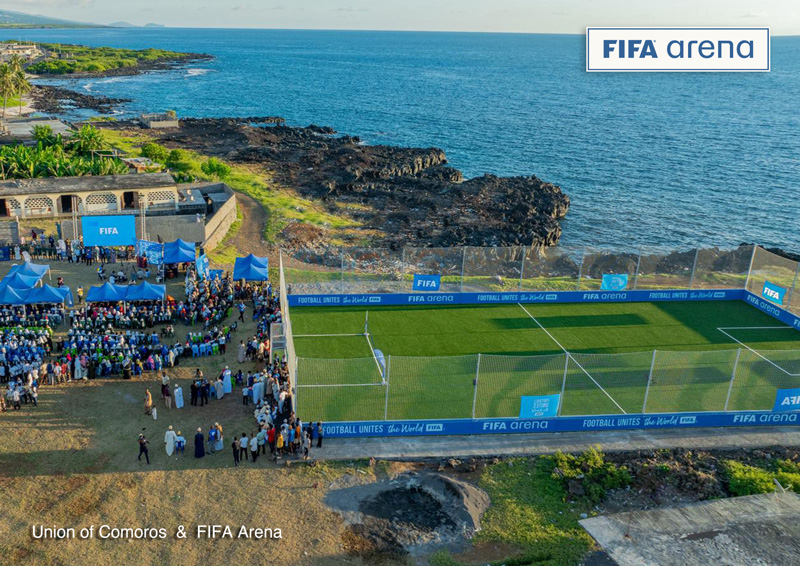
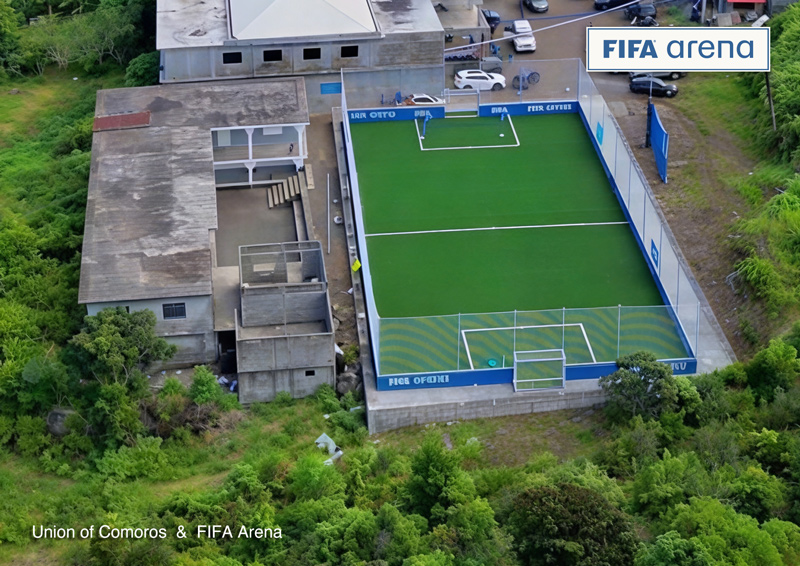
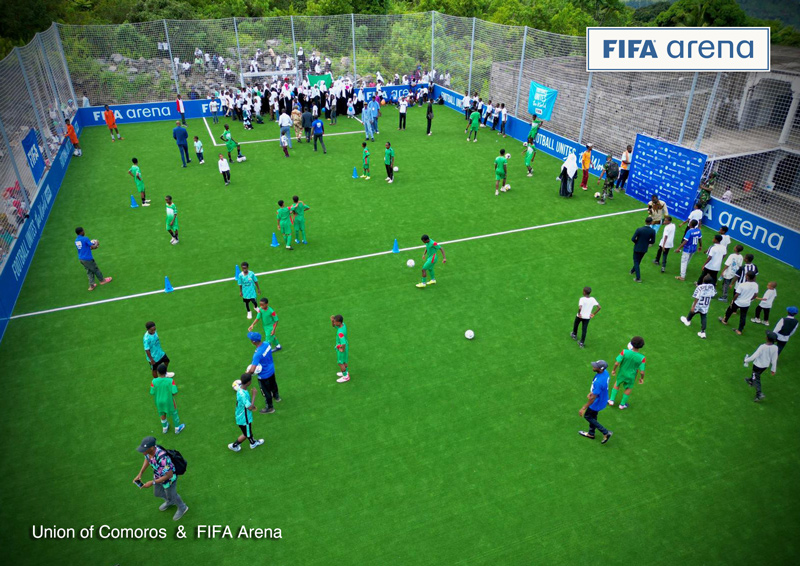
CCGrass, as an official supplier of the FIFA Arena Project, contributes to the expansion of the FIFA Arena Project into Africa with the completion of two mini-pitches in the Union of Comoros. The opening events gathered local officials, football representatives, and young players, highlighting the growing enthusiasm for football across the islands.

FIFA Arena Field Comoros 1
FIFA Arena Field Comoros 2

More than just a playing surface, these new facilities provide a safe, reliable, and high-quality environment for the local community. They create spaces where young people in Comoros can learn, play, and grow through football. By offering dependable access to sport, the project supports social development, promotes healthy lifestyles, and helps empower the next generation. The pitches will also serve as hubs for the FIFA Football for Schools programme and other local initiatives focused on youth and women’s football.

FIFA Arena Field Comoros

Both pitches feature CCGrass’s LEAP non-infill football turf system, designed to deliver a high-performance playing surface with minimal maintenance. The system provides excellent surface stability, resilient support, and consistent ball behavior, ensuring a safe and reliable experience for daily use. Free from rubber or sand infill, LEAP also offers a cleaner, more sustainable solution—particularly suited to community environments where durability and ease of upkeep are essential.

This project in Comoros is part of CCGrass’s ongoing efforts to support football development worldwide. Following successful installations across Asia and Latin America, this latest project in Africa further supports FIFA’s vision of expanding access to football. CCGrass remains committed to delivering innovative turf solutions that enable more people to access and enjoy the game.

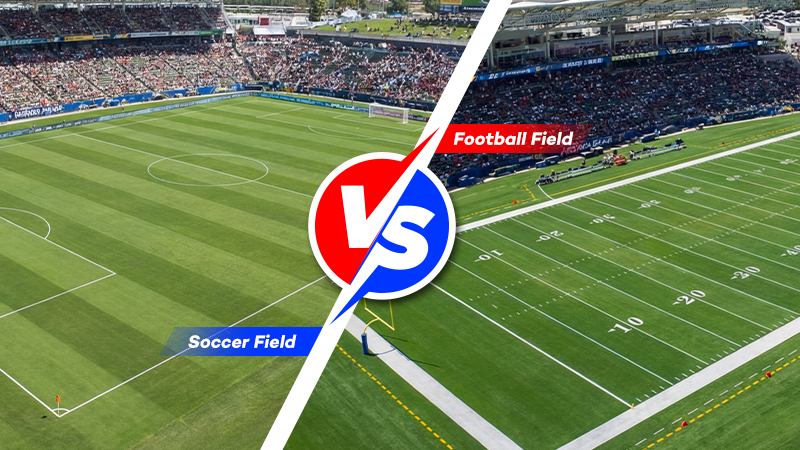
At first glance, a soccer field and an American football field may look very similar—both are rectangular, green, and played on large open surfaces. However, they differ significantly in size, layout, markings, and turf requirements.

Part of the confusion comes from the word “football.” In most parts of the world, it refers to soccer, while in North America, it means American football—two entirely different sports with unique field designs.

In this guide, we’ll break down the key differences between a soccer field and a football field, explain why these differences exist, and help you choose the right field setup for your project.

Soccer Field vs Football Field

Soccer Field vs Football Field: Quick Comparison

Here’s a quick side-by-side comparison to help you understand the core differences at a glance:

Feature Soccer Field Football Field
Governing Body IFAB / FIFA NFL / NCAA
Length 100–110 meters (110–120 yards) for international matches 120 yards (109.7 meters), including two 10-yard end zones
Width 64–75 meters (70–80 yards) 53⅓ yards (48.8 meters)
Markings Penalty areas, center circle, goal areas, corner arcs Yard lines, hash marks, end zones
Goal Structure Rectangular frame with net, on goal line. 8 ft H x 24 ft W. Y-shaped uprights, behind end zone. 10 ft H crossbar, 18.5 ft W uprights.

Soccer fields are generally wider and designed for continuous play, while football fields are narrower and built around structured, rule-driven gameplay.

Soccer Field vs Football Field Dimensions

In general, a soccer field has a larger total playing area, mainly due to its greater width.

The dimensions of a football field vs a soccer field are defined by different standards, reflecting how each sport is played.

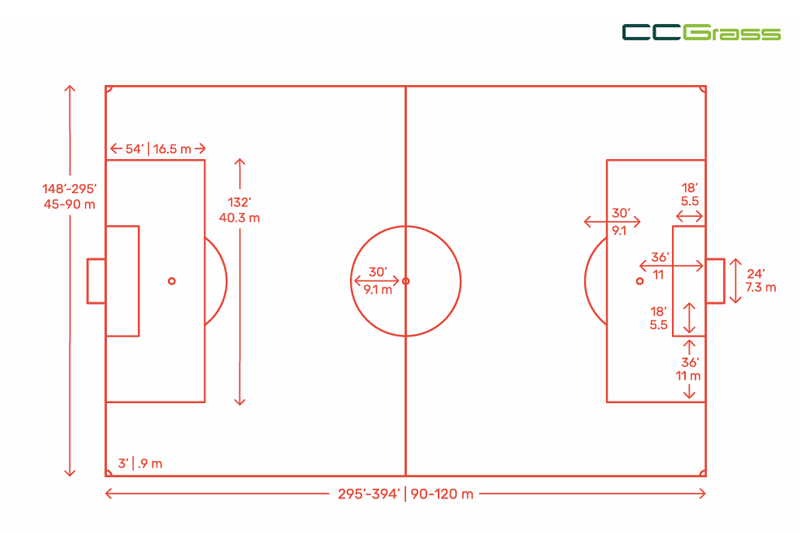
Soccer Pitch Size Standards

Soccer field dimensions are defined as a range rather than a fixed size, allowing flexibility across different levels of play.

According to the Laws of the Game issued by IFAB, a standard 11-a-side soccer field can measure:

  • Length: 90–120 m (100–130 yd)
  • Width: 45–90 m (50–100 yd)

In practice, most professional and international matches are played on pitches closer to:

  • Length: 100–110 m (110–120 yd)
  • Width: 64–75 m (70–80 yd)

A commonly used reference size is 105 × 68 m (115 × 74 yd).

This flexibility allows soccer fields to adapt to different stadium designs while maintaining consistent gameplay. A wider pitch creates more space for passing, positioning, and tactical movement across the field.

Standard soccer field layout with dimensions and field markings illustrated

Football Field Dimensions Explained

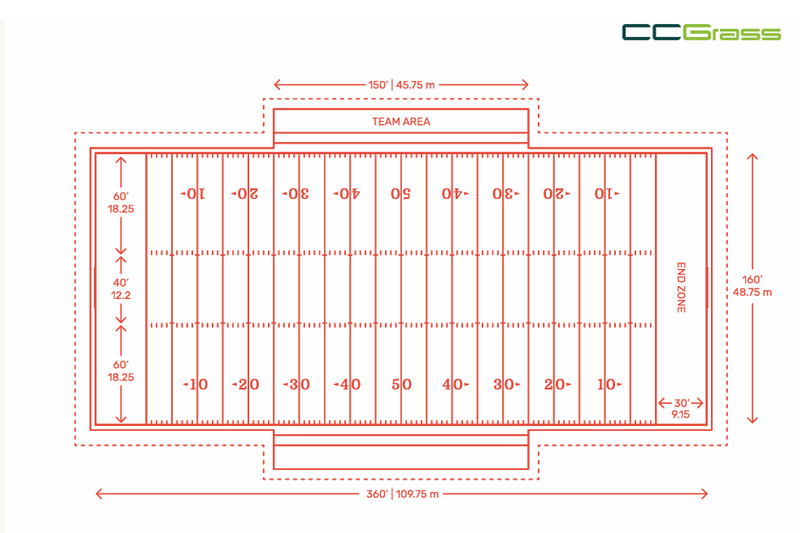
In contrast to soccer’s flexible sizing, football field dimensions are strictly standardized under organizations such as the NFL and the NCAA:

  • Total length: 120 yards (109.7 meters), including two 10-yard end zones
  • Width: 53⅓ yards (48.8 meters)

The fixed dimensions ensure consistency in gameplay and support rule-based mechanics such as yardage measurement, set plays, and field positioning.


American football field layout showing dimensions, yard lines, and markings

Which Field Is Bigger?

Overall, a soccer field is typically larger than a football field in total playing area.

While a football field is slightly longer when including end zones, a soccer field is significantly wider, resulting in a larger overall surface area in most cases.

This difference in dimensions directly influences how each sport is played:

  • Soccer fields prioritize space and continuous movement
  • Football fields prioritize structure, positioning, and short bursts of play

Understanding these differences is essential when comparing the dimensions of a soccer field vs a football field, especially for facility planning and turf system design.

Soccer Pitch vs Football Field Layout and Markings

While dimensions define the size of the field, the layout and markings reveal how each sport is played. In many ways, the field itself reflects the logic of the game—whether it emphasizes fluid movement or structured, territory-based action.

Soccer Pitch Layout and Markings

A soccer field is designed for open, continuous play, so its markings are relatively simple and functional. According to FIFA regulations, key markings include:

  • Center circle and halfway line
  • Penalty areas and goal areas
  • Corner arcs
  • Penalty spot and center spot

Each marking serves a specific purpose, but overall, the field remains visually uncluttered. This minimal layout allows players to move freely, supporting long passes, spatial positioning, and fluid transitions between attack and defense, while creating space for more creative play.

Football Field Layout and Markings

In contrast, a football field features a highly structured layout, with dense markings that divide the field into precise segments. Under standards set by the NFL and NCAA, key markings include:

  • Yard lines at 5-yard intervals
  • Hash marks for ball placement
  • End zones at both ends of the field
  • Numerical yard indicators (10, 20, 30, etc.)

Unlike soccer, every line on a football field serves a precise purpose. These markings are essential for measuring progress, enforcing rules such as downs and yardage, and guiding team positioning throughout the game.

Why the Layout Is So Different

The difference in field markings reflects two fundamentally different game structures. Soccer relies on open space and continuous movement, while football uses a detailed grid system where every line defines position, progress, and strategy.

Soccer Field vs Football Field Goal Size

Beyond field markings, the goal structures themselves highlight a fundamental difference in how points are scored. One is designed as a target to shoot into, while the other is a target to kick through.

Soccer Goal Structure

A soccer goal is a simple, intuitive target: a rectangular frame with a net, positioned directly on the goal line.

  • Size: 8 ft (2.44 m) high and 24 ft (7.32 m) wide

The goal defines a clear scoring area, where the entire ball must cross the goal line to count. The net provides immediate visual confirmation of a goal.

This design emphasizes accuracy, placement, and ball control, allowing players to score from a wide range of angles and situations.

Football Goal Structure

In contrast, a football goal structure consists of tall, Y-shaped uprights positioned at the back of each end zone.

  • Crossbar height: 10 ft (3.05 m)
  • Width between uprights: 18.5 ft (5.64 m)

Unlike soccer, scoring is achieved by kicking the ball above the crossbar and between the uprights. These goalposts are used in specific situations such as field goals and extra points.

Their design emphasizes trajectory, height, and precision, creating a challenge that is distinct from the main flow of gameplay.

Soccer vs Football Turf Systems: What Really Matters

Beyond dimensions and markings, the difference between a soccer field and a football field also extends to the turf system.

While both sports follow similar performance standards, they place different emphasis on how the surface performs—shaping how turf systems are designed in practice.

Soccer Turf: Precision, Consistency, and Comfort

For soccer, surface performance is closely tied to ball behavior and player experience. Standards defined by FIFA emphasize consistency across the entire field.

Key priorities include:

  • Ball roll and rebound
    The surface must deliver predictable ball movement to support accurate passing and control.
  • Player comfort and interaction
    A balance of cushioning and stability helps reduce fatigue while maintaining natural movement.
  • Surface uniformity
    Consistent fiber structure and infill distribution ensure reliable performance across all areas of the pitch.

Football Turf: Impact Resistance and Stability

Football places greater physical stress on the surface due to frequent contact, rapid changes of direction, and concentrated wear.

Standards referenced by organizations such as the NFL place greater emphasis on durability and impact performance.

Key priorities include:

  • Impact attenuation (Gmax and HIC)
    The system must absorb impact forces to help reduce injury risks during tackles and falls.
  • Durability under repeated use
    High-intensity play creates localized wear, requiring stronger and more resilient turf systems.
  • Traction and base stability
    Secure footing is essential for explosive movements, making infill stability and fiber support critical.

Can Soccer and Football Fields Be Used Interchangeably?

While it is technically possible to build a turf system that supports both soccer and football, fully shared fields are uncommon—especially at higher levels of play.

The main challenge lies not in the turf system, but in the field layout and markings:

  • Line markings conflict
    Football fields require dense yard lines and hash marks, which can interfere with visibility and gameplay in soccer.
  • Different field proportions
    Soccer pitches are wider, making full alignment difficult without compromising layout.
  • Different usage patterns
    Football concentrates impact in specific zones, while soccer distributes movement more evenly across the field.

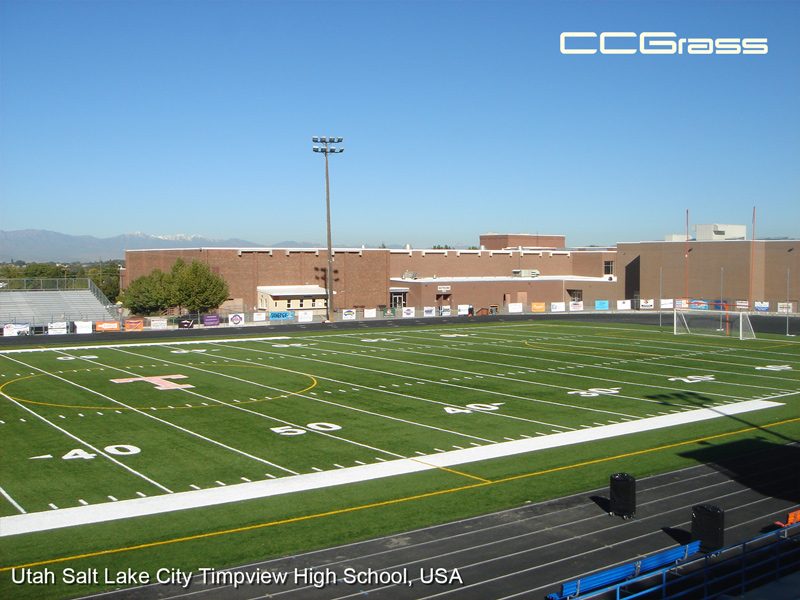
In practice, shared fields are typically limited to schools, training grounds, or community facilities, where marking compromises are acceptable. These fields often use temporary, removable paint or differently colored stitched lines (e.g., white for football and yellow for soccer) to distinguish between sports.

Multi-use sports field with soccer and football markings on the same surface

Recommended Turf Systems for Soccer and Football

Selecting the right turf system depends on performance priorities, usage intensity, and long-term value.

With extensive experience across both soccer and football field construction, CCGrass has delivered over 500 FIFA-certified pitches worldwide and developed more than 200 turf system configurations—enabling tailored solutions for different levels of play and usage scenarios.

Best Turf Systems for Soccer Fields

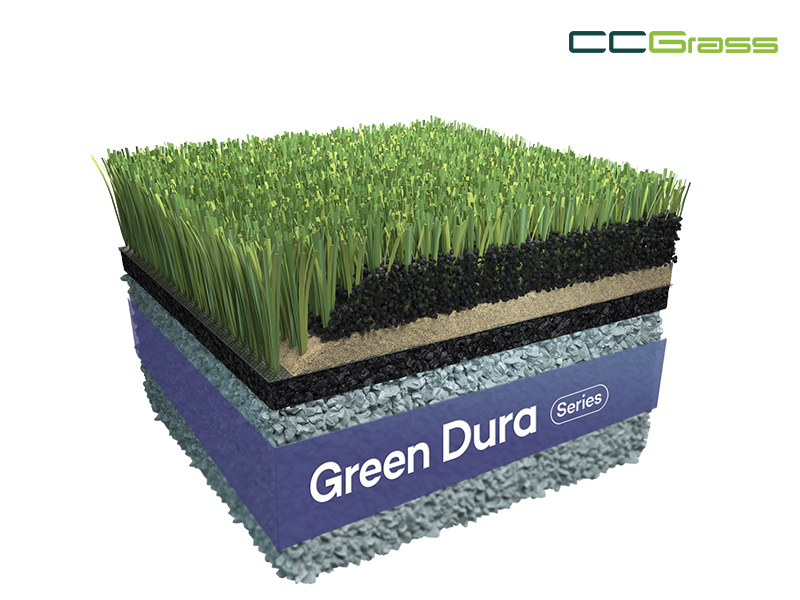
Wear-resistant artificial grass system for soccer fields with long service life

Green Dura — Built for durability and long-term use

  • Classic diamond-shaped fiber for proven wear resistance
  • Ultra-thick yarn (400μm+ ) enhances durability
  • Extended service life for high-frequency usage

Best for high-traffic fields requiring long-lasting durability.

Artificial turf system for soccer fields with natural look and balanced performance

Best Turf Systems for Football Fields

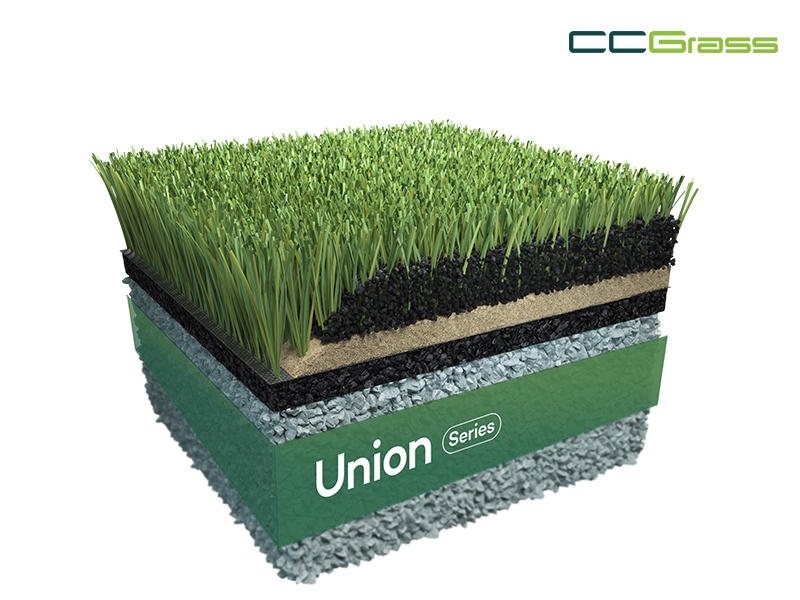
Union Series — Designed to replicate natural grass

  • Combines multiple yarn shapes and colors
  • Balances durability, resilience, and player comfort
  • More natural appearance and improved surface interaction

Best for premium fields prioritizing natural playability and aesthetics.

Artificial turf system for football fields designed for durability and stability

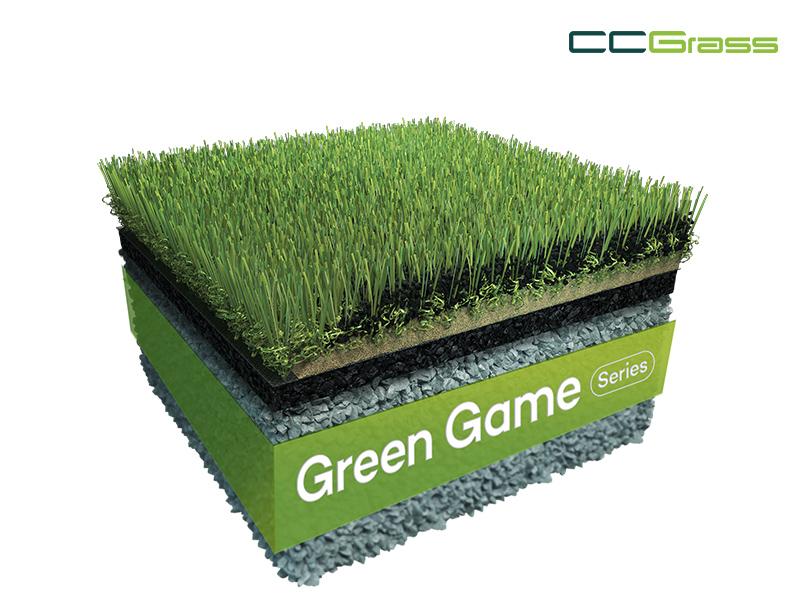
Green Game — Engineered for stability and impact performance

  • Monofilament fibers combined with curly yarn support layer
  • Enhances infill stability and reduces movement
  • Improves traction and base stability under high-impact play
  • Maintains fiber resilience for longer-lasting performance

Best for high-impact play requiring stability and traction.

Also suitable for soccer where enhanced durability and stability are required, particularly in multi-use or high-intensity scenarios

Common Questions About Soccer and Football Fields

Can you use a football field for soccer?

Not directly at a professional level. While both fields are rectangular, their dimensions, markings, and goal structures differ significantly. In practice, some facilities can host both sports with adjusted field layouts, but full interchangeability is limited.

Can a stadium be used for both soccer and football?

While some stadiums are capable of hosting both soccer and football, this is not typical at a professional level. Most elite venues are designed specifically for one sport to meet strict competition standards.

Multi-use configurations are more commonly found in schools, training facilities, or community fields, where compromises in field markings and layout are acceptable.

Is the soccer field longer than a football field?

A football field is slightly longer than a soccer field when including the two end zones (120 yards in total). However, soccer fields vary in length depending on FIFA regulations and are generally wider, resulting in a larger overall playing area compared to a football field.

Which sport is more popular, soccer or football?

Globally, soccer is the most popular sport, with a massive international following. However, American football remains one of the most popular sports in the United States, where it dominates viewership and fan engagement.

Do soccer and football fields use the same turf?

Soccer and football fields can use the same types of turf, but the system design is different.

Soccer prioritizes ball roll and player comfort, while football focuses more on durability, traction, and impact performance. As a result, turf systems are configured differently to meet the specific demands of each sport.

Conclusion

Understanding the differences between a soccer field and a football field goes beyond dimensions and markings. Each field is designed around the way the game is played—from open, continuous movement to structured, high-impact action.

These differences influence not only field layout, but also how turf systems are engineered in terms of ball behavior, player interaction, durability, and safety.

In practice, there is no one-size-fits-all solution. The right field—and the right turf system—depends on how the surface will be used, how often it will be played on, and what level of performance is expected.

With extensive experience in both soccer and football applications, CCGrass provides tailored artificial turf systems that balance playability, durability, and long-term value. From FIFA-certified soccer pitches to high-impact sports fields, every solution is designed to meet real-world performance demands.

If you’re planning a new sports field or upgrading an existing one, choosing the right turf system is where performance truly begins.

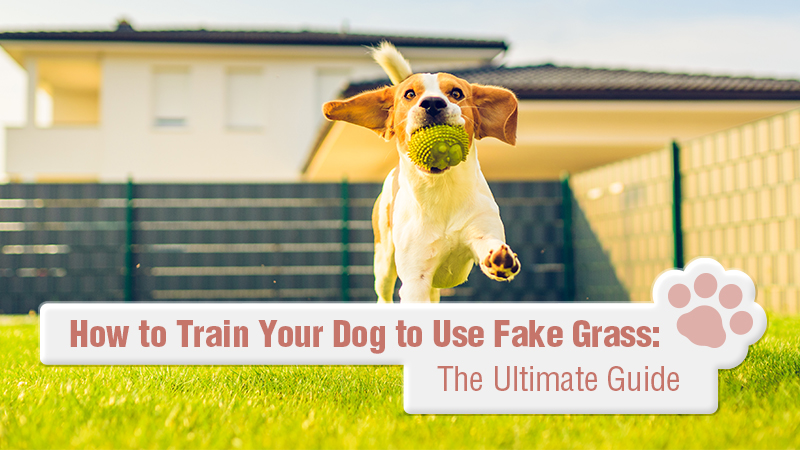
For dog owners, whether welcoming a new puppy or refining an older dog’s habits, potty training is a crucial step. Establishing a consistent potty routine reduces stress for your dog and keeps floors and furniture accident-free.

Training your dog to use fake grass or a grass pad as a designated potty spot is an ideal solution, especially for busy owners. With the right training, artificial turf provides a clean, low-maintenance area that promotes your dog’s well-being and makes life easier for you, both indoors and outdoors.

Quick Answer

To train your dog to use fake grass or a grass pad:

  1. Introduce them to the turf with a leash
  2. Use consistent potty times (after meals, naps)
  3. Give a clear verbal cue like “go potty”
  4. Reward immediately after success
  5. Stay consistent and avoid punishment

Most dogs adapt within 1–3 weeks with consistent training.

Why artificial turf is ideal for homes with dogs

Natural look and feel

Today’s artificial grass closely mimics the look and texture of real grass, so your dog will feel comfortable using it. The natural feel of the turf can help pets adapt quickly, providing them with a familiar surface that encourages proper potty habits.

Durability against wear and tear

Pet-friendly artificial grass is made to withstand the wear and tear of daily pet use. Unlike natural grass, which can become patchy or muddy, synthetic turf stays resilient and clean, providing a reliable, long-lasting potty area for your dog.

Resistant to urine damage

Dog urine can cause unsightly, discolored patches on natural grass, gradually turning a green yard dull and muddy as your pet marks its territory. Fake grass is resistant to such damage, maintaining its fresh, green look over time without the risk of discoloration.

Easy maintenance and odor control

Keeping artificial grass for dogs odor-free and hygienic is simple with regular rinsing and occasional use of pet-safe cleaners. Many turf types also come with antimicrobial properties that help control odors, making it a practical choice for busy pet owners.

Versatile for indoor and outdoor use

Synthetic grass works well in both indoor and outdoor settings, offering flexibility to fit various living spaces. Whether you need a designated area in your apartment or a durable spot in your yard, pet turf provides a solution that’s easy to adapt to any environment.

If your dog is hesitant to go outdoors—especially young puppies or those easily stressed—an indoor grass pad or balcony turf can serve as a gentle transition zone.

For more insights, see our guide on the pros and cons of artificial grass with dogs.

Before you start dog potty training

Choosing the right artificial grass for dog potty

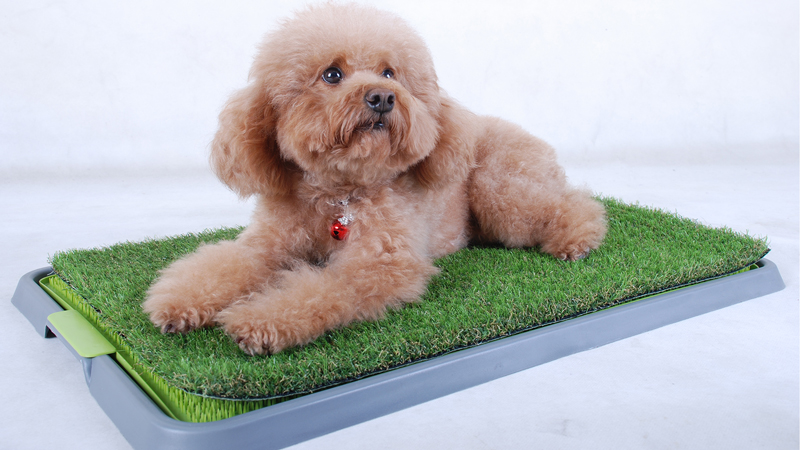
Indoor grass pad options

Indoor potty turf should be compact, portable, and easy to clean. Opt for a grass pad with a drainage tray, specifically designed for indoor use. Antimicrobial options are ideal for controlling odor in small spaces.

CCGrass fake grass potty pad

Outdoor turf options

Choose durable, well-draining turf with UV and antimicrobial protection. For a consistent potty area, opt for larger sections. CCGrass Argo Grass is a great option, featuring advanced antibacterial technology, high durability, and superior drainage for a comfortable, odor-free space.

Finding the ideal location

Indoor location

Pick a practical spot for the fake grass potty pad, ideally near a window or balcony to allow airflow and help with odor control. Position it away from busy areas in the home to give your dog a quiet space to focus. The spot should also be convenient for daily access and easy to clean.

Tip: Keep the dog potty away from your dog’s food and water bowls. Dogs naturally prefer to separate their eating and bathroom areas, and this helps maintain hygiene and comfort.

Outdoor location

Choose a designated outdoor spot that’s easy for your dog to reach and separate from play or relaxation zones. Shaded locations keep the turf cooler in hot weather, and proper drainage helps prevent puddles and odor buildup.

Essential training kit for dogs

Leash

Guide your dog to the potty turf with a leash, especially during initial training sessions. This limits movement and keeps them focused on the designated area.

Rewarding treats

Treats are a strong motivator. Reward your dog immediately after they use the artificial turf to create a positive association, making training quicker and more enjoyable.

Comforting toys

If your dog is hesitant, place a favorite toy on the turf to encourage exploration. A familiar item can make the new potty area feel more inviting.

(Optional) Pee Post

A small upright object—like a training pee post or traffic cone—can help male dogs aim and mark more consistently. Many males prefer to urinate against vertical surfaces, so placing one in the middle of the turf may encourage them to use the right spot.

Note: This tool works best for male dogs that already show marking behaviour. It may not be effective for puppies or female dogs.

Steps to train your dog to use artificial grass or grass pads

Whether you’re training a puppy or an adult dog, consistency and encouragement are essential to help them get comfortable using fake grass as their potty area. Here’s a straightforward guide to get started.

Step 1: Introducing your dog to artificial turf

First encounter

When your dog is introduced to the artificial grass for the first time, use a leash to gently guide them onto the edge of the turf. Allow your dog to sniff and explore the area at their own pace, getting used to the new scent and texture.

Positive reinforcement

When your dog steps onto the turf, immediately offer praise and a reward, like a treat, gentle petting, or verbal encouragement. Repeating this process helps create a positive association, so they begin to connect “stepping on the turf = getting rewarded.”

Encourage short stays

Some dogs may step on and step off quickly—that’s normal.

If they seem uneasy or try to leave, don’t force them. Instead, speak calmly and guide them back, rewarding them each time they stay a little longer. Over time, this builds a positive emotional connection with the potty area.

Step 2: Set a consistent routine

Establish potty times

Observe your dog’s natural potty schedule, like after meals, naps, and playtime. Bring them to the artificial grass lawn at these times and let them move around within the area. This consistency helps them recognize the turf as their designated potty spot.

Use verbal cues

Choose a short, clear command like “go potty” and use it consistently each time you bring your dog to the grass potty area.

Over time, your dog will associate the phrase with going to the bathroom on the turf, making the process easier and more predictable.

Step 3: Reward success immediately

Praise and treat

As soon as your dog uses the fake grass potty successfully, offer praise and a treat right away.

Rewards need to come within 1–2 seconds to help your dog make the right connection. Any delay can weaken the learning effect.

Tip: Use a “jackpot treat” (like cheese or steak) specifically for potty success. Saving the best rewards for turf training can significantly speed up results.

Stay consistent

All family members should follow the same training routine and use the same phrase and reward system. Dogs learn through patterns—even small inconsistencies can delay success.

Also, try to keep the artificial grass dog potty in the same spot once you’ve chosen a location.

Step 4: Address mistakes without punishment

Calm redirection

If your dog goes in the wrong spot, don’t scold them.

Punishment can erode their sense of safety, leading them to sneak off and potty in hidden places. Just clean thoroughly and guide them back next time.

Patience is key

Training your dog to use artificial turf may take time, especially if they’re used to another potty routine, like natural grass. Stay patient during the transition, provide positive reinforcement, and stick to the routine for the best results.

Artificial grass for dogs

Troubleshooting: When your dog still won’t go

Some dogs need a little extra help adjusting to artificial grass—especially if they’ve developed strong preferences for other surfaces or routines.

If your dog is still not using fake grass or a grass pad, try these solutions:

Use separate spots for peeing and pooping

Many dogs don’t like doing both in the same place. If your dog pees on the turf but refuses to poop, try placing a second turf pad nearby as a separate toilet.

Add familiar scents (sparingly)

Dogs rely heavily on smell to identify potty areas. Dab a bit of their urine on the turf or slide a used pee pad underneath. Avoid strong smells—too much scent can overwhelm rather than attract.

Try other dogs’ scent (with caution)

In multi-dog households or pet-friendly areas, the smell of another dog’s urine can stimulate marking behavior. A small amount of scent from a trusted dog may encourage your dog to “join in.” This works best for dogs with strong marking instincts.

Simulate outdoor cues

Some dogs are sensitive to the full outdoor experience—grass, soil, even leaves.

Rub a bit of dirt or grass from their usual potty spot onto the turf, and try leaving a few leaves or natural debris on top. The added texture and scent may help your dog recognize the area as “real enough” to use.

Encourage sniffing with treats

Scatter a few pieces of kibble in a small trail around and onto the turf. This mimics a dog’s natural sniffing and circling behavior before going potty. As your dog follows the trail, they may relax and become more willing to use the area.

Artificial Grass for Dogs

How to clean your artificial grass after potty training

One of the greatest advantages of using artificial grass for potty training is the ease of cleaning. Keeping the turf clean not only helps maintain a hygienic environment but also ensures that your dog continues to use the area without reluctance.

Cleaning solid waste

When dealing with solid waste, allow it to dry before picking it up to avoid any mess. Use a scoop or gloves for a quick and sanitary clean-up.

Cleaning dog urine

For dog urine, rinse the area with water to dilute and prevent odors. If dog pee has been on the turf for an extended period, use a mild soap and water solution for a deeper clean, ensuring to rinse thoroughly afterward to remove any soap residue.

You can also leave a small trace of scent from previous use to help your dog recognize the area as their designated potty spot.

FAQ: Dog Potty Training with Fake Grass

How long does it usually take to fully potty train a dog?

Most dogs learn basic potty training within 1–3 weeks, while full consistency can take up to 1–2 months. Puppies or dogs switching to a new surface, such as a grass pad or artificial grass, may need extra time and a consistent routine.

How do you stop a dog from peeing and pooping in the house?

To stop indoor accidents, establish a regular potty schedule and guide your dog to a designated area like a grass pad. Reward them immediately after success and supervise closely. Consistency is the most effective way to reinforce good potty habits.

What age is too late to potty train a dog?

It’s never too late to potty train a dog. While puppies may learn faster, adult dogs can still adapt well with patience and consistency. Using a clear, designated potty area—such as artificial grass or a grass pad—can make training easier at any age.

What is a red flag for potty training?

A red flag in potty training is when a dog frequently has accidents despite a consistent routine. This may indicate confusion, stress, or even a medical issue. Inconsistent use of a grass pad or refusal to use fake grass can also signal adjustment difficulties.

What is the 10-10-10 rule for potty training?

The 10-10-10 rule suggests taking your dog to the potty area 10 minutes after eating, drinking, or waking up. This method helps build a predictable routine and works well when training dogs to use fake grass or a grass pad consistently.

What is the 3-3-3 rule for dog training?

The 3-3-3 rule refers to a dog’s adjustment period: 3 days to decompress, 3 weeks to learn routines, and 3 months to feel fully settled. Understanding this timeline can help set realistic expectations during potty training, especially when introducing new surfaces like artificial grass.

Unlock stress-free potty training with fake grass

Potty training your dog may take patience, but it’s a rewarding process that strengthens your bond. With a fake grass or grass pad solution, you’ll enjoy easier clean-up and a reliable potty area for your dog.

Potty training is a process that takes time, consistency, and patience. By understanding your dog’s natural behaviors—like their preference for soft textures, their use of scent for communication, and their need for a secure potty spot—you can guide them toward success with artificial turf.

Explore our high-quality dog turf options designed for comfort, hygiene, and easy maintenance—and make potty training a smoother experience for both you and your pet.

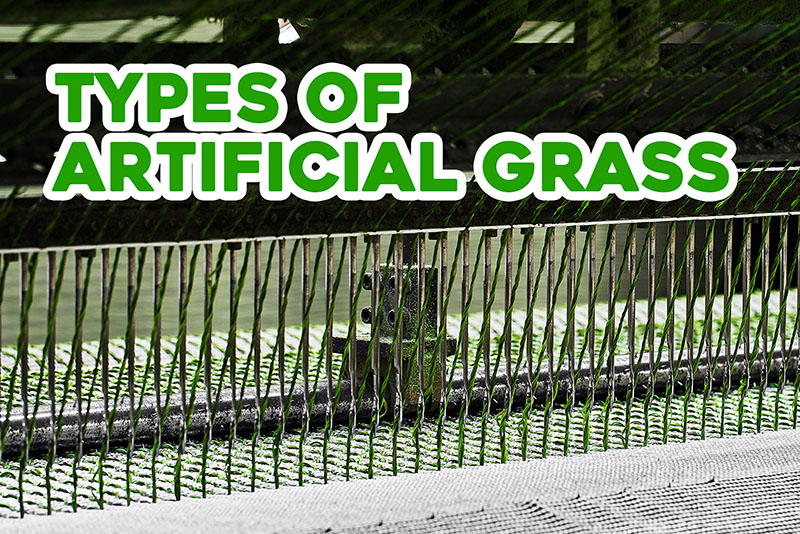
Artificial grass has evolved into a versatile solution used across residential, commercial, and sports applications. While it may look similar at first glance, different types of artificial grass vary significantly in materials, structure, appearance, and performance.

Understanding these differences is essential if you want to choose the right turf for your project. In this guide, we break down the main types of artificial grass and explain how to select the best option based on your needs.

CCGrass, types of artificial grass

What Are the Main Types of Artificial Grass?

Artificial grass can be categorized in several ways, but the most practical approach is to look at it from three key perspectives: application, material, and fiber structure.

  • By application: residential, commercial, sports turf, playgrounds, pet areas, and putting greens
  • By material: polyethylene (PE), polypropylene (PP), nylon
  • By fiber structure: monofilament, fibrillated, curly yarn

Understanding these categories makes it easier to compare options and choose the right artificial grass for your specific needs.

Types of Artificial Grass by Application

Artificial grass is most commonly classified by application, as different use cases require distinct performance characteristics.

Residential Turf

Residential artificial grass is ideal for gardens, backyards, and private outdoor spaces. It is designed to provide a soft, realistic lawn that stays green year-round with minimal upkeep.

  • Medium to long pile height for a natural look and feel
  • Multi-tone color blends for realism
  • Soft, comfortable surface for daily use

To achieve a natural-looking lawn, see our guide on the most realistic artificial grass.

CCGrass, artificial landscape turf

Commercial Landscape Turf

Commercial turf is used in offices, public areas, and urban landscapes where durability and consistent appearance are essential. It is built to handle moderate to heavy foot traffic while maintaining visual appeal.

  • Enhanced durability for high-traffic environments
  • Consistent appearance across large areas
  • Low maintenance for long-term cost efficiency

CCGrass commercial turf landscapes

Playground Turf

Playground turf is designed to create safe and durable play environments for children. It provides a clean, mud-free surface while helping reduce the risk of injury during active play.

  • Shock-absorbing systems to cushion falls
  • Durable fibers for heavy use
  • Non-toxic and easy-to-clean surface

For a deeper look at safety and selection, check our guide to choosing artificial grass for playgrounds.

CCGrass playground turf for kids

Pet-Friendly Turf

Pet turf is engineered for hygiene, durability, and easy maintenance. It helps keep outdoor spaces clean while withstanding frequent pet activity.

  • Excellent drainage to prevent odor buildup
  • Durable fibers resistant to digging and wear
  • Easy cleaning and low maintenance

If you’re considering turf for pets, read our detailed guide on artificial grass with dogs pros and cons.

CCGrass, pet friendly artificial turf for dogs and pets

Putting Green Turf

Putting green turf is designed to replicate the performance of natural golf greens, offering a smooth and consistent playing surface.

  • Short, dense fibers for accurate ball roll
  • Stable surface for precision play
  • Suitable for both residential and professional use

To better understand how to select and install the right surface, explore our artificial putting green turf guide.

CCGrass, putting green turf for golf

Sports Artificial Turf

Sports turf is engineered for performance, durability, and player safety. Unlike landscaping grass, it is designed to meet the specific demands of different sports.

Different systems are developed for football, rugby, hockey, tennis, and other sports, each requiring specific performance characteristics such as shock absorption, traction, and ball behavior.

  • High durability for intensive use
  • Consistent playing performance
  • Designed to meet sport-specific standards

See our detailed breakdown of artificial turf types for sports fields.

CCGrass, artificial turf ideal for sports fields

Types of Artificial Grass by Material

The material used in artificial grass fibers plays a major role in determining durability, softness, and cost.

Polyethylene (PE)

Polyethylene is the most widely used material in modern artificial grass. It offers an excellent balance between softness, durability, and visual appeal. Its natural look and comfortable feel make it a popular choice for both landscaping and sports applications.

Polypropylene (PP)

Polypropylene is a more affordable option, but it is generally less durable than polyethylene. It is often used in low-traffic areas or as part of the thatch layer in landscaping turf.

While lightweight and cost-effective, it is less resistant to heat and heavy use.

Nylon

Nylon is the strongest and most durable type of artificial grass material. It can withstand high temperatures and heavy loads without losing its shape.

However, it tends to be stiffer and more expensive, so it is typically used in specialized applications such as sports fields or high-performance surfaces.

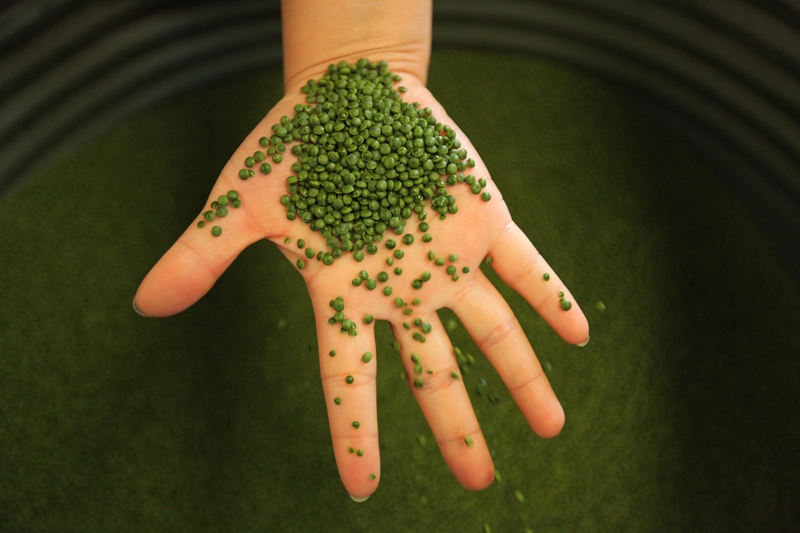
CCGrass, artificial grass, raw polymer pellets

Types of Artificial Grass by Fiber Structure

Beyond materials, the structure of the fibers plays a key role in how artificial grass performs, influencing durability, resilience, appearance, and suitability for different applications.

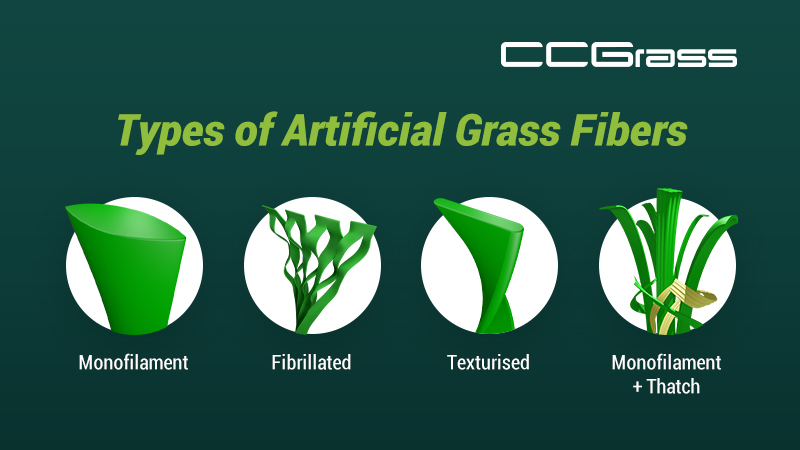
Monofilament Grass

Monofilament yarn is the most widely used and versatile type of artificial grass fiber, applied across both sports and landscaping applications.

One of their key advantages is the ability to be engineered into different shapes. For example, diamond-shaped fibers tend to offer greater strength and durability, while C-shaped or S-shaped designs enhance softness for a more comfortable feel. Shapes such as V-shaped or W-shaped fibers improve resilience, helping the grass blades recover quickly after heavy use.

In sports turf, these engineered shapes are often used to optimize performance characteristics such as durability, traction, and ball behavior. In landscaping applications, different yarn shapes are frequently combined to achieve a more natural appearance while balancing comfort and wear resistance.

Fibrillated Grass Fiber

Fibrillated fibers feature a mesh-like structure that gradually splits into multiple strands during use. This design helps to effectively hold infill in place, improving surface stability.

They are typically a more cost-effective option and are widely used in applications such as tennis courts, recreational sports fields, and playgrounds, where durability and functionality are important but extreme performance is not always required.

Texturised Yarn (Curly Fiber)

Texturised yarn, often referred to as curly fiber, is produced through a texturising process that creates a curled or crimped structure. Unlike upright monofilament fibers, these yarns form a dense, compact surface.

This type of fiber is commonly used in sports such as hockey, tennis, padel, and putting greens, where a low, stable, and uniform playing surface is required. It helps control ball speed and ensures consistent interaction between the ball and the turf.

Thatch Layer

The thatch layer is a secondary fiber layer used mainly in landscaping artificial grass. It typically consists of shorter fibers in natural tones such as light green, yellow, and brown, designed to replicate the underlying layer of real grass.

Its primary role is to enhance visual realism by mimicking natural variation, while also adding support to the upright fibers and improving the overall fullness of the turf.

Types of Artificial Grass Fibers

How to Choose the Best Artificial Grass

Selecting the right artificial grass can make a significant difference in performance, appearance, and durability. The key is to evaluate the intended use, environmental conditions, project requirements, and budget before making a decision.

Here’s a practical guide to help you choose:

Consider the Primary Application

  • Sports Turf: Prioritize durability, resilience, and consistent playing performance. Look for systems that meet recognized standards such as FIFA, FIH, World Rugby, ITF, or FEP.
  • Residential or Commercial Landscaping: Focus on natural appearance, softness, and UV resistance to maintain long-term visual appeal.
  • Playgrounds & Pet Areas: Emphasize safety, durability, drainage, and ease of maintenance to ensure a clean and long-lasting surface.
  • Putting Greens: Require precision, smoothness, and consistent ball roll for optimal playability.

Match the Right Fiber Structure & Material

  • For high-performance sports fields: Polyethylene (PE) monofilament fibers are widely used for their strength and resilience. They can also be combined with texturised yarn or fibrillated fibers in advanced turf systems to help control infill movement and improve surface stability.
  • For recreational or multi-use areas: Fibrillated fibers offer a more cost-effective solution while still delivering reliable durability and infill retention.
  • For landscaping applications: Combining monofilament fibers with a thatch layer helps achieve a balance between natural appearance, comfort, and wear resistance.
  • For precision sports surfaces (hockey, tennis, padel, putting greens): Texturised monofilament yarn is commonly used to create a dense, stable surface for controlled ball interaction.

Check Pile Height & Density

  • Shorter piles (10–25 mm): Ideal for high-traffic areas, putting greens, playgrounds, and pet zones.
  • Medium to long piles (30–50 mm+): Better suited for residential lawns or commercial landscapes where comfort and a lush appearance are priorities.
  • Higher density (face weight): Generally improves durability and provides a more natural look and feel.

Evaluate Color Requirements

  • Although green is the standard for most artificial grass applications, color selection may vary depending on functional or design requirements.
  • In sports such as hockey, tennis, and padel, non-green surfaces (such as blue) are often used to enhance ball visibility and improve player focus.
  • For playgrounds, colored turf options help create more engaging and visually stimulating environments.
  • The right color choice can enhance both functionality and overall user experience.

Consider Environmental Factors

  • Sunlight & Heat: Polyethene fibres offer better heat resistance, while polypropylene is less suitable for high-temperature environments.
  • Drainage & Moisture: Ensure the backing and system design provide efficient drainage, especially for pet areas and playgrounds.
  • Climate & Maintenance: Choose UV-stabilised products for sunny regions and easy-clean systems for high-use areas.

Infill, Backing & Shock Pad

  • Infill: Helps support fibers, improve cushioning, and maintain surface stability. Common options include silica sand, rubber, zeolite, and organic alternatives. Some modern systems are designed without infill, offering a cleaner and lower-maintenance solution for specific sports applications.
  • Backing: A high-quality dual-layer backing system improves durability, dimensional stability, and drainage performance.
  • Shock Pad (Optional): Often used in sports fields and playgrounds to enhance shock absorption, improve player comfort, and reduce injury risk.

Conclusion

Understanding the different types of artificial grass is the first step toward making the right choice. From materials and fiber structures to application-specific systems, each option is designed to meet different performance and aesthetic needs.

By evaluating your intended use, environmental conditions, and technical requirements, you can select a solution that delivers long-term durability, consistent performance, and natural visual appeal.

For more accurate decision-making, it is recommended to seek advice from experienced turf professionals and review turf samples based on your specific project requirements.

new-chat