

Artificial grass is widely used in pet-friendly spaces because it’s durable, low-maintenance, and easy to clean. In many cases, a simple rinse is enough to keep it in good condition—even with regular dog use.
However, odor can develop over time, especially in areas where dogs repeatedly use the same spot. When that happens, surface cleaning may help, but not always for long.
To deal with it effectively, it helps to understand why the smell occurs—and what actually makes a difference.
In this article:
Does Artificial Grass Smell with Dogs
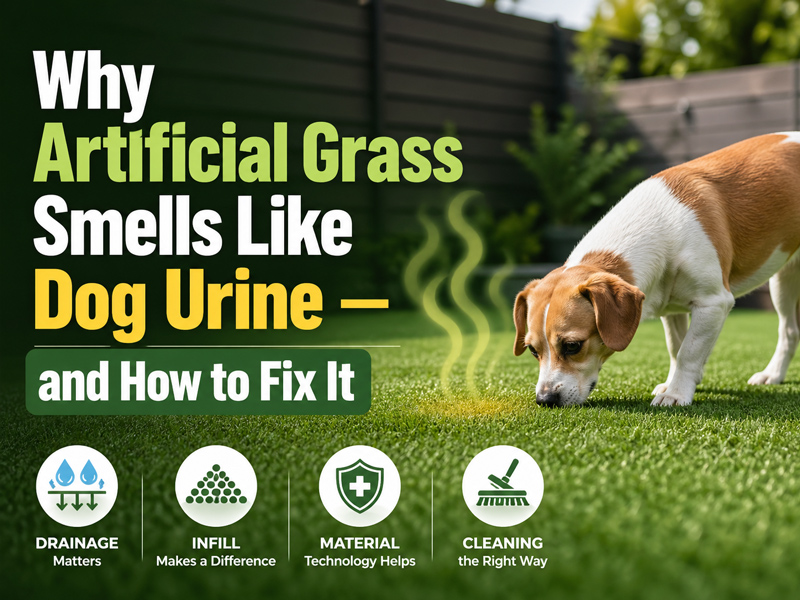
Yes, artificial grass can develop odor with dogs—primarily due to dog urine rather than the grass itself.
The main cause is urea, a natural waste compound in urine. As it breaks down, it releases ammonia, which is responsible for the characteristic smell.
On natural grass, soil and microorganisms help dilute and process these compounds. Artificial turf works differently. Liquids pass through the surface into the layers below rather than being absorbed.
If drainage is fast and complete, odor is usually minimal. But when small amounts of urine residue remain—especially in frequently used areas—those compounds can build up over time and gradually release odor.
What Most People Do First (And Why It Usually Works)
When odor appears, cleaning is the first and most logical step.
- Rinse with water to flush fresh urine
- Use a vinegar solution to help neutralize surface ammonia
- Apply enzyme-based cleaners to break down odor-causing compounds
For many households, especially with light to moderate use, these methods are effective and may be all that’s needed to keep odor under control.
But when the smell keeps returning, it usually points to something beyond surface-level cleaning.
Why the Smell Keeps Coming Back
If cleaning is done properly but odor still returns, the issue is usually not the method—it’s what remains in the system over time.
Liquids move through the turf into the infill and base layers. If drainage is not fast or consistent enough, small amounts of residue can remain and accumulate.
Material choices also play a role. For example:
- Sand infill can trap moisture and urine residue between particles, especially in high-use areas
- Turf systems with limited permeability (such as perforated backing with fewer drainage points) can restrict water flow, preventing liquids from flushing through quickly
In simple terms, odor tends to return when moisture and residue are not fully flushed out of the system.
What to Do When Odor Keeps Returning
When odor keeps coming back, the solution usually involves going beyond surface cleaning and addressing what’s happening within the system.
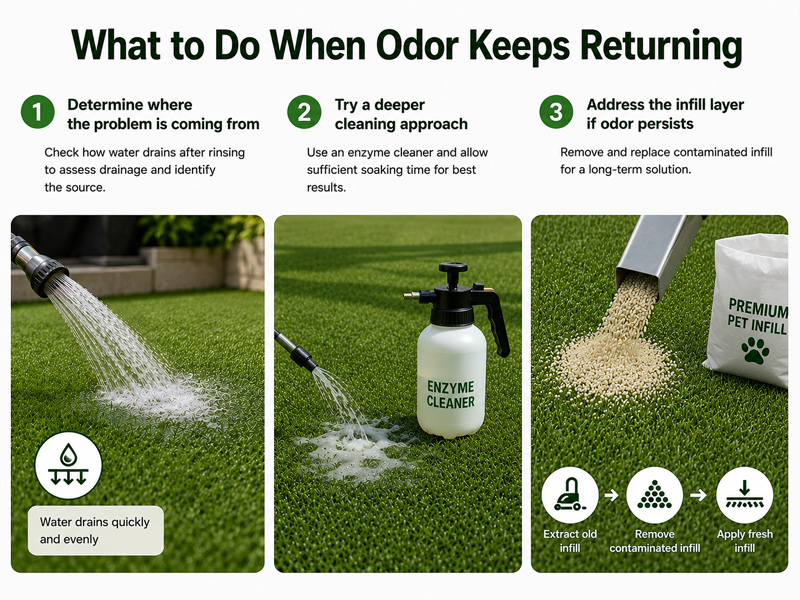
Step 1: Determine where the problem is coming from
If odor keeps returning after cleaning, the first step is to identify whether the issue is mainly related to:
- surface residue,
- trapped infill contamination,
- or poor drainage beneath the turf.
A quick way to assess this is to observe how the turf behaves after rinsing.
If water drains quickly and evenly, the drainage system is likely functioning properly.
If water moves slowly, lingers in certain spots, or the same area repeatedly develops odor, moisture may be accumulating within the base layer.
Step 2: Try a deeper cleaning approach
If drainage appears normal, the next step is a true deep clean.
Use a quality enzyme-based cleaner and allow sufficient soaking time so it can penetrate below the turf surface and break down embedded uric compounds.
A quick spray-and-rinse is often not enough once odor has developed within the system.
For many lawns, regular deep cleaning is enough to keep odor under control.
Step 3: Address the infill layer if odor persists
If deep cleaning only provides temporary relief, the infill layer is often the main source of recurring odor.
Over time, urine residue can accumulate between infill particles, especially in frequently used pet areas.
In these cases, removing and replacing contaminated infill can significantly improve long-term performance.
This is usually a professional process involving:
- brushing the turf fibers upright,
- extracting the old infill with specialized equipment,
- and applying fresh infill.
When replacing infill, upgrading to a pet-specific infill can also help reduce future buildup and improve moisture management.
How to Prevent Artificial Grass Smell (For New Installations)
When odor is considered early in the design, it’s much easier to manage over time.
Drainage should be the first priority.
A well-performing system depends on how efficiently liquid moves through and away from the turf. This starts with a properly prepared base that allows water to drain effectively, rather than accumulate beneath the surface.
The turf backing then plays a central role.
Fully permeable backing allows water to pass through evenly across the entire surface and helps reduce the chance of moisture lingering within the system.
Choosing an infill suited to pet use is also important. In high-use areas, infill designed to manage moisture and reduce odor buildup can make a noticeable difference over time.
Material design can further support long-term performance. Some turf systems incorporate antimicrobial or anti-mold technologies within the yarn and backing, helping to limit the growth of odor-causing bacteria. For example, our pet turf Argo Grass combines a fully permeable backing with built-in antimicrobial protection, supporting both drainage and hygiene at the material level.
Finally, consider how the space will actually be used. If dogs tend to use the same area repeatedly, planning for that—through layout, drainage direction, or designated potty zones—can help reduce buildup and make maintenance more manageable.
Final Thoughts
Artificial grass doesn’t develop odor simply because dogs use it—the real factor is how the system handles what’s left behind over time.
Surface cleaning can manage fresh use, but when moisture and residue remain within the system, odor is more likely to return.
In practice, long-term results come down to three things: how effectively the turf drains, how the infill behaves under repeated use, and how the space is used day to day.
When these elements are properly considered, artificial grass can stay clean, practical, and comfortable—even in pet-heavy environments.
Frequently Asked Questions
Does artificial grass smell more than natural grass with dogs?
Not necessarily. Natural grass can absorb and break down some waste through soil and microorganisms, while artificial grass relies on drainage. If the turf system drains well and is properly maintained, odor can be minimal in both cases.
How often should I clean artificial grass if I have dogs?
For regular use, rinsing once or twice a week is usually sufficient. In high-use areas or with multiple dogs, more frequent rinsing and occasional deep cleaning with enzyme-based solutions may be needed.
Can dog urine damage artificial grass?
No. High-quality artificial grass is designed to be durable and resistant to urine. The main issue is not damage, but potential odor if residue is not properly flushed out.
What is the most effective way to remove dog urine smell from artificial grass?
Start with thorough rinsing and enzyme-based cleaning. If odor persists, the issue is often within the infill layer or drainage system, which may require deeper cleaning or infill replacement.