

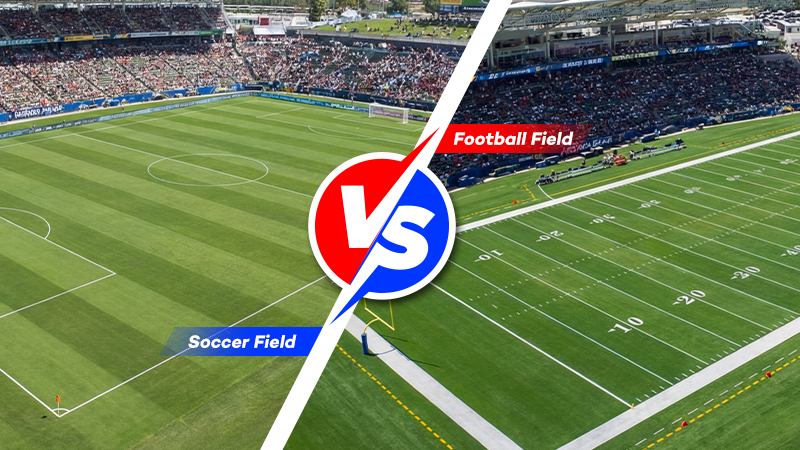
At first glance, a soccer field and an American football field may look very similar—both are rectangular, green, and played on large open surfaces. However, they differ significantly in size, layout, markings, and turf requirements.
Part of the confusion comes from the word “football.” In most parts of the world, it refers to soccer, while in North America, it means American football—two entirely different sports with unique field designs.
In this guide, we’ll break down the key differences between a soccer field and a football field, explain why these differences exist, and help you choose the right field setup for your project.
In this article:
Soccer Field vs Football Field: Quick Comparison
Here’s a quick side-by-side comparison to help you understand the core differences at a glance:
| Feature | Soccer Field | Football Field |
| Governing Body | IFAB / FIFA | NFL / NCAA |
| Length | 100–110 meters (110–120 yards) for international matches | 120 yards (109.7 meters), including two 10-yard end zones |
| Width | 64–75 meters (70–80 yards) | 53⅓ yards (48.8 meters) |
| Markings | Penalty areas, center circle, goal areas, corner arcs | Yard lines, hash marks, end zones |
| Goal Structure | Rectangular frame with net, on goal line. 8 ft H x 24 ft W. | Y-shaped uprights, behind end zone. 10 ft H crossbar, 18.5 ft W uprights. |
Soccer fields are generally wider and designed for continuous play, while football fields are narrower and built around structured, rule-driven gameplay.
Soccer Field vs Football Field Dimensions
In general, a soccer field has a larger total playing area, mainly due to its greater width.
The dimensions of a football field vs a soccer field are defined by different standards, reflecting how each sport is played.
Soccer Pitch Size Standards
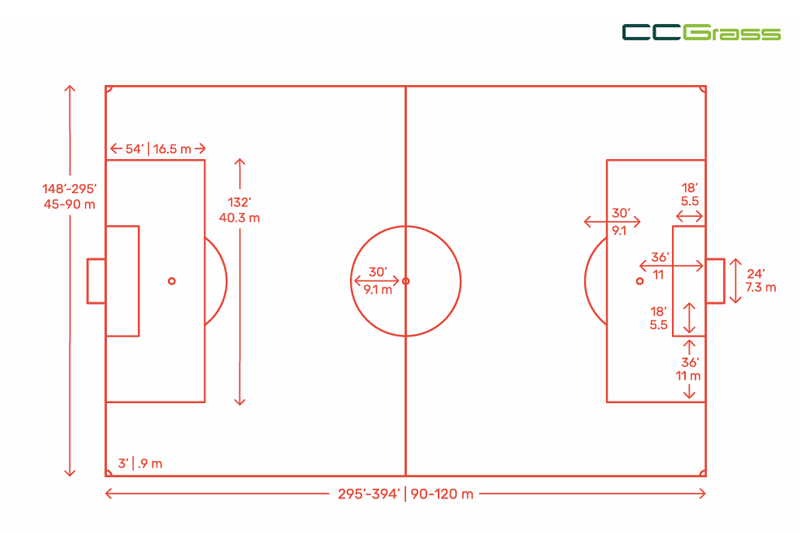
Soccer field dimensions are defined as a range rather than a fixed size, allowing flexibility across different levels of play.
According to the Laws of the Game issued by IFAB, a standard 11-a-side soccer field can measure:
- Length: 90–120 m (100–130 yd)
- Width: 45–90 m (50–100 yd)
In practice, most professional and international matches are played on pitches closer to:
- Length: 100–110 m (110–120 yd)
- Width: 64–75 m (70–80 yd)
A commonly used reference size is 105 × 68 m (115 × 74 yd).
This flexibility allows soccer fields to adapt to different stadium designs while maintaining consistent gameplay. A wider pitch creates more space for passing, positioning, and tactical movement across the field.
Football Field Dimensions Explained
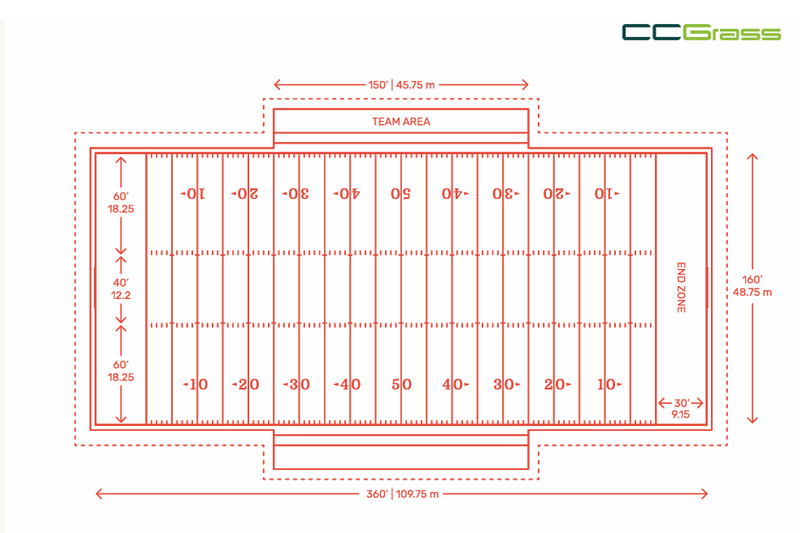
In contrast to soccer’s flexible sizing, football field dimensions are strictly standardized under organizations such as the NFL and the NCAA:
- Total length: 120 yards (109.7 meters), including two 10-yard end zones
- Width: 53⅓ yards (48.8 meters)
The fixed dimensions ensure consistency in gameplay and support rule-based mechanics such as yardage measurement, set plays, and field positioning.
Which Field Is Bigger?
Overall, a soccer field is typically larger than a football field in total playing area.
While a football field is slightly longer when including end zones, a soccer field is significantly wider, resulting in a larger overall surface area in most cases.
This difference in dimensions directly influences how each sport is played:
- Soccer fields prioritize space and continuous movement
- Football fields prioritize structure, positioning, and short bursts of play
Understanding these differences is essential when comparing the dimensions of a soccer field vs a football field, especially for facility planning and turf system design.
Soccer Pitch vs Football Field Layout and Markings
While dimensions define the size of the field, the layout and markings reveal how each sport is played. In many ways, the field itself reflects the logic of the game—whether it emphasizes fluid movement or structured, territory-based action.
Soccer Pitch Layout and Markings
A soccer field is designed for open, continuous play, so its markings are relatively simple and functional. According to FIFA regulations, key markings include:
- Center circle and halfway line
- Penalty areas and goal areas
- Corner arcs
- Penalty spot and center spot
Each marking serves a specific purpose, but overall, the field remains visually uncluttered. This minimal layout allows players to move freely, supporting long passes, spatial positioning, and fluid transitions between attack and defense, while creating space for more creative play.
Football Field Layout and Markings
In contrast, a football field features a highly structured layout, with dense markings that divide the field into precise segments. Under standards set by the NFL and NCAA, key markings include:
- Yard lines at 5-yard intervals
- Hash marks for ball placement
- End zones at both ends of the field
- Numerical yard indicators (10, 20, 30, etc.)
Unlike soccer, every line on a football field serves a precise purpose. These markings are essential for measuring progress, enforcing rules such as downs and yardage, and guiding team positioning throughout the game.
Why the Layout Is So Different
The difference in field markings reflects two fundamentally different game structures. Soccer relies on open space and continuous movement, while football uses a detailed grid system where every line defines position, progress, and strategy.
Soccer Field vs Football Field Goal Size
Beyond field markings, the goal structures themselves highlight a fundamental difference in how points are scored. One is designed as a target to shoot into, while the other is a target to kick through.
Soccer Goal Structure
A soccer goal is a simple, intuitive target: a rectangular frame with a net, positioned directly on the goal line.
- Size: 8 ft (2.44 m) high and 24 ft (7.32 m) wide
The goal defines a clear scoring area, where the entire ball must cross the goal line to count. The net provides immediate visual confirmation of a goal.
This design emphasizes accuracy, placement, and ball control, allowing players to score from a wide range of angles and situations.
Football Goal Structure
In contrast, a football goal structure consists of tall, Y-shaped uprights positioned at the back of each end zone.
- Crossbar height: 10 ft (3.05 m)
- Width between uprights: 18.5 ft (5.64 m)
Unlike soccer, scoring is achieved by kicking the ball above the crossbar and between the uprights. These goalposts are used in specific situations such as field goals and extra points.
Their design emphasizes trajectory, height, and precision, creating a challenge that is distinct from the main flow of gameplay.
Soccer vs Football Turf Systems: What Really Matters
Beyond dimensions and markings, the difference between a soccer field and a football field also extends to the turf system.
While both sports follow similar performance standards, they place different emphasis on how the surface performs—shaping how turf systems are designed in practice.
Soccer Turf: Precision, Consistency, and Comfort
For soccer, surface performance is closely tied to ball behavior and player experience. Standards defined by FIFA emphasize consistency across the entire field.
Key priorities include:
- Ball roll and rebound
The surface must deliver predictable ball movement to support accurate passing and control. - Player comfort and interaction
A balance of cushioning and stability helps reduce fatigue while maintaining natural movement. - Surface uniformity
Consistent fiber structure and infill distribution ensure reliable performance across all areas of the pitch.
Football Turf: Impact Resistance and Stability
Football places greater physical stress on the surface due to frequent contact, rapid changes of direction, and concentrated wear.
Standards referenced by organizations such as the NFL place greater emphasis on durability and impact performance.
Key priorities include:
- Impact attenuation (Gmax and HIC)
The system must absorb impact forces to help reduce injury risks during tackles and falls. - Durability under repeated use
High-intensity play creates localized wear, requiring stronger and more resilient turf systems. - Traction and base stability
Secure footing is essential for explosive movements, making infill stability and fiber support critical.
Can Soccer and Football Fields Be Used Interchangeably?
While it is technically possible to build a turf system that supports both soccer and football, fully shared fields are uncommon—especially at higher levels of play.
The main challenge lies not in the turf system, but in the field layout and markings:
- Line markings conflict
Football fields require dense yard lines and hash marks, which can interfere with visibility and gameplay in soccer. - Different field proportions
Soccer pitches are wider, making full alignment difficult without compromising layout. - Different usage patterns
Football concentrates impact in specific zones, while soccer distributes movement more evenly across the field.
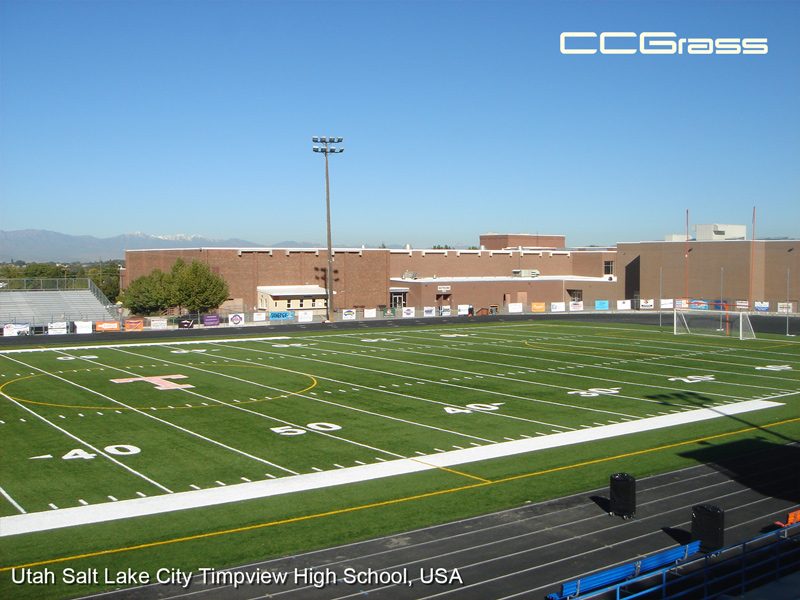
In practice, shared fields are typically limited to schools, training grounds, or community facilities, where marking compromises are acceptable. These fields often use temporary, removable paint or differently colored stitched lines (e.g., white for football and yellow for soccer) to distinguish between sports.
Recommended Turf Systems for Soccer and Football
Selecting the right turf system depends on performance priorities, usage intensity, and long-term value.
With extensive experience across both soccer and football field construction, CCGrass has delivered over 500 FIFA-certified pitches worldwide and developed more than 200 turf system configurations—enabling tailored solutions for different levels of play and usage scenarios.
Best Turf Systems for Soccer Fields
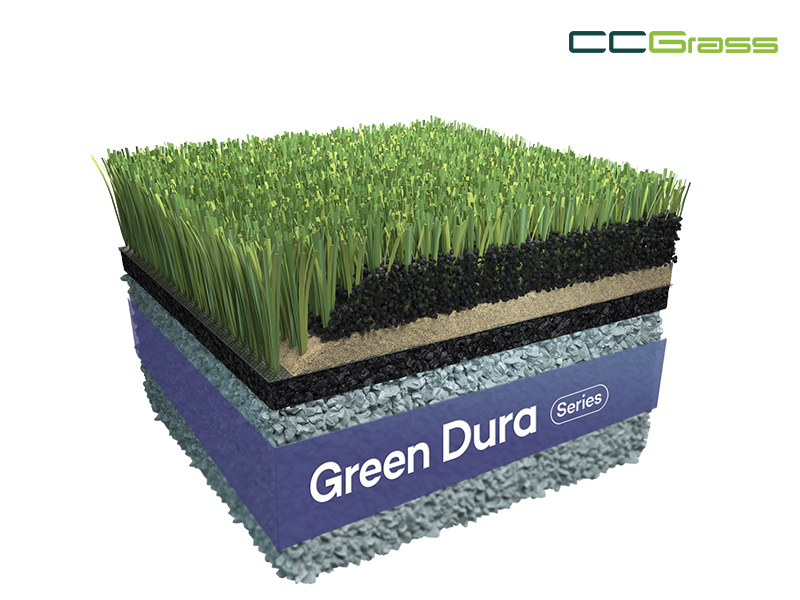
Green Dura — Built for durability and long-term use
- Classic diamond-shaped fiber for proven wear resistance
- Ultra-thick yarn (400μm+ ) enhances durability
- Extended service life for high-frequency usage
Best for high-traffic fields requiring long-lasting durability.
Best Turf Systems for Football Fields
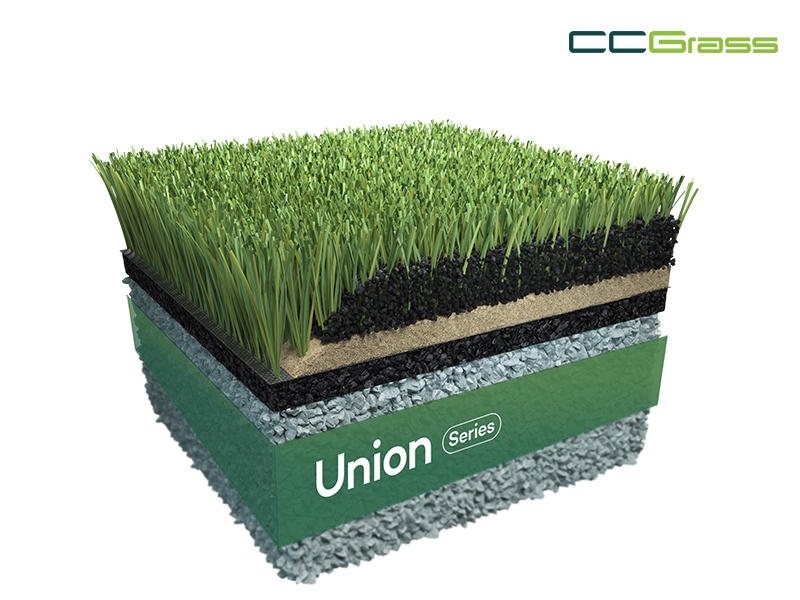
Union Series — Designed to replicate natural grass
- Combines multiple yarn shapes and colors
- Balances durability, resilience, and player comfort
- More natural appearance and improved surface interaction
Best for premium fields prioritizing natural playability and aesthetics.
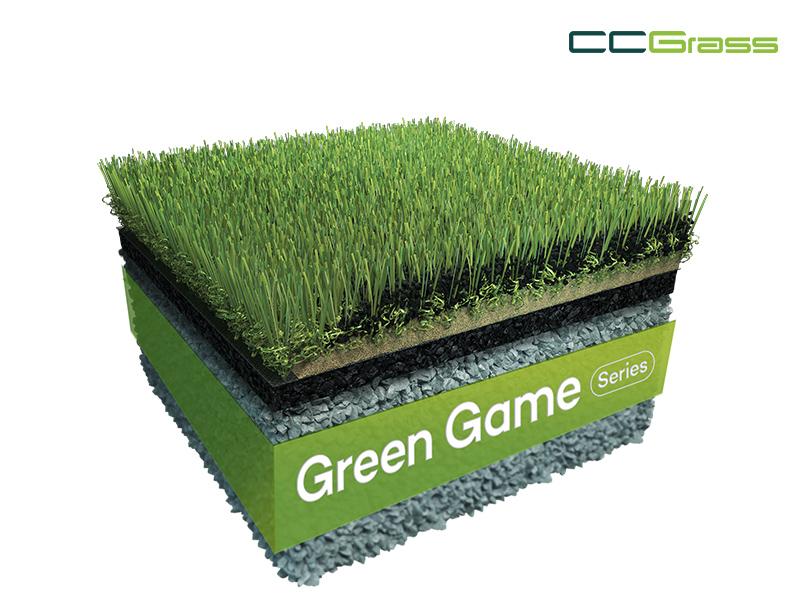
Green Game — Engineered for stability and impact performance
- Monofilament fibers combined with curly yarn support layer
- Enhances infill stability and reduces movement
- Improves traction and base stability under high-impact play
- Maintains fiber resilience for longer-lasting performance
Best for high-impact play requiring stability and traction.
Also suitable for soccer where enhanced durability and stability are required, particularly in multi-use or high-intensity scenarios
Common Questions About Soccer and Football Fields
Can you use a football field for soccer?
Not directly at a professional level. While both fields are rectangular, their dimensions, markings, and goal structures differ significantly. In practice, some facilities can host both sports with adjusted field layouts, but full interchangeability is limited.
Can a stadium be used for both soccer and football?
While some stadiums are capable of hosting both soccer and football, this is not typical at a professional level. Most elite venues are designed specifically for one sport to meet strict competition standards.
Multi-use configurations are more commonly found in schools, training facilities, or community fields, where compromises in field markings and layout are acceptable.
Is the soccer field longer than a football field?
A football field is slightly longer than a soccer field when including the two end zones (120 yards in total). However, soccer fields vary in length depending on FIFA regulations and are generally wider, resulting in a larger overall playing area compared to a football field.
Which sport is more popular, soccer or football?
Globally, soccer is the most popular sport, with a massive international following. However, American football remains one of the most popular sports in the United States, where it dominates viewership and fan engagement.
Do soccer and football fields use the same turf?
Soccer and football fields can use the same types of turf, but the system design is different.
Soccer prioritizes ball roll and player comfort, while football focuses more on durability, traction, and impact performance. As a result, turf systems are configured differently to meet the specific demands of each sport.
Conclusion
Understanding the differences between a soccer field and a football field goes beyond dimensions and markings. Each field is designed around the way the game is played—from open, continuous movement to structured, high-impact action.
These differences influence not only field layout, but also how turf systems are engineered in terms of ball behavior, player interaction, durability, and safety.
In practice, there is no one-size-fits-all solution. The right field—and the right turf system—depends on how the surface will be used, how often it will be played on, and what level of performance is expected.
With extensive experience in both soccer and football applications, CCGrass provides tailored artificial turf systems that balance playability, durability, and long-term value. From FIFA-certified soccer pitches to high-impact sports fields, every solution is designed to meet real-world performance demands.
If you’re planning a new sports field or upgrading an existing one, choosing the right turf system is where performance truly begins.