
If you’re researching artificial turf for a soccer field, you’ve probably come across terms like monofilament, fibrillated, and various other fiber designs. At the same time, you’ll also see specifications such as pile height, density, infill, shock pads and FIFA certification, making it difficult to understand what actually matters.
The good news is that these terms don’t describe completely different soccer surfaces. Instead, they refer to different ways manufacturers design artificial grass fibers to improve durability, playing performance and long-term appearance.
In this guide, we’ll start with the main types of artificial turf used for soccer before explaining what makes each one different. Later, we’ll look beyond fiber design to explore the other factors that determine how a football turf system performs.
In this article:
What Are the Different Types of Artificial Turf for Soccer?
Artificial turf can be classified in several ways, including by material, application or installation system. However, when people talk about the different types of artificial turf for soccer, they are usually referring to the fiber design—the structure and shape of the synthetic grass blades.
Over the years, manufacturers have developed different fiber designs to improve durability, ball performance, player comfort and long-term appearance. While monofilament turf has become the industry standard for modern football fields, several other fiber designs are also used to achieve specific performance goals.
The main fiber designs used in soccer turf include:
| Fiber Design | Key Characteristics | Typical Applications |
| Monofilament Turf | Individual upright fibers with a natural grass appearance | Professional, school and community football fields |
| Fibrillated Turf | Flat fibers that split into a mesh-like structure during use | Recreational football and multi-purpose sports areas |
| Straight + Curly Turf | Upright playing fibers supported by curly texturised yarns | High-use football fields requiring greater stability |
| Mono + Fibrillated Turf | Combines monofilament and fibrillated fibers within one system | Football fields balancing durability and infill retention |
| Multi-profile Monofilament Turf | Uses two or more monofilament yarn profiles in one tuft | Premium football turf systems designed for enhanced performance |
Although these are often described as different “types” of soccer turf, they are better understood as different fiber design approaches. Each is developed to improve particular aspects of performance, rather than replacing another completely.
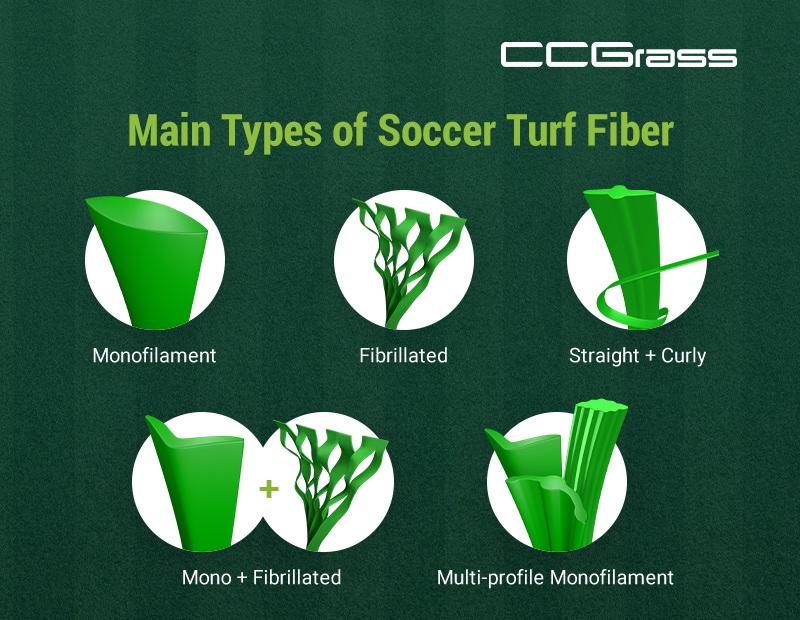
Let’s take a closer look at how each design works.
Understanding Different Soccer Turf Fiber Designs
Monofilament Turf
Monofilament turf is the foundation of most modern soccer turf systems and is widely used for professional stadiums, training grounds, schools and community sports facilities.
Unlike older flat fibers, each blade is manufactured as an individual upright strand, giving the surface a more natural appearance while helping deliver consistent ball roll, predictable ball bounce and comfortable player interaction.
Today’s monofilament fibers are available in a variety of engineered shapes, such as diamond, spine, S-shaped and other proprietary profiles. Although each manufacturer has its own designs, the objective is the same: to improve fiber resilience so the grass blades recover more effectively after repeated play.
Because it offers an excellent balance of durability, playability and aesthetics, monofilament turf has become the preferred choice for most modern soccer fields, including many FIFA-tested turf systems.
At a glance
- Excellent ball roll and ball control
- Natural-looking appearance
- Strong resilience and durability
- Suitable for almost all levels of football
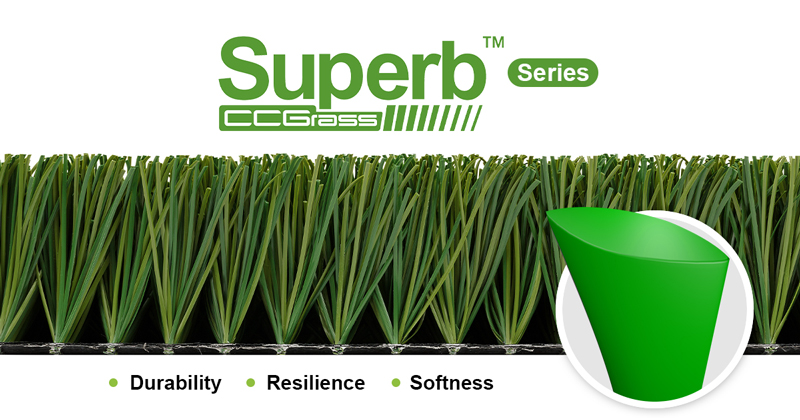
Featured CCGrass Solution — Superb Series
Superb Series is CCGrass’ premium monofilament soccer turf, engineered with durable 400 μm diamond-shaped yarn for excellent resilience, consistent ball performance and long-term durability. It is designed for projects seeking high performance, long service life and excellent player experience.
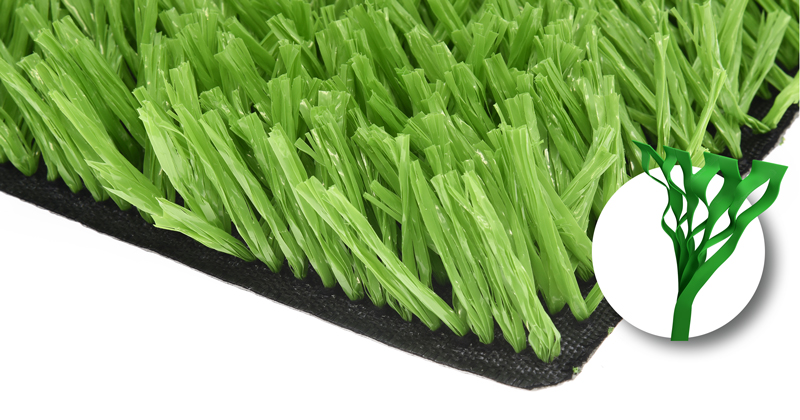
Fibrillated Turf
Fibrillated turf uses flat synthetic fibers that gradually split into narrow strands during use, creating a mesh-like structure that helps retain infill materials.
Before monofilament technology became widely adopted, fibrillated turf was commonly used on football fields because of its durability and relatively low cost. Today, it is less common in new professional football installations but remains a practical option for recreational pitches, schools and multi-purpose sports facilities.
Compared with monofilament turf, fibrillated fibers generally provide less natural appearance and may flatten more easily under intensive use. However, they still offer reliable performance in applications where long-term durability and cost-effectiveness are priorities.
At a glance
- Good infill retention
- Durable and economical
- Suitable for recreational use
- Common on multi-purpose sports areas
Featured CCGrass Solution — YEII Series
YEII features a unique fibrillated yarn structure with excellent wear resistance and reliable playing performance. It offers an economical solution for recreational football and multi-purpose sports facilities where value and durability are priorities.
Straight + Curly Turf
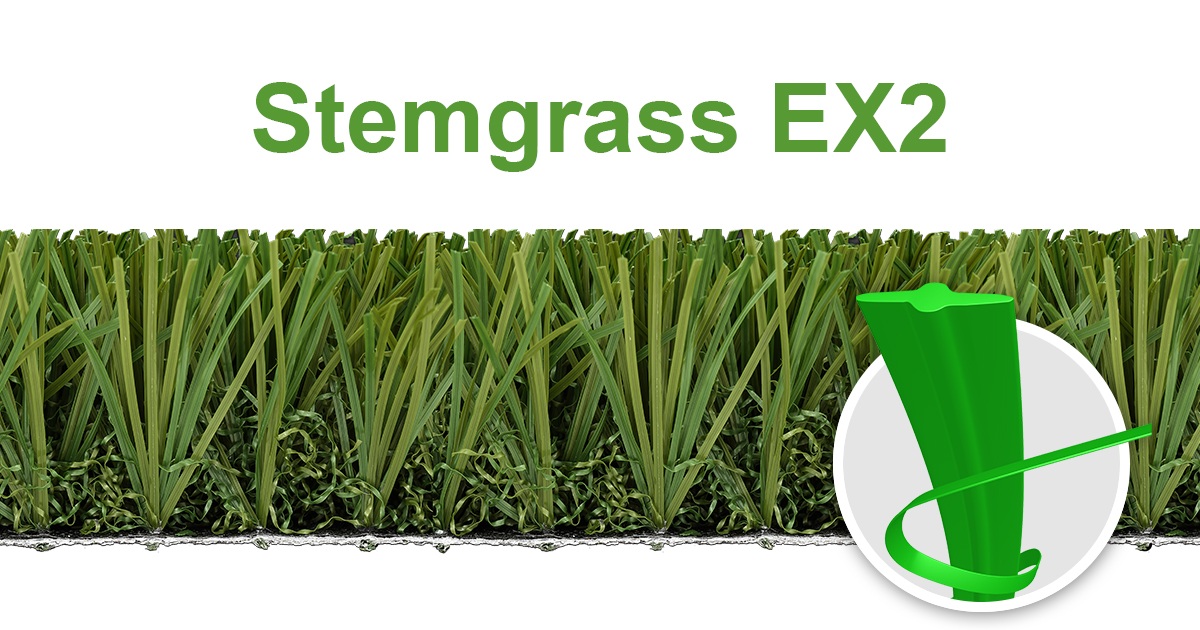
Straight + Curly turf combines two different yarn structures within the same system.
The straight monofilament fibers form the primary playing surface, while the curly texturised yarn supports the upright fibers and helps hold the infill in place. Rather than replacing monofilament turf, this design builds upon it by improving fiber recovery and maintaining a more consistent surface over time.
The additional curly yarn can also reduce infill splash and improve the field’s appearance after extended use, making this design well suited to soccer fields with high playing frequency.
At a glance
- Improved fiber support
- Better infill stability
- Consistent playing surface
- Suitable for high-use football fields
Featured CCGrass Solution — Stemgrass EX2
Stemgrass EX2 combines resilient monofilament fibers with curly yarns to improve fiber support and infill stability. The system has been selected for projects including the Chelsea FC Training Ground, demonstrating its suitability for demanding soccer environments.
Mono + Fibrillated Turf
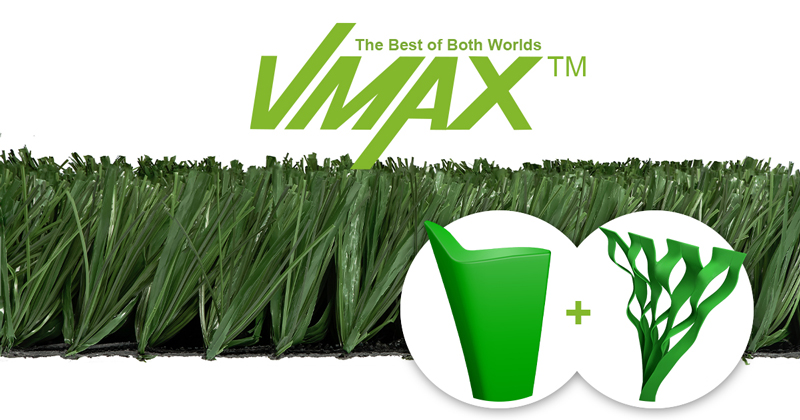
Mono + Fibrillated turf combines upright monofilament fibers with fibrillated fibers in a single turf system.
The monofilament fibers provide the primary playing characteristics, while the fibrillated fibers help support the infill and add structural stability. By combining the strengths of both fiber designs, manufacturers can create a surface that balances durability, appearance and playing performance.
Although this design is not as widely used as pure monofilament turf, it remains a valuable option for football fields where durability and infill control are equally important.
At a glance
- Combines two fiber structures
- Improved surface fiber coverage
- Balanced durability and appearance
- Suitable for football fields with frequent use
Featured CCGrass Solution — Vmax Series
Vmax combines resilient V-shaped monofilament with long fibrillated fibers for improved surface fiber coverage, creating a more consistent and durable playing surface. It is well suited to football facilities seeking dependable performance with reduced infill splash.
Multi-profile Monofilament Turf
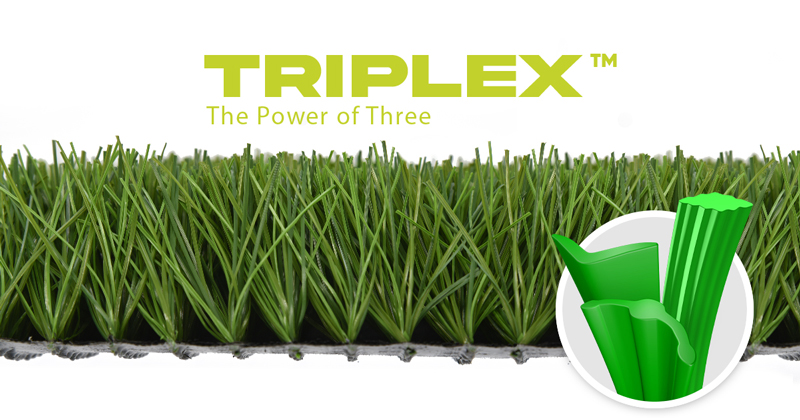
Some premium football turf systems combine two or more monofilament yarn profiles within the same tuft instead of relying on a single fiber shape.
Different yarn profiles can contribute different characteristics, such as resilience, softness, structural support or visual appearance. By combining these properties, manufacturers can optimise multiple aspects of performance within one turf system.
Rather than representing an entirely new category of soccer turf, this approach reflects the continued development of monofilament technology. It is commonly found in premium football turf systems where long-term performance and player experience are key priorities.
At a glance
- Multiple engineered yarn profiles
- Enhanced resilience and appearance
- Balanced playing performance
- Typically used in premium football turf systems
Featured CCGrass Solution — Triplex Series
Triplex combines three different monofilament profiles within each tuft to balance resilience, softness and durability. The result is a more natural-looking surface with consistent ball behaviour throughout intensive use.
What Else Should You Consider When Choosing Soccer Turf?
Choosing the right fiber design is only the first step. In practice, football turf is selected and tested as a complete system, with several factors working together to determine how the field performs over time.
If you’re comparing different soccer turf products, these are the specifications worth paying attention to.
Fiber Materials
Artificial grass is typically manufactured using polyethylene (PE), polypropylene (PP) or nylon, although modern soccer turf predominantly uses PE fibers because they provide an excellent balance of comfort, resilience and durability.
- Polyethylene (PE)– The standard material for most modern soccer turf systems, offering a natural feel and consistent playing performance.
- Polypropylene (PP)– Used in some artificial grass products and selected sports applications, but less common as the primary fiber for football turf.
- Nylon– Highly durable and resilient, though typically reserved for specialist applications due to its firmer feel and higher cost.
Pile Height
Pile height influences how the field feels underfoot and how the ball moves across the surface.
For most outdoor soccer fields, pile heights between 40 mm and 60 mm are commonly used. Shorter fibers generally create a faster playing surface, while taller fibers provide greater cushioning and shock absorption.
The ideal pile height depends on the level of play, the turf system and the field’s intended use rather than a single “best” measurement.
Fiber Density
Fiber density refers to how many yarns are installed within a given area of turf.
Higher density can improve durability, surface stability and visual appearance, particularly on soccer pitches with frequent use. However, more fibers do not automatically mean better performance. Density should always be balanced with pile height, yarn design and infill to achieve the desired playing characteristics.
Infill System
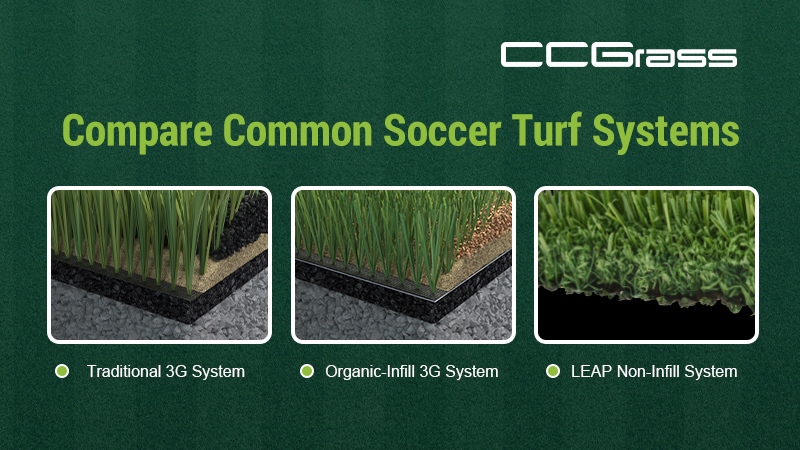
Most modern soccer fields use an infill system, typically combining silica sand with performance infill to help support the fibers, improve shock absorption and maintain consistent ball behaviour.
Common performance infill options include SBR, TPE, EPDM and a growing range of organic infills, each offering different balances of performance, durability and sustainability.
Alongside conventional 3G systems, non-infill soccer turf has also matured significantly, providing an alternative for projects with different maintenance preferences or environmental objectives.
CCGrass example: In addition to its FIFA-certified 3G systems, CCGrass has developed the LEAP 100% Non-Infill System, which delivers high-level football performance without the need for sand or rubber infill. LEAP has already been installed in multiple FIFA Arena projects, demonstrating that non-infill technology has become a practical option for selected football applications.
Ultimately, the right solution depends on the project’s performance requirements, maintenance strategy and long-term goals.
Shock Pad
Not every soccer turf system includes a shock pad, nor does every project require one.
Depending on the overall turf system design, a shock pad may be used to provide additional impact absorption and player comfort. In other cases, the desired playing performance can be achieved without one through the combination of pile height, infill and other system components.
The key is not whether a shock pad is included, but whether the complete turf system is designed to meet the performance requirements of the field.
Certification
When comparing soccer turf systems, technical specifications are only part of the picture. Independent certification provides an objective benchmark for evaluating overall football performance.
The FIFA Quality Programme is the world’s most widely recognized testing programme for football turf systems. It evaluates key performance characteristics such as ball roll, ball rebound, shock absorption, rotational resistance and durability to verify that a turf system performs as intended.
Whether a project is intended for FIFA field certification, choosing a FIFA-tested turf system provides added confidence through independently verified football performance.
Before Requesting a Quote
Preparing the following information will help suppliers recommend a more suitable soccer turf system and provide a more accurate quotation.
✓ Intended field use
✓ Expected usage intensity
✓ Approximate field dimensions
✓ Whether multiple sports will be played
✓ Whether a FIFA-tested system is preferred
✓ Sustainability or maintenance priorities
Need Help Choosing the Right Soccer Turf System?
If you’re unsure which soccer turf system best fits your project, working with an experienced football turf manufacturer can make the selection process much easier.
As a FIFA Preferred Provider, CCGrass has developed over 200 FIFA-tested football turf systems and completed more than 600 FIFA-certified fields worldwide.
Whether you’re planning a new soccer field or upgrading an existing one, our turf experts can help you assess your project needs and recommend a soccer turf system that best fits your performance goals, budget and long-term maintenance priorities.
Conclusion
Modern soccer turf has evolved far beyond simply choosing between different fiber types.
While monofilament remains the industry standard, manufacturers continue to develop new fiber designs and complete turf systems to improve durability, player comfort and long-term field performance.
By understanding how fiber design, pile height, density, infill and certification work together, you’ll be better equipped to compare different artificial turf systems and choose the right solution for your football project.
Whether you’re planning a professional stadium, a school field or a community pitch, looking at the complete system—not just the grass fibers—will lead to a better long-term investment.
Continue Exploring Soccer Turf
Looking for more insights? Explore our expert guides on FIFA standards, field planning, turf selection and other key topics to help you make informed decisions for your next soccer project.