

Baseball Field Dimensions: Layout, Measurements & Turf Guide
Baseball field dimensions define the size and layout of a baseball playing field, from the 90-foot baseball diamond and the 60 ft 6 in pitching distance to the varying outfield fence distances that make every baseball field unique. These standardized measurements help ensure fair play, player safety, and consistent performance across all levels of baseball.
Whether you’re planning a new baseball field, comparing league requirements, or simply wondering how big a baseball field is, understanding these dimensions is the first step. While the infield follows standardized measurements, outfield fence distances can vary significantly between ballparks, giving each field its own distinctive character.
In this guide, we’ll explain the standard baseball field dimensions, introduce the key parts of a baseball field, compare field sizes across different leagues, and discuss how artificial turf is used in modern baseball facilities.
In this article:
Baseball Field Layout
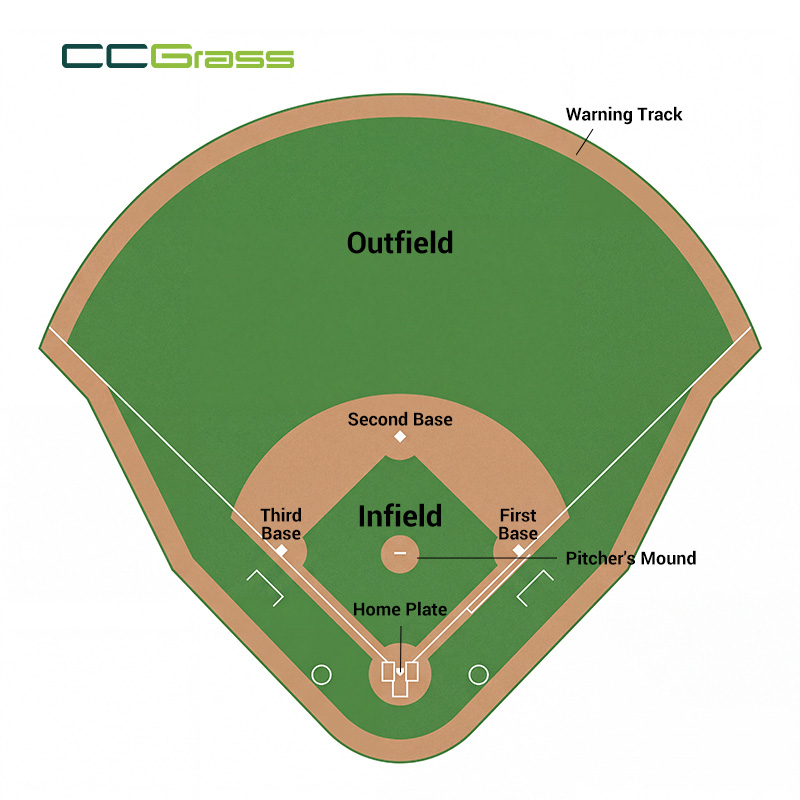
All baseball fields share the same basic layout, regardless of the level of play. The field is divided into two primary areas: the infield, also known as the baseball diamond, and the outfield, which extends beyond the infield to the perimeter fence. Together, these areas create the distinctive fan-shaped playing field used in baseball worldwide.
The infield contains the most precisely measured elements of the field, including home plate, first base, second base, third base, the pitcher’s mound, and the baselines connecting the four bases. The outfield begins beyond the infield and stretches between the two foul lines to the outfield fence.
In addition to the infield and outfield, a standard baseball field includes several other important elements:
- Home Plate– The five-sided plate where every at-bat begins.
- Bases– First, second, and third base define the baseball diamond.
- Pitcher’s Mound– A raised area where the pitcher delivers the ball.
- Foul Lines– Two lines extending from home plate to the outfield fence, separating fair territory from foul territory.
- Warning Track– A path of contrasting material along the outfield fence that warns fielders they are approaching the wall.
- Backstop– A protective barrier behind home plate that helps keep spectators safe and prevents passed balls from traveling too far.
- Dugouts– Designated areas where players and coaches remain during the game.
While the overall layout remains consistent, the dimensions of these elements vary depending on the competition level, from Little League to Major League Baseball.
Standard Baseball Field Dimensions
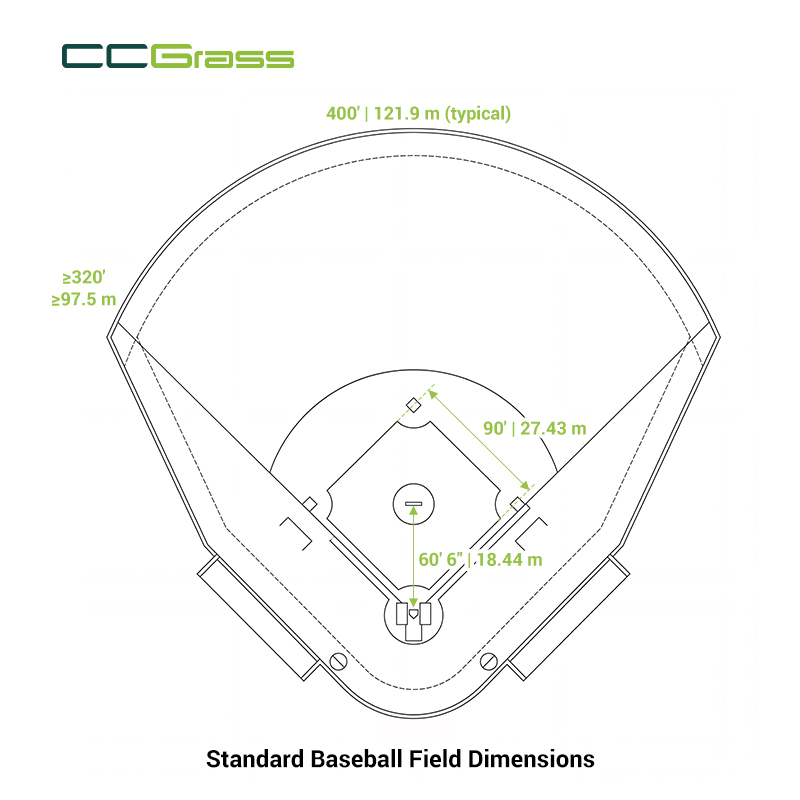
Although baseball fields can vary in their overall size, several key measurements remain standardized across professional, collegiate, and high school baseball. These dimensions form the foundation of baseball field design and construction.
| Field Component | Standard Dimension (MLB / NCAA / High School) |
| Basepath | 90 ft (27.43 m) |
| Home Plate to Pitcher’s Rubber | 60 ft 6 in (18.44 m) |
| Home Plate to Second Base | 127 ft 3⅜ in (38.80 m) |
| Pitcher’s Mound Diameter | 18 ft (5.49 m) |
| Pitcher’s Mound Height | 10 in (25.4 cm) |
| Base Size | 18 × 18 in (45.7 × 45.7 cm) |
| Minimum Left & Right Field Distance | 320 ft (97.5 m) |
| Recommended Center Field Distance | 400 ft (121.9 m) |
The following sections explain the three measurements that define nearly every baseball field: the baseball diamond, the pitching area, and the outfield.
Baseball Diamond Dimensions
The baseball diamond forms the heart of every baseball field. It is a square infield defined by four bases connected by equal-length basepaths.
For professional, college, and high school baseball, each basepath measures 90 ft (27.43 m). This standardized distance creates a balance between offensive and defensive play and has remained unchanged for more than a century.
One of the most recognizable measurements is the diagonal distance from home plate to second base, which measures 127 ft 3⅜ in (38.80 m).
Youth baseball fields use shorter basepaths to match players’ physical development. Little League fields typically use 60-foot basepaths, while intermediate divisions often use 70-foot or 80-foot diamonds before transitioning to the full-size field.
Pitcher’s Mound Dimensions
The pitcher’s mound is positioned at the center of the baseball diamond and serves as the starting point for every pitch.
At the professional, college, and high school levels, the official pitching distance is 60 ft 6 in (18.44 m), measured from the front edge of the pitcher’s rubber to the back point of home plate.
A regulation mound is 18 ft (5.49 m) in diameter and raised 10 inches (25.4 cm) above home plate. This elevation helps pitchers generate momentum while maintaining a consistent release point.
Youth leagues shorten the pitching distance to suit younger athletes, with common distances ranging from 46 ft to 54 ft before reaching the professional standard.
Outfield Dimensions
Unlike the infield, outfield dimensions are not fixed.
Most professional baseball fields have foul-line distances of at least 320 ft (97.5 m) and a center-field distance of approximately 400 ft (121.9 m), but every ballpark has its own unique layout. Variations in fence distance, wall height, and overall field geometry contribute to the distinct character of each stadium.
Outfield dimensions also play an important role in baseball facility planning. Larger outfields require more surface materials, affect drainage design, and increase the total amount of artificial turf needed for installation.
Baseball Field Dimensions by League
While the overall layout of a baseball field remains consistent across all levels of play, the field dimensions become progressively larger as players develop. Youth leagues use shorter basepaths, pitching distances, and outfield fences to better match players’ physical abilities, while high school, college, and professional baseball adopt the full-size field.
The table below compares the most common baseball field dimensions across different levels of baseball.
| Level | Basepath | Pitching Distance | Typical Outfield Distance |
| Little League | 60 ft | 46 ft | 200 ft+ |
| Intermediate (50/70) | 70 ft | 50 ft | 200–275 ft |
| Pony League | 80 ft | 54 ft | 275–315 ft+ |
| High School | 90 ft | 60 ft 6 in | 300–400 ft |
| College (NCAA) | 90 ft | 60 ft 6 in | 330–400 ft |
| MLB | 90 ft | 60 ft 6 in | 320–420+ ft |
As players progress through different levels of baseball, the infield gradually expands until reaching the standard dimensions used in high school, college, and professional baseball. Beyond that point, the primary variation between leagues lies in the outfield fence distances, which often differ by league requirements and individual ballpark design.
Baseball vs. Softball Field Dimensions
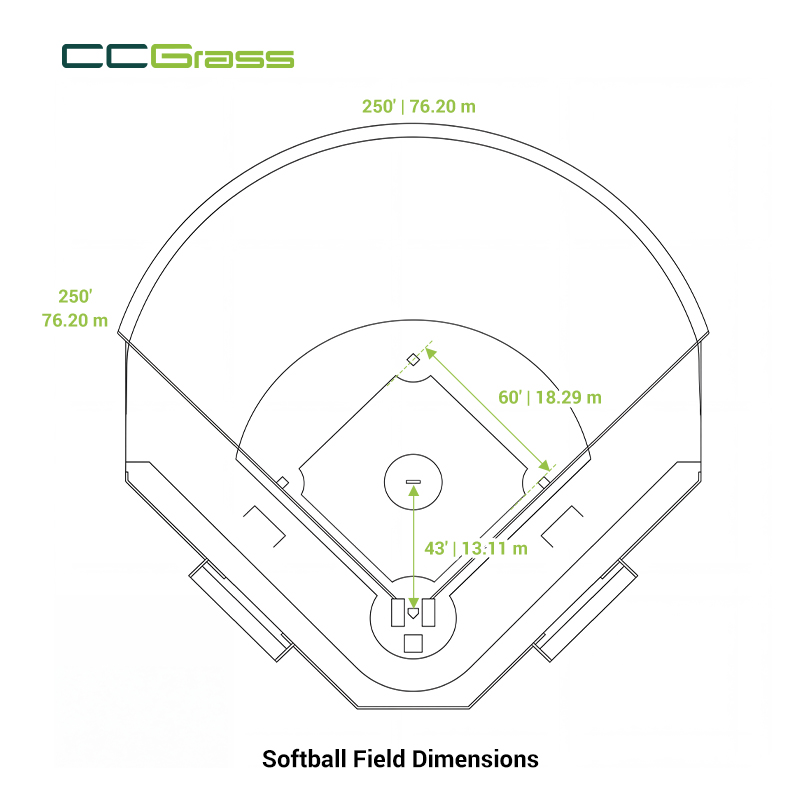
Although baseball and softball share a similar field layout, softball fields are built on a smaller scale. Shorter basepaths, a shorter pitching distance, and a more compact outfield make the game better suited to younger players and the underhand pitching style used in softball.
The table below highlights the main differences between a regulation baseball field and a standard softball field.
| Field Component | Baseball | Softball |
| Basepath | 90 ft (27.43 m) | 60 ft (18.29 m) |
| Pitching Distance | 60 ft 6 in (18.44 m) | 35–43 ft (10.67–13.11 m)* |
| Infield Shape | Square (Baseball Diamond) | Square (Smaller Diamond) |
| Typical Outfield Fence | 320–400+ ft | 200–250 ft |
| Pitcher’s Mound | Raised mound | Flat pitching circle |
*Pitching distance varies by softball league and age group.
Despite these differences, both sports follow the same basic field geometry, with home plate, three bases, foul lines, and an outfield enclosed by the foul poles. The smaller dimensions of a softball field allow for quicker gameplay while maintaining many of the same strategic elements found in baseball.
Artificial Turf for Baseball Fields
Artificial turf has become an increasingly popular choice for baseball facilities at all levels, from community parks and schools to collegiate and professional venues. Compared with natural grass, artificial turf provides a durable, all-weather playing surface while reducing routine maintenance and increasing field availability throughout the year.
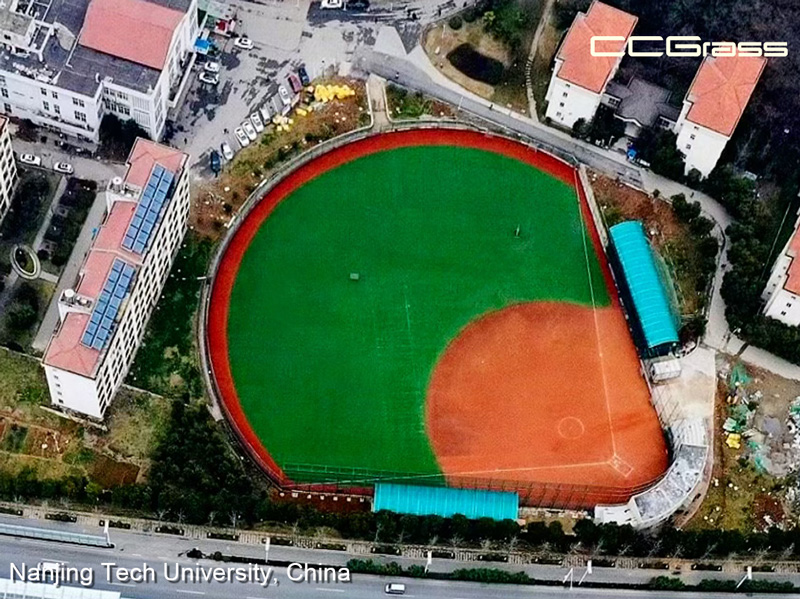
Unlike many other sports fields, baseball fields often combine different surface materials. The infield is traditionally constructed with clay or engineered dirt, while the outfield is covered with natural grass or artificial turf. However, many modern facilities now install artificial turf across the entire field—or use synthetic clay-colored turf in the infield—to improve durability and minimize maintenance.
When selecting artificial turf for a baseball field, several factors should be considered:
- Playing Area– Outfields typically use longer-pile turf to provide reliable footing, player comfort, and predictable ball interaction, while infields often require shorter, denser turf for consistent ball bounce and faster play.
- Durability– Baseball fields experience concentrated wear around bases, dugouts, and player pathways. High-quality turf systems should withstand repeated sliding, running, and intensive daily use.
- Drainage Performance– Efficient drainage allows the field to recover quickly after rain, reducing cancellations and extending playable hours throughout the season.
- Player Safety– Well-designed baseball turf systems help provide reliable footing and predictable ball behavior, while optional shock pads can improve impact absorption in high-use facilities.
- Maintenance Requirements– Compared with natural grass, artificial turf eliminates mowing, irrigation, and many routine maintenance tasks, helping facility owners reduce long-term operating costs.
For synthetic turf infields, the CCGrass FastPro Series provides a dense, smooth playing surface that replicates the appearance of traditional clay while delivering excellent durability for high-frequency use. It is also suitable for baseball training facilities and practice areas where consistent ball response is important.
For outfields, CCGrass offers a range of longer-pile sports turf systems that provide reliable footing, long-term wear resistance, and consistent playing performance. The right turf system depends on the level of play, expected field usage, maintenance goals, and overall project requirements.
Conclusion
Understanding baseball field dimensions is the first step toward building a safe, durable, and high-performing baseball facility. Once the field layout is established, selecting the right artificial turf system helps maximize field availability, reduce maintenance, and deliver consistent playing performance.
Whether you’re planning a school field, community ballpark, or professional facility, CCGrass offers baseball turf solutions tailored to your project requirements. Contact our team to discuss your project and find the right solution for your field.
FAQ
What are the standard dimensions of a baseball field?
A standard baseball field used for professional, college, and high school baseball features a 90-foot (27.43 m) baseball diamond and a pitching distance of 60 ft 6 in (18.44 m). Outfield fence distances are not standardized, but most fields measure at least 320 ft (97.5 m) down the foul lines and approximately 400 ft (121.9 m) to center field.
How big is a baseball field?
There is no single overall size for a baseball field because the outfield dimensions vary between leagues and stadiums. While the infield follows standardized measurements, the total playing area depends primarily on the distance from home plate to the outfield fence.
What are the measurements of a baseball diamond?
A regulation baseball diamond measures 90 ft on each side for professional, college, and high school baseball. The diagonal distance from home plate to second base is 127 ft 3⅜ in (38.80 m). Youth leagues use smaller diamonds, typically ranging from 60 to 80 ft, depending on the age group.
How long are baseball fields?
The “length” of a baseball field is usually measured from home plate to the outfield fence. Most professional fields have foul-line distances of at least 320 ft (97.5 m) and center-field distances around 400 ft (121.9 m), although every ballpark has its own unique layout.
Can baseball fields use artificial turf?
Yes. Artificial turf is widely used for baseball fields, particularly in schools, municipalities, sports complexes, and multi-use facilities. Some fields install turf only in the outfield, while others use synthetic turf across the entire field, including clay-colored turf in the infield.
What type of artificial turf is best for a baseball field?
The ideal turf system depends on how the field will be used. Synthetic turf infields generally benefit from shorter, denser turf that provides consistent ball bounce and durability, while outfields typically use longer-pile sports turf for reliable footing and natural ball interaction. Factors such as usage frequency, maintenance goals, climate, and budget should also be considered when selecting a turf system.