

A standard field hockey pitch has specific dimensions and markings designed to support fast-paced play. Whether you are planning a new facility or upgrading an existing field, understanding the field size, layout and turf requirements is essential.
Quick Answer: How Big Is a Hockey Field?
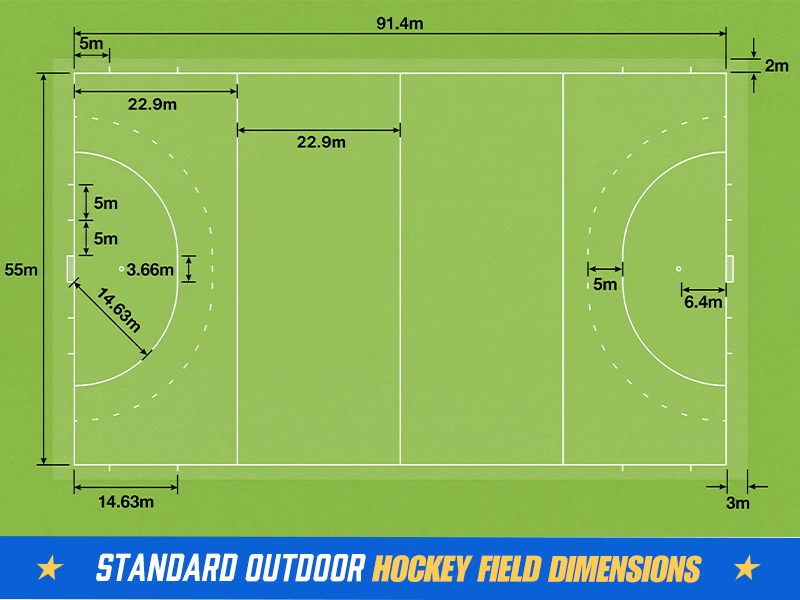
A standard outdoor field hockey pitch measures 91.4 m × 55 m (299.9 ft × 180.4 ft), covering a playing area of approximately 5,027 m² (54,107 sq ft).
This measurement refers to the field of play, excluding the surrounding run-off areas. Including the recommended run-offs, the overall field footprint increases to approximately 101.4 m × 61 m (332.7 ft × 200.1 ft), or 6,185 m² (66,574 sq ft).
In this article:
Hockey Field Dimensions and Layout
A standard outdoor field hockey pitch is rectangular, measuring 91.4 metres long and 55 metres wide. These dimensions define the field of play (FOP), the area enclosed by the boundary lines.
Standard Field Size
| Measurement | Metres (m) | Feet (ft) |
| Field length | 91.4 | 299.9 |
| Field width | 55.0 | 180.4 |
| Playing area | 5,027 m² | 54,107 sq ft |
The field is divided into two equal halves by a centre line, with a goal positioned at the centre of each backline. Several additional markings define the playing zones and key areas around the goals.
Field Markings and Layout
A hockey field has several lines and markings that define the playing zones and support the rules of the game.
Centre Line
The centre line runs across the width of the field, halfway between the two backlines. It divides the pitch into two equal halves, with the centre spot marking where play starts at the beginning of each half and after a goal.
23-Metre Lines
Two 23-metre lines run parallel to the backlines, each positioned 22.9 metres from the nearest backline. They mark the 23-metre areas at each end of the field and help define specific rules during play.
Although commonly called 23-metre lines, their official distance from the backline is 22.9 metres.
Shooting Circles
A shooting circle, often called the D, is marked in front of each goal. It consists of a curved line extending from the backline, forming a semi-circular playing area around the goal. The circle has a radius of 14.63 metres (48 feet), measured from the specified point on the backline.
A goal can only be scored when an attacker plays the ball from within the opposing team’s circle.
Goals and Penalty Spots
The goals are positioned at the centre of each backline. A standard outdoor hockey goal measures 3.66 metres (12 feet) wide and 2.14 metres (7 feet) high.
A penalty spot is marked in front of each goal, with its centre 6.4 metres (21 feet) from the inner edge of the goal line.
Hockey Field Run-Off Areas
A hockey field requires additional space beyond the playing area to give players room to slow down and stop safely. These surrounding areas are known as run-offs and form part of the overall field layout.
The FIH specifies both recommended and minimum run-off widths. The recommended dimensions should be used wherever possible and are mandatory for certain higher-level fields.
Recommended and Minimum Run-Off Dimensions
| Area | Recommended | Minimum |
| End run-off (each end) | 5.0 m (16.4 ft) | 3.0 m (9.8 ft) |
| Side run-off (each side) | 3.0 m (9.8 ft) | 2.0 m (6.6 ft) |
These total widths include both the inner run-off, which uses hockey turf, and the outer run-off, which may use hockey turf or a suitable hard surface such as paving. The inner turf section is wider in the recommended layout, providing a continuous playing surface beyond the boundary lines.
Total Hockey Field Space Requirements
When the recommended run-offs are included, the overall field footprint measures 101.4 m × 61.0 m, requiring approximately 6,185 m² (66,574 sq ft).
For projects using the minimum run-off dimensions, the overall footprint is smaller:
| Layout | Overall Length | Overall Width | Total Area |
| Recommended run-offs | 101.4 m (332.7 ft) | 61.0 m (200.1 ft) | Approx. 6,185 m² (66,574 sq ft) |
| Minimum run-offs | 97.4 m (319.6 ft) | 59.0 m (193.6 ft) | Approx. 5,747 m² (61,861 sq ft) |
The actual site area may need to be larger to accommodate team benches, access routes, fencing, lighting and other facility features. For higher-level competitions, additional operational space may also be required.
Artificial Turf Planning for Hockey Fields
Artificial turf is widely used for outdoor hockey fields because it provides a consistent playing surface for fast-paced play and regular training. When planning an artificial hockey field, turf selection, colour scheme, surface area and installation requirements should all be considered alongside the field dimensions.
Types of Hockey Turf Systems
Several types of artificial turf are used for hockey, each offering different playing characteristics and suitability for different levels of play.
| Turf System | Key Characteristics | Typical Applications |
| Water-Based Turf | Non-filled, dense fibres; watered before play. | Elite and high-level competitions |
| Dry Hockey Turf | Non-filled, non-irrigated; designed to replicate water-based playing characteristics. | High-performance fields with reduced water requirements |
| Sand-Dressed Turf | Sand supports the lower fibres, leaving the tips exposed. | National, regional and club-level fields |
| Sand-Filled Turf | Sand fills most of the pile, supporting the fibres. | Community and recreational facilities |
The appropriate system depends on the intended level of play, performance requirements, water availability and maintenance resources.
Turf Quantity and Colour Planning
The amount of turf required depends on the area to be covered and the roll layout. For example, using 4 m-wide rolls to cover a 97.4 m × 59 m area, with each roll cut to 59 m in length, requires 25 rolls. This gives a total carpet area of approximately 5,900 m², excluding additional cutting allowances.
When different colours are used for the playing area and run-offs, the turf rolls are laid separately for each area, so the layout and turf quantities need to be calculated accordingly.
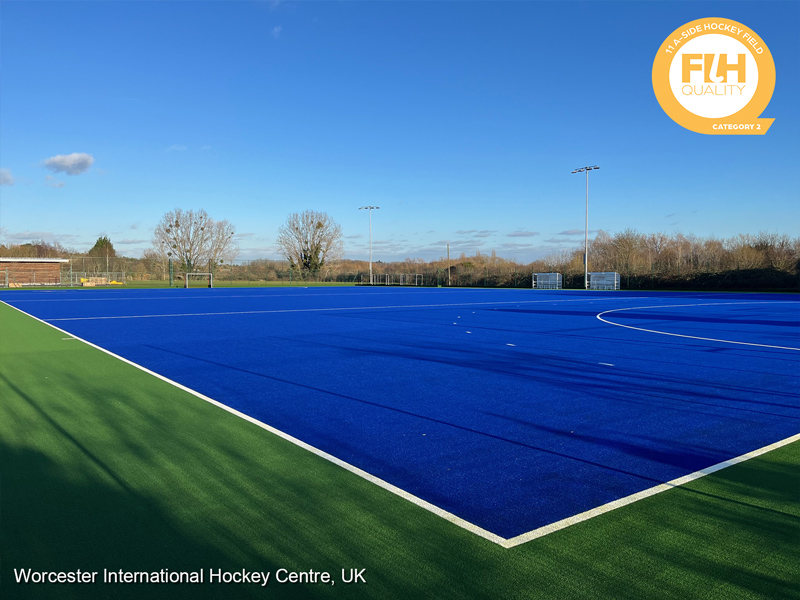
Colour selection also influences the overall appearance of the field. Blue is widely used because it contrasts strongly with the white ball, making it easier to follow during play.
Common combinations include a blue playing area with green, red or pink run-offs, as well as uniform blue or green designs. Hockey line markings are typically white and 75 mm wide.
Turf Installation and Line Markings
For FIH-standard fields, turf rolls should run across the full width of the field, from sideline to sideline, without head seams (transverse joints) within the field of play. This helps maintain a consistent surface for ball roll.
The five longitudinal white lines can be tufted into the turf during manufacturing, reducing the need for on-site cutting and joining. For other markings that require on-site cutting, longer continuous sections should be used wherever possible to minimise joints and maintain a smooth playing surface.
Indoor vs. Outdoor Hockey Field Dimensions
Field hockey is played in both outdoor and indoor formats, with differences in pitch size, team composition and playing surface. The main differences are summarised below.
| Feature | Outdoor Hockey | Indoor Hockey |
| Team size | 11 players per team | 6 players per team |
| Standard pitch dimensions | 91.4 m × 55 m (299.9 ft × 180.4 ft) | 44 m × 22 m (144.4 ft × 72.2 ft); minimum 36 m × 18 m (118.1 ft × 59.1 ft) |
| Goal dimensions (W × H) | 3.66 m × 2.14 m (12 ft × 7 ft) | 3.00 m × 2.00 m (9.8 ft × 6.6 ft) |
| Field boundaries | Side-lines and backlines | Side-boards and backlines |
| Playing surface | Artificial hockey turf (water-based or sand-dressed) | Smooth sports flooring (vinyl, polymeric or sprung timber) |
Indoor hockey is played on a smaller pitch, with sideboards along the longer sides to keep the ball in play. Its compact layout and different rules create a faster-paced style of game.
Conclusion
Getting the hockey field dimensions right is the starting point for a successful field project. The playing area, run-offs and available site space all need to be considered together to ensure the layout meets the requirements of the intended level of play.
CCGrass offers a range of artificial hockey turf systems for different levels of play and project needs. Contact our team to discuss a suitable turf solution for your hockey field.