

Polyethylene (PE): Properties, Types, and Its Role in Modern Materials
From the plastic bags we use every day to the vibrant green surfaces of sports fields, one material quietly supports many aspects of modern life—polyethylene (PE). As the world’s most widely produced plastic, its influence extends far beyond what we often realize.
This article takes a closer look at polyethylene—its properties, how it is produced, and the different forms it takes—before exploring why it has become a key material in artificial grass.
In this article:
Understanding Polyethylene (PE)
What is polyethylene?
Polyethylene is a polymer made of repeating ethylene (C₂H₄) units forming long chains of carbon and hydrogen, represented as (C₂H₄)ₙ.
Its molecular structure varies in branching and crystallinity, directly influencing density, stiffness, tensile strength, and flexibility. These variations give rise to multiple grades and performance levels that serve a wide range of industrial uses.
A brief history of polyethylene
Polyethylene was discovered in 1933 when British chemists Reginald Gibson and Eric Fawcett at Imperial Chemical Industries (ICI) accidentally produced it during high-pressure experiments. Early production focused on low-density polyethylene (LDPE), which played a crucial role as insulation material for wartime radar cables.
Breakthroughs in the 1950s—especially Karl Ziegler’s low-pressure catalyst technology (later earning a Nobel Prize with Giulio Natta)—enabled the commercial production of high-density polyethylene (HDPE) and other advanced variants.
Today, global PE production exceeds 100 million tons annually, reflecting its evolution from a laboratory accident to one of the world’s most important industrial materials.
How is polyethylene produced?
Polyethylene is produced by polymerizing ethylene gas under controlled conditions of heat, pressure, and catalysts. Key production routes include:
- High-pressure polymerization (LDPE):
Ethylene reacts under extremely high pressures (up to ~3,000 atm) with oxygen-based initiators, creating highly branched molecular structures that give LDPE its softness and clarity.
- Low-pressure processes (HDPE, LLDPE, specialty grades):
Using Ziegler–Natta or metallocene catalysts, polymerization occurs at much lower pressures, producing more linear chains with higher crystallinity and strength. Gas-phase and slurry-phase reactors are the dominant technologies here.
Bio-based ethylene derived from renewable feedstocks, such as sugarcane, is leading the development of more sustainable “green PE”.
Types of Polyethylene
PE includes several main categories, each offering distinct performance characteristics:
- LDPE (Low-Density Polyethylene): Flexible, transparent, and impact-resistant; widely used in films, bags, and general packaging.
- LLDPE (Linear Low-Density Polyethylene): Combines flexibility with higher tensile and puncture strength; ideal for stretch films, agricultural films, and lids.
- HDPE (High-Density Polyethylene): Strong, rigid, and chemically resistant; commonly used for pipes, containers, bottles, and structural parts.
- UHMWPE (Ultra-High Molecular Weight PE): Extremely wear-resistant with outstanding impact strength; used for medical implants, high-performance fibers, and protective equipment.
- Specialty Grades: Includes metallocene-PE (offering enhanced film clarity, sealing, and strength) and other modified grades tailored for specific processing or performance needs.
Key properties of polyethylene
Its essential properties include:
- Chemical Resistance:
Highly inert to most acids, bases, and solvents, making it reliable for pipes, tanks, and industrial systems.
- Moisture & Weather Resistance:
Very low moisture absorption and strong water-barrier performance. With UV stabilizers, PE withstands prolonged outdoor exposure.
- Mechanical Performance:
Excellent toughness, impact resistance, and flexibility—supporting components exposed to repeated stress or deformation.
- Thermal Performance:
Stable across a broad temperature range. While melting points vary among LDPE, HDPE, and specialty grades, all exhibit dependable thermal behavior for common applications.
- Electrical Insulation:
High dielectric strength enables use in cable jackets and insulation layers.
- Processability & Sustainability:
Polyethylene is easy to process via common methods such as injection molding and extrusion. It is among the world’s most recycled plastics, especially HDPE. The market for circular, recycled, and bio-based PE continues to expand.
Applications across industries
Thanks to these properties, polyethylene plays a vital role across major global industries:
- Packaging: Films, bags, wraps, and rigid containers—representing more than 40% of global PE consumption.
- Construction: Pipes, fittings, insulation layers, geomembranes, and vapor barriers, valued for durability and chemical resistance.
- Automotive & Healthcare: Fuel tanks, fluid containers, prosthetic components, medical tubing, and sterile packaging.
- Textiles & Fibers: Synthetic fibers for carpets, ropes, and artificial grass, benefiting from PE’s flexibility, durability, and UV resistance.
- Consumer Goods: Toys, bottles, housewares, storage items, and everyday household products.
Its low cost and processability drive innovation in emerging fields like 3D printing and sustainable composites.
Polyethylene in Artificial Grass
Why polyethylene is the primary polymer for artificial grass
Artificial turf has historically used three main polymers: polyethylene (PE), polypropylene (PP), and nylon (PA).
As turf technology evolved, PE became the dominant choice—in both sports turf and landscape turf—because it offers the best overall balance of softness, durability, and safety.
PE vs. PP vs. Nylon
| Property | PE | PP | Nylon (PA) |
| Softness & Realism | Excellent – soft, natural feel and look | Good, but less realistic | Stiff, less natural |
| Durability / Wear | High – resists wear and UV fading | Moderate – flattens over time | Highest – extreme resilience |
| Cost | Mid-range | Lowest | Highest |
| Typical Use | Main turf fibers (sports & landscape) | Thatch layers, low-cost turf | Early sports turf, now rare |
Why PE leads the market
PE offers the best balance of softness, durability, UV stability, and manufacturing flexibility. It’s gentle for athlete contact, strong enough for long-term use, and easy to engineer into realistic, resilient turf. This well-rounded performance is why PE has become the dominant fiber material in today’s artificial grass systems.
Inside the fiber: How PE is engineered for better performance
Polyethylene’s versatility allows it to be engineered into fibers with different structures, shapes, and textures—each contributing to the performance of modern artificial grass. The following design elements explain how PE is transformed into high-performing turf fibers.
Additives for stability and longevity
Color masterbatches are blended into the polymer to give the fibres their intended shade and visual consistency. Crucially, UV stabilizers are compounded in to slow sunlight-related ageing and help the turf maintain its appearance over time.
Depending on project needs, other additives—such as flame-retardant or antimicrobial agents—may also be used to enhance safety or long-term durability.
Fiber production types
PE fibers for artificial turf are primarily manufactured in two structural forms:
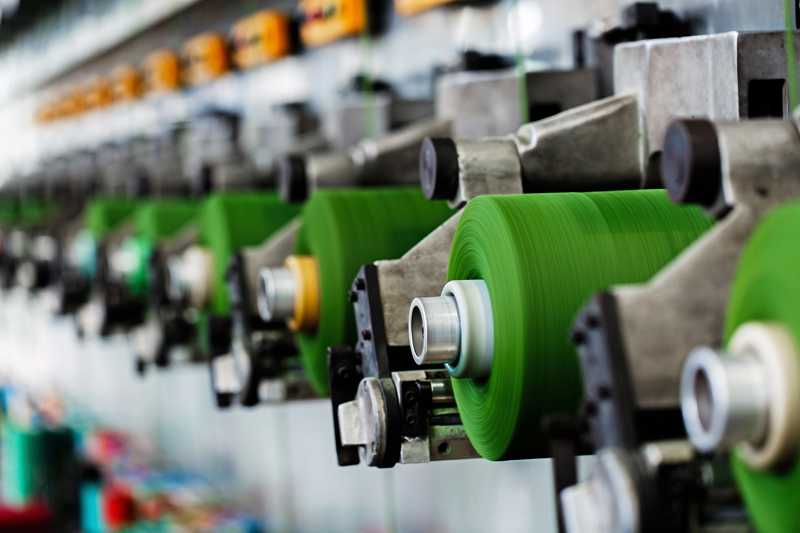
- Monofilament fibers
The mainstream choice for both sports and landscape turf.
They are extruded as individual strands and stretched to increase strength and resilience. Monofilaments allow precise control over shape, thickness, and recovery, making them ideal for surfaces that require softness, durability, and natural appearance.
- Fibrillated fibers
Flat tapes that are slit or perforated to create a net-like structure.
They are a cost-efficient option, often used in recreational and decorative turf where high-performance fibers are not required.
Texturised PE fibers
In high-performance turf—commonly used for sports like hockey, tennis, padel, and putting greens—PE monofilament fibers can be texturised with a permanent crimp. This creates a dense, compact surface with a smooth, uniform texture that enhances stability, optimizes ball–surface interaction, and delivers consistent, predictable play.
Fiber density and system integration
Beyond individual fiber design, PE performance in synthetic grass also depends on how fibers work together within the system. Fiber density, tuft configuration, and backing interaction all influence surface stability, comfort underfoot, and long-term appearance, reinforcing the importance of integrated fiber engineering rather than isolated material choices.
PE will continue to shape the future of artificial grass
As sustainability becomes an increasingly important consideration, the artificial grass industry is gradually exploring mono-material turf systems—where fibers and other key components are designed within the same polymer family—to improve recyclability and end-of-life handling.
With its established track record in durability, play comfort, and processing flexibility, polyethylene remains well positioned to support these evolving approaches. Rather than defining a single technical direction, PE continues to provide a stable foundation for future material and system-level innovation in artificial grass.
Frequently Asked Questions
What is polyethylene mainly used for?
Polyethylene is mainly used in packaging materials, containers, pipes, and everyday consumer products due to its durability, chemical resistance, and cost efficiency. It is also widely applied in construction, automotive, healthcare, and fiber-based products.
Is polyethylene environmentally friendly?
Polyethylene is recyclable and increasingly used in recycled form across many industries. While it is still a plastic material, its durability, long service life, and recyclability help reduce overall environmental impact compared with short-lived alternatives.
What is the best material for artificial turf?
Polyethylene is widely regarded as the best material for artificial turf. Is polyethylene better than nylon? For most modern turf applications, the answer is yes. Polyethylene fibers provide a softer feel, better flexibility, and a more natural appearance, making them suitable for both sports and landscape surfaces.
While nylon may still appear in limited, specialized uses, it is less commonly selected today due to its stiffness and higher cost. Polyethylene offers a more balanced combination of comfort, durability, and visual realism across different types of artificial grass.
Is polyethylene grass safe for dogs?
Yes, polyethylene artificial grass is safe for dogs and pets. It is non-toxic, durable against digging and chewing, drains well to prevent odors, and provides a soft, mud-free surface. High-quality PE turf contains no harmful chemicals and is free from pests and insects.
How long does polyethylene artificial grass last?
High-quality polyethylene artificial grass typically lasts 8–15 years, depending on usage, climate, and maintenance. Proper UV stabilization and fiber design are key factors influencing long-term performance.
Is nylon or polyethylene better for putting greens?
Polyethylene is generally preferred for modern putting greens. Texturised PE monofilament fibers help create a dense and uniform surface that supports smooth, predictable ball roll while remaining comfortable underfoot.
Compared with nylon, polyethylene also offers better play comfort and visual realism—key requirements for golf and recreational putting surfaces.
Conclusion
Polyethylene’s value lies in its adaptability. From polymer chemistry to fiber-level engineering, PE can be tailored to meet a wide range of functional and performance requirements. In artificial grass, it enables surfaces that are durable, visually appealing, and practical for long-term use.
For those looking for premium polyethylene artificial grass, CCGrass provides reliable, high-quality products for sports and landscape applications worldwide. Our clientele includes wholesalers, retailers, contractors, DIY/retail chains, sports clubs, and schools. As a global industry leader with manufacturing facilities in China, Vietnam, and Indonesia, CCGrass delivers solutions that meet diverse customer needs.