

The Ultimate Guide to Tennis Court Dimensions (2026)
Precision is the soul of tennis. Whether you’re planning a professional tournament venue, managing a club facility, or dreaming of a private backyard court, understanding the official tennis court dimensions is your first step.
In this guide, you’ll find official ITF tennis court dimensions, recommended total court footprints for different use cases, and understand how the right playing surface—especially modern artificial turf—can elevate your court’s performance and versatility.
In this article:
The Foundation: Official ITF Playing Dimensions
According to the International Tennis Federation (ITF), the following measurements define the official playing area for all regulation tennis courts worldwide. These dimensions are non-negotiable and apply equally to hard courts, clay courts, grass courts, and modern synthetic turf tennis courts.
| Feature | Feet (Standard) | Meters (Metric) |
| Court Length (Singles & Doubles) | 78 ft | 23.77 m |
| Singles Court Width | 27 ft | 8.23 m |
| Doubles Court Width | 36 ft | 10.97 m |
| Net Height (at posts) | 3.5 ft | 1.07 m |
| Net Height (at center) | 3 ft | 0.914 m |
Understanding the Playing Area
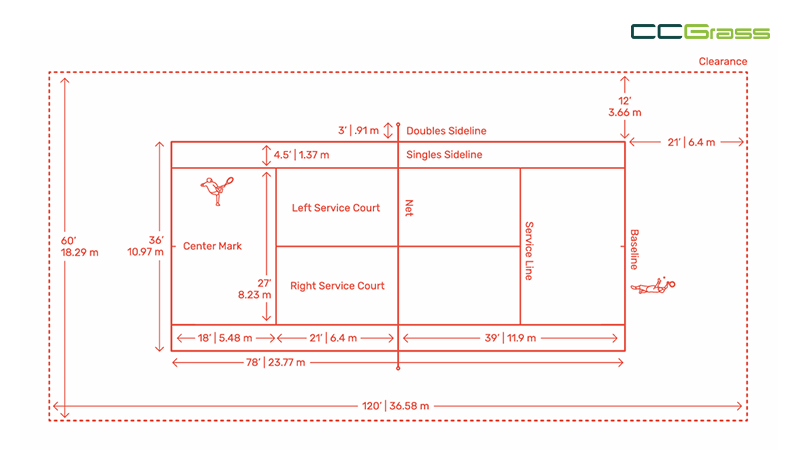
The dimensions above define the playing lines only, not the total space required for a tennis court.
- A doubles tennis court measures 78 × 36 ft (23.77 × 10.97 m), with a total playing area of 260.87 m².
- A singles court is marked within the doubles court, measuring 78 × 27 ft (23.77 × 8.23 m), with a total playing area of 195.65 m².
- The service line is positioned 21 ft (6.4 m) from the net on both sides, forming the service boxes used during play.
Beyond the painted lines, the surrounding clearance areas—often referred to as run-back (behind the baselines) and side-stop (beside the sidelines)—play a decisive role in player safety and court quality. Inadequate clearance restricts movement and increases injury risk, particularly during competitive play.
Planning Your Space: How Much Room Do You Really Need?
Knowing the size of the playing lines is only half the equation. The total land area required for a tennis court depends entirely on how the court will be used. A casual recreational court and a professional competition court demand very different spatial allowances.
Below is a breakdown of recommended tennis court footprints by project type.
Professional & Tournament Tennis Courts
Courts designed for professional or tournament-level play must accommodate high-speed lateral movement, deep defensive sprints, and space for officials and ball persons.
Typical total footprint: 130 × 70 ft (39.62 × 21.34 m)
This layout provides approximately 21 ft (6.4 m) of run-back behind each baseline and 12 ft (3.66 m) of side-stop on each side. These clearances are essential for elite-level safety, unrestricted movement, and proper match flow.
Club & Recreational Tennis Courts
Most tennis clubs, community parks, and school facilities aim to balance comfortable play with efficient land use—especially when installing multiple courts on one site.
Typical total footprint: 120 × 60 ft (36.58 × 18.29 m)
This configuration offers generous clearance for competitive recreational play while allowing facility owners to optimize space and court density.
Multi-court layout tip:
When planning adjacent courts, a shared fence line or a minimum 12 ft (3.66 m) separation between playing lines is commonly used to reduce collision risks during cross-court rallies.
Residential Backyard Tennis Courts
Residential courts are typically designed around available space rather than ideal competition clearances. While playability can still be achieved, reduced run-off areas naturally limit player movement.
Minimum recommended footprint: 114 × 56 ft (34.75 × 17.07 m)
Aggressively shrinking clearance zones can affect rally rhythm and safety, particularly during baseline exchanges. Wherever space allows, staying closer to the 120 × 60 ft standard helps preserve a more authentic playing experience.
Indoor Tennis Courts
Indoor tennis courts introduce an additional factor that outdoor courts do not face: vertical clearance.
Minimum ceiling height guidelines:
- 30 ft (9.14 m)above the net line
- 18 ft (5.5 m)above the baselines
Insufficient ceiling height can significantly alter play patterns, limiting effective lobs and overhead shots and making the court unsuitable for advanced training or competitive matches.
Lighting design is equally critical—fixtures should be positioned outside the playing area to minimize glare during serves and smashes.
For easy reference, the table below summarizes the key spatial requirements for each project type.
| Project Type | Footprint (L x W) | Total Area (Approx.) | Key Consideration |
| Professional / Tournament | 130 x 70 ft (39.6 x 21.3 m) | 9,100 sq ft (846 m²) | Elite performance & official event standard. |
| Club & Recreational | 120 x 60 ft (36.6 x 18.3 m) | 7,200 sq ft (669 m²) | Optimal balance of playability & space. |
| Residential (Minimum) | 114 x 56 ft (34.8 x 17.1 m) | 6,384 sq ft (593 m²) | Compact design for limited home spaces. |
Choosing the Right Surface for Your Tennis Court
Court dimensions provide the blueprint, but the surface defines how the game is played. Ball speed, bounce consistency, player comfort, and long-term maintenance costs are all directly influenced by surface choice.
Traditional hard courts, natural clay, and modern synthetic turf each offer distinct advantages. To explore these differences in detail, see our dedicated guide: Tennis Court Surfaces Compared.
Why Artificial Grass Is Gaining Popularity for Tennis Courts
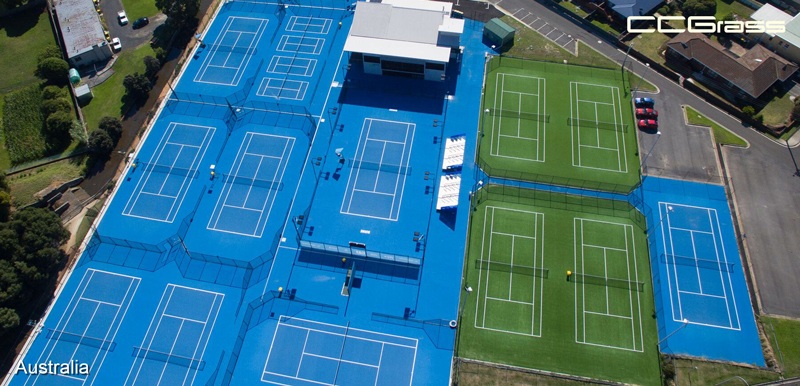
For clubs, schools, and multi-purpose sports facilities, artificial grass tennis courts are becoming an increasingly popular alternative due to their balance of consistent playability, reduced maintenance, and long service life.
Modern tennis turf systems are engineered for precise line tufting, stable footing, and predictable ball response. They are well suited for both dedicated tennis courts and multi-sport layouts, offering controlled pace and shock absorption that can help reduce joint stress during intensive use.
Our Tennis Turf Solutions
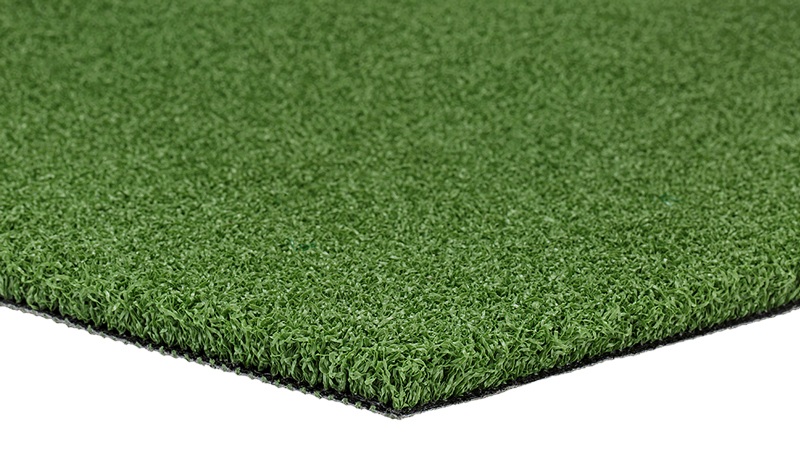
FastPro HF Series
Designed for players and facilities that demand top-tier performance, FastPro HF delivers a professional playing experience combined with exceptional durability.
- Dense, texturised monofilament yarn
- True and consistent tennis ball response
- Excellent resilience under intensive use
- Medium- to fast-paced court characteristics
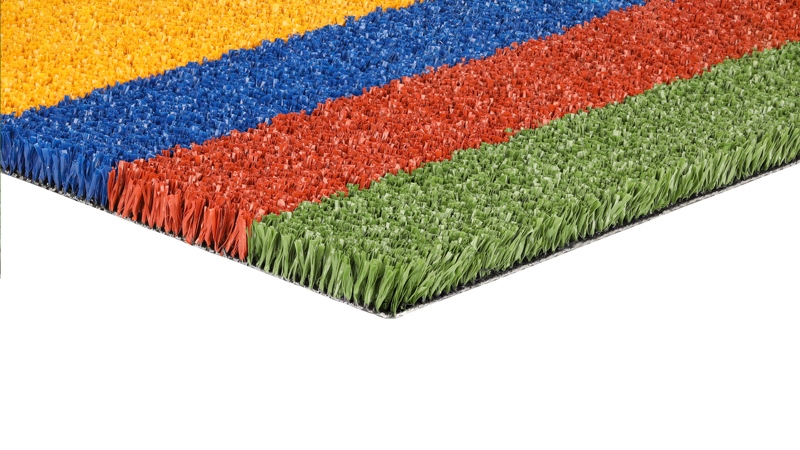
YEII Series
The YEII Series is engineered for high-traffic environments where durability, comfort, and value are equally important.
- Unique fibrillated yarn structure
- Stable, comfortable playing surface
- High wear resistance for schools and clubs
- Fast-paced play with reliable performance
Versatility: Maximizing a Standard Tennis Court Footprint
Because a regulation 78-foot tennis court represents a significant investment, many facilities now design courts with multi-sport use in mind.
A standard tennis footprint can easily accommodate multiple Pickleball courts, as a Pickleball court measures only 44 × 20 ft. Our turf systems support permanent, multi-colored line tufting, allowing multiple sports to coexist on one surface without additional construction—dramatically increasing facility utilization.
Frequently Asked Questions About Tennis Court Dimensions
What is the minimum size for a tennis court?
The minimum recommended size for a tennis court is 114 × 56 ft (34.75 × 17.07 m). This footprint allows basic recreational play but offers limited run-off space. For a more comfortable and authentic playing experience, a 120 × 60 ft layout is generally preferred.
How much space should be around a tennis court?
Adequate clearance around a tennis court is essential for safety and playability. Competitive courts typically provide 21 ft of run-back behind each baseline and 12 ft of side clearance. Recreational courts may use slightly reduced clearances, but tighter layouts limit player movement.
Are tennis court dimensions the same worldwide?
Yes. Official tennis court playing dimensions are standardized worldwide by the International Tennis Federation (ITF). The court length, width, net height, and line markings remain identical regardless of country or region, ensuring consistent play at all regulation facilities.
Do tennis court dimensions change for artificial grass courts?
No. The playing dimensions do not change for artificial grass tennis courts. ITF-defined court sizes apply to all surfaces, including hard courts, clay courts, grass, and synthetic turf. Only surface performance characteristics—such as pace and cushioning—vary.
Do indoor tennis courts have different dimension requirements?
The playing dimensions of indoor tennis courts are the same as outdoor courts, but ceiling height requirements differ. Indoor courts typically require at least 30 ft (9.14 m) above the net line and 18 ft (5.5 m) above the baselines to allow proper lobs and overhead play.
What is the recommended orientation for a tennis court?
Outdoor tennis courts are commonly oriented north–south. This alignment minimizes direct sunlight in players’ eyes during morning and late-afternoon play, improving visibility and overall playing comfort, especially for facilities with frequent daytime use.
Can I play pickleball on a tennis court?
Yes. A standard tennis court can be used for pickleball by adding pickleball line markings. Many facilities choose multi-colored or permanent line solutions, allowing tennis and pickleball to coexist on the same court without interfering with regular tennis play.
How many pickleball courts fit on one tennis court?
Depending on layout and clearance preferences, up to four pickleball courts can fit within the footprint of a single tennis court. This makes shared-use courts an efficient option for clubs, schools, and community facilities seeking maximum space utilization.
How big is a mini tennis court?
A mini tennis court, often used for junior training or beginner programs, is smaller than a standard court. Common sizes include 36 × 18 ft or 60 × 21 ft, depending on age group and training format, with modified nets and equipment.
Conclusion
A tennis court is a long-term investment in performance, safety, and user experience. By adhering to correct tennis court dimensions and selecting a high-quality surface such as FastPro HF or YEII, you create a facility that is professional, versatile, and built to last.
Ready to plan your layout?
Explore our Tennis Turf solutions or contact our experts for a customized layout recommendation and free samples.