

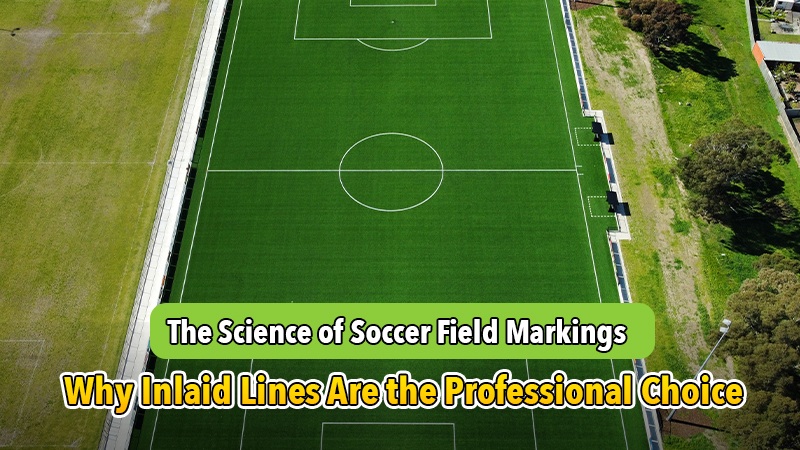
The Science of Soccer Field Markings: Why Inlaid Lines Are the Professional Choice
In the world of professional football, precision is everything. From the ball’s bounce to a player’s sprint, every detail influences how the game is played at a professional level. Among these, soccer field markings are one of the most immediately visible indicators of a pitch’s overall quality.
While natural grass fields require constant, manual repainting, modern synthetic turf technology offers a more permanent and durable solution: inlaid lines. In this guide, we explore the technical advantages of inlaid markings and explain why they have become the gold standard for high-performance soccer pitches.
In this article:
What are Inlaid Lines? A Matter of Integration
Consider the difference between a design printed onto a fabric versus a pattern woven into it. A printed design sits on the surface and can be prone to cracking or fading over time. A woven pattern, however, is integral to the fabric itself—it shares the same texture and is designed to last as long as the garment.
Inlaid lines for synthetic turf apply this very same philosophy of superior integration.
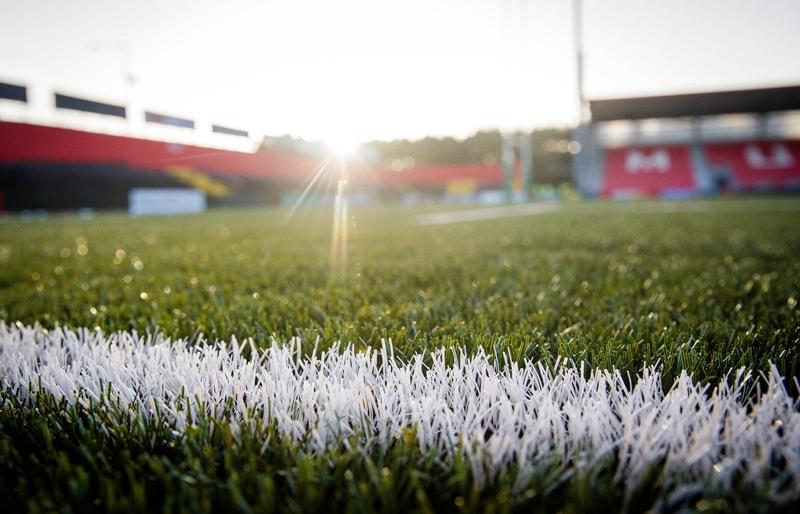
Simply put, an inlaid line is not a layer of paint applied on top of the turf. It is a section of colored turf (typically white) that is physically cut and seamed into the green playing surface during installation. This process creates a single, unified turf carpet where the markings are an integral component, not a superficial addition—a fundamental difference that has profound implications for performance, durability, and long-term value.
But how is this seamless integration achieved?
Step-by-Step: The “Cut and Embed” Process
The flawless finish of an inlaid line is the result of a deliberate and methodical installation process. The goal is not just to place a line, but to make it an inseparable part of the turf surface. Here is a simplified overview of how that integrity is achieved:
- Measure and Mark: First, the entire field is precisely measured and marked according to official blueprints and game standards (like FIFA). This initial step ensures every line is positioned with geometric accuracy.
- Cut the Channels: Next, clean channels are carefully cut into the green turf along the marked paths. This creates a perfect space ready to receive the new turf section.
- Embed and Bond: The white turf lines are then set into these channels. The sections are bonded from beneath using industrial-strength adhesive and durable seaming tape, creating a single, unified surface with no discernible difference in texture or height.
This process ensures the markings become a permanent, integral part of the playing surface, delivering the consistency and durability demanded by a professional pitch.
The Lines That Define the Game
Those precisely inlaid soccer field lines are more than just visual guides on a green background. They are the rules of the game made visible, each one defining a boundary, an area, or an action that is fundamental to how soccer is played.
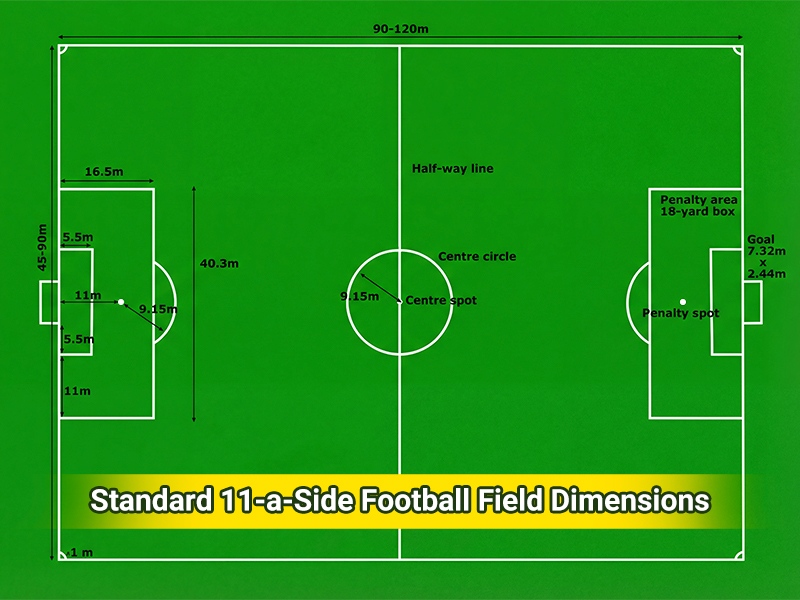
According to FIFA regulations, all soccer field lines must be of the same width, which shall not exceed 12 cm (5 inches).
Touchlines and Goal Lines
These lines define the outer boundaries of the field. The touchlines run along the length of the pitch, while the goal lines run along its width. When the ball completely crosses a touchline, play restarts with a throw-in. When it crosses a goal line (without a goal being scored), the restart is either a goal kick or a corner kick, depending on which team last touched the ball.
For a full-size pitch, the length can range from 90–120 m (100–130 yds), and the width can range from 45–90 m (50–100 yds).
The Centre Circle
This ensures opponents keep a fair distance (9.15m / 10 yds) during the kick-off.
The Penalty Area
A critical zone where the goalkeeper can handle the ball. Defensive fouls inside this 16.5m (18 yds) deep box can result in a penalty kick.
The Goal Area
Located within the penalty area, this smaller box (5.5m / 6 yds deep) designates the area from which a goal kick must be taken.
The Corner Arc
A small quarter-circle with a 1m (1 yd) radius, marking the exact spot for a corner kick.
For those interested in a more comprehensive breakdown, including the stricter dimensions for international matches, explore our complete guide to football field dimensions.
Why Inlaid Markings Are the Professional Standard
For any new, dedicated synthetic turf soccer pitch, inlaid markings are the established industry standard. This isn’t a random trend; it’s a direct solution to the perpetual maintenance and performance issues associated with painted lines, especially those common in the world of natural grass.
A direct comparison makes the long-term value of this approach clear, while also highlighting the niche scenarios where painting remains a practical option.
| Feature | Inlaid Markings | Painted Markings |
| Durability | Permanent. Designed to last the entire functional lifetime of the field as an integral part of the turf surface. | Temporary. Susceptible to wear, weather, and UV degradation. Requires frequent reapplication to remain visible and compliant. |
| Long-Term Cost | One-Time Investment. While the initial installation cost is higher, it eliminates all future expenses for line marking (paint, labor, equipment). | Recurring Operational Expense. Creates a continuous drain on the budget for materials, equipment, and man-hours, often multiple times a year. |
| Performance & Safety | Perfectly Uniform Surface. Ensures a completely consistent surface for true ball roll and predictable player traction, everywhere on the field. | Surface Inconsistency. Creates a separate physical layer that can alter ball-surface interaction and potentially become a slip hazard, especially when wet or over-applied. |
| Aesthetics | Permanently Sharp. Lines remain crisp, straight, and vibrant, providing a championship-ready appearance year after year. | Degrades Quickly. Lines can become blurry, crooked, or faded between paint jobs, diminishing the professional look of the facility. |
When Do Painted Lines Still Have a Place?
While demonstrably inferior for permanent, dedicated soccer fields, painted markings serve a purpose in specific situations, such as:
- Multi-Purpose Fields: This is the primary use case. Paint is used to add temporary lines for other sports (e.g., American football, lacrosse) on a field that has permanent, inlaid soccer lines. These painted lines can be removed after the season.
- Temporary or Training Areas: For practice fields or event-specific areas where a long-term, permanent solution is not necessary.
- Fields Initially Marked with Paint: On older or low-budget fields that were originally designed with painted markings, re-painting is the only method for maintenance.
Conclusion: Build Once, Play On.
From the rulebook to the player’s boot, every element of the game demands consistency from the playing surface. As we’ve explored, the technology and installation techniques behind modern soccer field markings are designed to deliver exactly that: unwavering precision, year after year.
By choosing to integrate lines directly into the turf system, a facility moves beyond the temporary, high-maintenance cycle of painting. It is a decision that prioritizes long-term value over short-term savings, and consistent playability over recurring operational headaches.
For any school, club, or community aiming to build a truly first-class facility, the investment in permanent, inlaid markings reflects a clear and powerful philosophy. It’s an investment in the quality of the game, the safety of the players, and the enduring professional image of the venue itself.
Ready to Build a Pitch That Lasts?
As a FIFA Preferred Provider, CCGrass specializes in high-performance soccer turf systems engineered for durability and consistent playability. Have a project in mind? Contact our team for a no-obligation consultation to discuss your specific needs.