

How to Secure Artificial Grass Properly?
Many people struggle to decide whether to use glue, tape, or nails when installing artificial grass. Yet the fixing method you choose will directly affect the durability, safety, and appearance of your lawn.
This guide explains each option clearly, shows when to use it, and helps you choose based on your surface, project type, and priorities. Most professional installations combine more than one method—and we’ll explain why later in the article.
In this article:
All Fixing Methods at a Glance
| Method | Best for | Pros | Cons |
| Artificial Grass Glue / Adhesive | Bonding turf to hard surfaces; reinforcing seams | Strong, long-lasting bond; ideal for concrete/asphalt | Requires careful application; not ideal for full-area soil installs |
| Jointing Tape + Glue | All turf seams on any surface | Professional finish; strongest seam connection | Only for seams, not full-area fixing |
| Artificial Turf Nails / Pins | Soil, sub-base, and perimeter fixing | Fast, simple, cost-effective; allows drainage | Not suitable for concrete or indoor areas |
| Double-sided Tape | Temporary installs, balconies, rentals | Easy, mess-free, removable | Not weatherproof; weaker bond; short lifespan |
This table gives you the big picture. Below is the practical detail.
Artificial Grass Fixing Methods: Glue vs Nails vs Tape
Method 1: Glue / Adhesive
Artificial grass adhesive (often called artificial grass glue) is a polyurethane-based product designed specifically for synthetic turf. It creates a strong, weather-resistant bond that lasts many years when applied correctly.
Use this method when:
- You’re installing on concrete, patio tiles, balconies, or roof terraces
- You want zero visible fixings and a completely seamless look
- You need extra resistance against movement caused by foot traffic, pets, or shifting objects
Tip: Always follow the adhesive manufacturer’s instructions. On hard, non-porous surfaces, apply the adhesive with a notched trowel—either in continuous strips or along the perimeter and key fixing points—while avoiding any coverage that blocks drainage holes or channels.
Method 2: Jointing Tape + Glue
This is the gold-standard method for how to seam artificial grass on almost every professional turf installation.
Here’s why installers rely on it:
- Creates smooth, seamless joins when connecting two or more rolls
- Extremely durable – resists separation even after years of expansion and contraction
- Works on all base types – whether soft (prepared soil/sub-base) or hard (concrete, asphalt, timber)
To install, lay the jointing tape under the seam, fold back both turf edges, apply adhesive, then press the turf back into place and weigh it down until fully cured.
Method 3: Nails & Pins
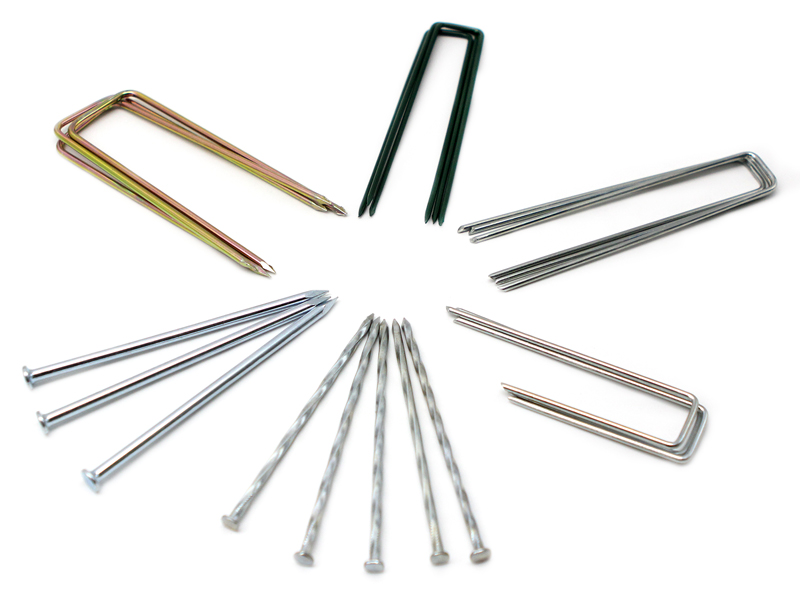
Metal fixing pins — such as galvanized turf nails and U-shaped sod staples — are the quickest and most economical way to secure artificial grass on soil or a compacted sub-base.
Best for:
- Gardens and landscapes on a prepared base
- Budget-friendly DIY installations
- Perimeter fixing, or reinforcing seams together with adhesive
Types of pins:
- Galvanized turf nails:Single-shank nails that provide strong hold on firm, compacted base layers. They are ideal for perimeter fixing along the turf edges.
- U-pins / sod staples:U-shaped staples that offer wider surface grip, making them helpful for stabilising seams and easier to install and adjust during fitting.
Pro tip:
Space pins every 10–20 cm around the perimeter and 50–75 cm along seams. Always use galvanized or stainless steel to prevent rust.
Method 4: Double-sided Tape
Double-sided tape is a quick and convenient solution for securing artificial grass, especially in hot climates or for temporary installations.
Advantages:
- Super-fast and simple to apply
- Fully removable – perfect for rented properties or events
- Provides excellent initial adhesion on smooth surfaces
Limitations: It can lose grip over time in cooler or very humid climates and isn’t usually recommended as the only fixing method for permanent residential lawns.
Choosing the Right Method to Secure Artificial Turf
Surface type matters most.
On soil with a prepared sub-base (e.g., compacted crushed stone), a combined approach delivers the best stability:
- Seams: jointing tape + artificial grass glue plus U-pins for extra stabilisation
- Perimeter: U-pins or galvanized turf nails to prevent lifting
For concrete and other hard surfaces, adhesive-based methods are the correct and most reliable choice. Bond the perimeter, and optionally place adhesive strips at key points. For seams, always use jointing tape + glue.
Project type and installation scenario
Permanent lawns, putting greens, pet areas, and high-traffic zones require strong seam bonding and firm perimeter fixing to keep the surface stable long term.
For small-scale DIY garden projects, perimeter nails combined with standard seam bonding provide a reliable and cost-effective installation.
Temporary or rental setups benefit from removable options like double-sided tape for artificial grass, which is fast, clean, and leaves no residue.
For indoor spaces like small balconies, extra fixing is generally unnecessary. Furniture or planters can be used if minor stabilisation is needed.
Conclusion
Proper artificial grass installation is key to a long-lasting, safe, and attractive lawn. By choosing the right fixing method for your site and project, you set the foundation for years of reliable performance.
For guidance on preparing the base, check out our detailed guide on laying artificial grass on soil or learn about installing artificial grass on concrete for hard surfaces.
As a leading global synthetic turf manufacturer, we offer a full range of high-quality turf products for sports and landscaping applications. Supporting installation accessories—such as turf seaming cloth, U-pins, and nails—are also available to help achieve a secure and professional finish when needed.
For expert guidance or to explore our full range of artificial turf solutions, contact our team today.