

When planning an artificial football pitch, you’ll often come across two certification levels: FIFA Quality and FIFA Quality Pro.
At first glance, it’s easy to assume that FIFA Quality Pro is simply a higher or better version of FIFA Quality. In reality, that’s one of the most common misconceptions.
Both certifications are part of the FIFA Quality Programme for Football Turf, but they are designed for different types of football pitches. While FIFA Quality prioritises durability and intensive use, FIFA Quality Pro is intended for pitches where elite-level playing performance is the primary objective.
In this guide, we’ll explain how a football pitch becomes FIFA certified and compare the key differences between FIFA Quality and FIFA Quality Pro.
In this article:
How Does a Football Pitch Become FIFA Certified?
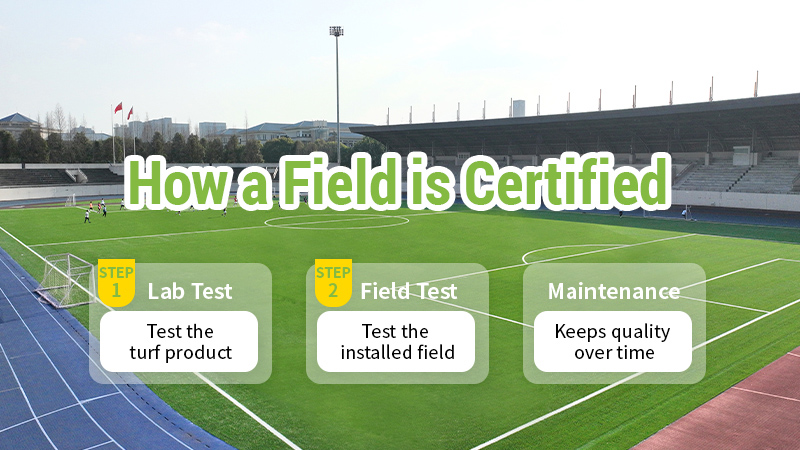
To become FIFA certified, a football pitch must first be built using a FIFA-tested football turf system. Once installation is complete, the finished pitch must also pass a series of on-site performance tests before certification can be awarded.
This two-stage process ensures that both the football turf system and the completed field meet FIFA’s requirements for playing performance, player safety and durability.
Only after both stages are successfully completed can the football pitch be awarded FIFA Quality or FIFA Quality Pro certification.
FIFA Quality vs FIFA Quality Pro: Key Differences
Although both certifications are awarded under the FIFA Quality Programme for Football Turf, they are not simply different levels of quality. Instead, each certification is designed around different project priorities, playing requirements and long-term maintenance expectations.
The comparison below highlights the key differences.
| Feature | FIFA Quality | FIFA Quality Pro |
| Recommended weekly usage* | Up to 40 hours | Up to 20 hours |
| Acceptable weekly usage* | Up to 60 hours | Up to 40 hours |
| Typical application | Schools, community facilities, municipal pitches and training grounds | Professional clubs, elite training centres and stadiums |
| Primary focus | Durability, player safety and intensive use | Elite-level playing performance |
| Performance requirements | Meets FIFA Quality performance requirements | Meets the more demanding FIFA Quality Pro performance requirements |
| Certification validity | 3 years | 1 year |
| Maintenance requirements | Standard routine maintenance | Higher maintenance standards to preserve elite performance |
*Recommended and acceptable weekly usage is based on FIFA guidance. Actual playing hours may vary depending on maintenance, field management and local conditions.
Different Priorities, Not Different Quality
Instead of representing a simple “higher” and “lower” certification, FIFA Quality and FIFA Quality Pro are designed around different project priorities.
FIFA Quality is intended for football pitches that accommodate a higher volume of play while maintaining good performance, player safety and long-term durability. It is commonly specified for schools, community sports facilities, municipal pitches and training grounds, where multiple matches and training sessions may take place every day.
By contrast, FIFA Quality Pro is designed for professional football, where the priority is delivering elite playing characteristics. Professional clubs and competition venues place greater emphasis on ball behaviour, surface consistency and overall playing experience. To help preserve these playing characteristics over time, FIFA recommends a lower weekly playing capacity for FIFA Quality Pro pitches.
This difference is also reflected in FIFA’s testing requirements. Both certification levels evaluate the same key performance characteristics—including ball roll, ball rebound, shock absorption, vertical deformation and rotational resistance. However, FIFA Quality Pro requires tighter performance tolerances to achieve the consistency expected for elite-level football.
Certification Period and Maintenance
Another important difference lies in long-term certification and maintenance.
A FIFA Quality football pitch is typically certified for three years, while FIFA Quality Pro certification is generally valid for one year. This does not mean a FIFA Quality Pro pitch has a shorter service life. Instead, it reflects the higher performance standards expected for professional football, where more frequent recertification helps ensure the field continues to deliver elite playing characteristics.
Likewise, maintaining FIFA Quality Pro certification generally requires a higher standard of routine maintenance than a typical FIFA Quality pitch, helping preserve the playing performance expected throughout the certification period.
Common Misconceptions about FIFA Certification
Even experienced project owners and contractors sometimes misunderstand how FIFA certification works. Here are a few of the most common misconceptions—and what they actually mean.
Is FIFA Quality Pro Simply a Higher-Level Version of FIFA Quality?
Not exactly.
This is perhaps the most common misconception. Although FIFA Quality Pro has more demanding performance requirements, it isn’t designed to replace FIFA Quality.
The two certifications serve different purposes. FIFA Quality is intended for pitches that prioritise durability and higher playing capacity, while FIFA Quality Pro is designed for professional football, where elite playing performance takes priority.
For many school, community and municipal projects, FIFA Quality is the more appropriate certification—not a compromise.
Does Using a FIFA-Tested Turf System Make a Football Pitch FIFA Certified?
No.
Using a FIFA-tested turf system is an essential requirement for FIFA field certification, but it does not automatically make the completed pitch FIFA certified.
To receive FIFA field certification, the finished football pitch must also successfully pass FIFA’s on-site performance tests.
FIFA-Tested Turf Systems Are Only Used on FIFA-Certified Football Pitches
Not true.
Many football fields do not require FIFA field certification. However, FIFA-tested turf systems are widely used for non-certified projects as well.
Choosing a FIFA-tested system means selecting a product that has already met FIFA’s laboratory testing requirements for performance, durability and player safety. While this alone does not make the completed field FIFA certified, it gives field owners greater confidence in the quality of the turf system they are specifying.
As a FIFA Preferred Provider, CCGrass offers more than 200 FIFA-tested turf systems covering a wide range of performance requirements and budgets, allowing customers to benefit from FIFA-tested products whether or not they pursue FIFA field certification.
Conclusion
Understanding the difference between FIFA Quality and FIFA Quality Pro is about more than comparing two certification marks—it’s about selecting the right standard for your football project.
The right certification should be determined during the planning stage, based on the intended level of play, expected usage and long-term maintenance strategy. A certification that matches your project’s objectives will deliver better long-term value than simply aiming for the highest certification available.
If you’re also comparing different football turf systems, explore our guide to types of artificial turf for soccer to better understand the options available for different levels of play and project requirements.
Whether or not your project requires FIFA field certification, choosing a FIFA-tested turf system provides a proven foundation for long-term field performance. If you need help understanding FIFA certification requirements or selecting the right football turf system, the CCGrass team is ready to support your project.