

Artificial Turf for 7-a-Side and 11-a-Side Football Pitches
Artificial turf has become a core surface solution for modern football pitches, supporting both small-sided 7-a-side formats and full-size 11-a-side competitions. As football facilities face increasing usage intensity, limited land availability, and higher performance expectations, artificial turf systems provide a practical balance between durability, playability, and operational efficiency.
Understanding how artificial turf responds to the distinct demands of different football formats is essential when planning, upgrading, or operating football pitches.
In this article:
The development of 7-a-side and 11-a-side football
Football’s roots trace back to the 19th century, with standardized rules emerging through organizations like FIFA. The traditional 11-a-side format remains the professional standard, featuring larger teams and expansive fields that emphasize strategy, endurance, and positional play.
In contrast, 7-a-side football emerged as a more accessible variant, popular in amateur leagues, youth development, and urban settings where space is limited. This faster-paced game promotes technical skills, quick decision-making, and higher player involvement.
Today, both formats thrive, with artificial turf enabling year-round play on durable 7-a-side football pitches and full-size 11-a-side football pitches.
Why artificial turf is widely used for football fields
Artificial turf is widely adopted for football pitches due to a combination of performance stability and operational practicality. Compared with natural grass, modern football turf systems are engineered to meet the physical and technical demands of today’s game.
High usage tolerance
Artificial turf maintains playable conditions under intensive training schedules, tournaments, and daily recreational use, making it ideal for both 7-a-side and 11-a-side football facilities.
Consistent playing performance
Engineered turf systems provide reliable ball roll, predictable ball rebound, and stable footing, helping maintain match quality across the entire pitch.
All-weather reliability
Synthetic turf is less affected by rainfall, temperature variation, or seasonal changes, reducing downtime and surface recovery periods.
System-based design
Football turf is not a single surface layer but an integrated system consisting of turf, infill materials, and optional elastic layers. This allows performance characteristics to be adapted to different pitch sizes and usage profiles.
These advantages have positioned synthetic grass as a long-term surface solution for football facilities operating under diverse conditions and intensity levels.
Key differences between 7-a-side and 11-a-side football
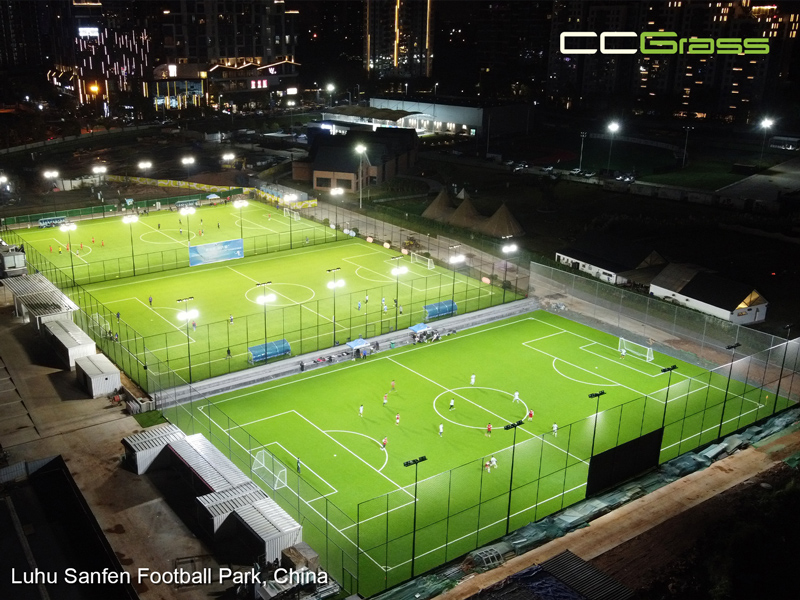
While 7-a-side and 11-a-side football share the same core rules, differences in pitch scale and match format lead to distinct playing characteristics and field requirements.
Pitch scale
A full-size 11-a-side pitch measures 90–120 m by 45–90 m, while a 7-a-side pitch is more compact at 50–70 m by 30–50 m (commonly 60 m × 40 m). The reduced dimensions increase player interaction and ball-contact frequency.
Game intensity and player density
With fewer players on a smaller pitch, 7-a-side football places greater emphasis on acceleration, ball control, and quick transitions. Full-size 11-a-side football focuses more on positional structure, endurance, and long-distance movement.
Ball and match format
11-a-side football uses a size 5 ball in standard 90-minute matches (2×45 minutes). The 7-a-side game is shorter, typically lasting 50–60 minutes, and commonly uses a size 4 ball (or size 5 for older players), resulting in higher intensity with lower overall physical load.
| Format | Players per Team | Typical Pitch Size (L × W) | Ball Size | Match Duration |
| 11-a-side football | 11 | 90–120 m × 45–90 m | Standard size 5 | 90 minutes |
| 7-a-side football | 7 | Typically 50–70m x 30–50m | Often size 4 or 5 | Usually 50–60 minutes |
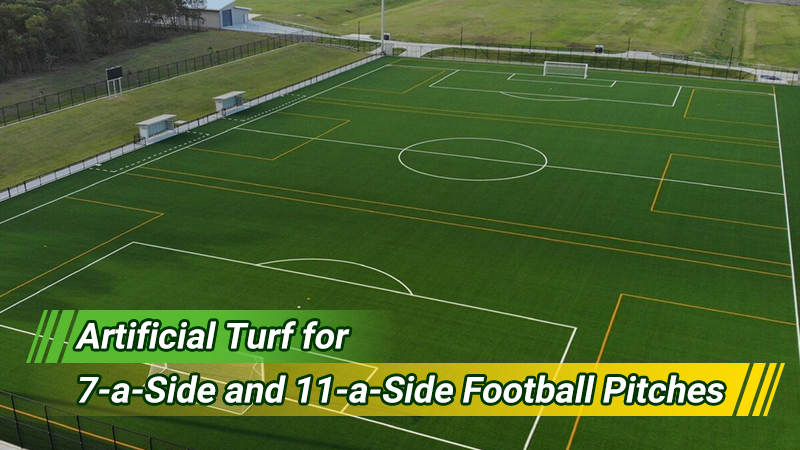
From a facility planning perspective, full-size artificial turf pitches offer greater layout flexibility. By adding transverse markings in a distinct color, a single pitch can be efficiently adapted to accommodate two or even three 7-a-side fields, improving space utilization and operational efficiency.
Synthetic turf systems for 7-a-side and 11-a-side football pitches
Artificial grass for football is typically discussed and specified as a system, rather than a single product. In practice, football turf systems for both 7-a-side and 11-a-side pitches are typically configured within the 40–60 mm pile height range, with system design adjusted to deliver stable playing performance and comply with recognized football standards.
Football turf systems in the 40–50 mm range
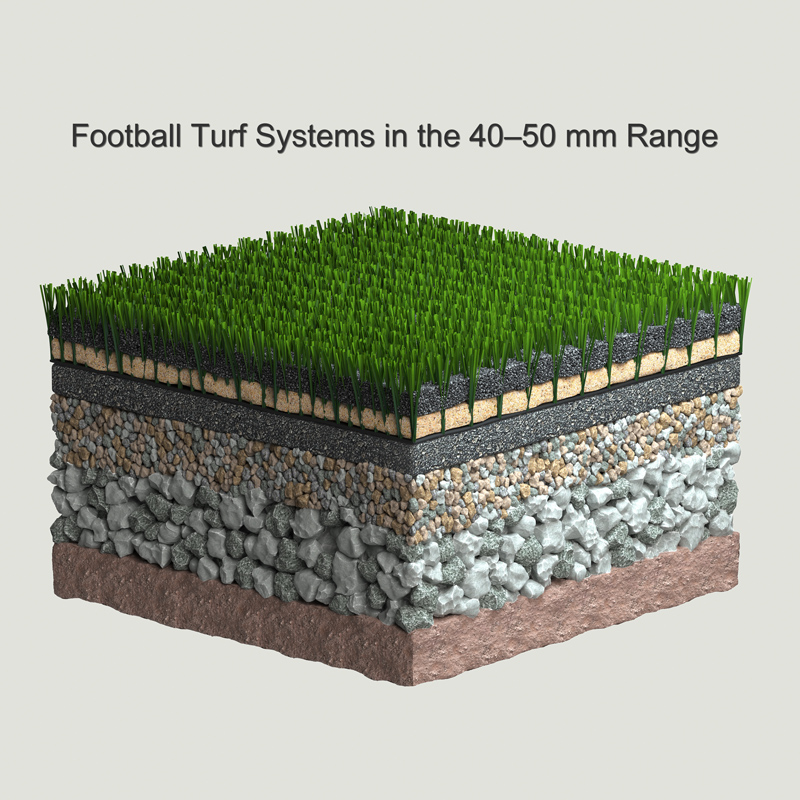
Football turf systems with pile heights between 40 and 50 mm are commonly used on compact football pitches and high-use training fields.
Because the lower pile height provides limited inherent shock absorption, these systems are typically combined with a shock pad to ensure appropriate surface deformation and impact attenuation, resulting in stable footing and consistent playing performance under frequent use.
- Lower infill volume compared to taller systems
- Controlled shock absorption through elastic layers
- Stable performance under intensive use
Football turf systems in the 50–55 mm range
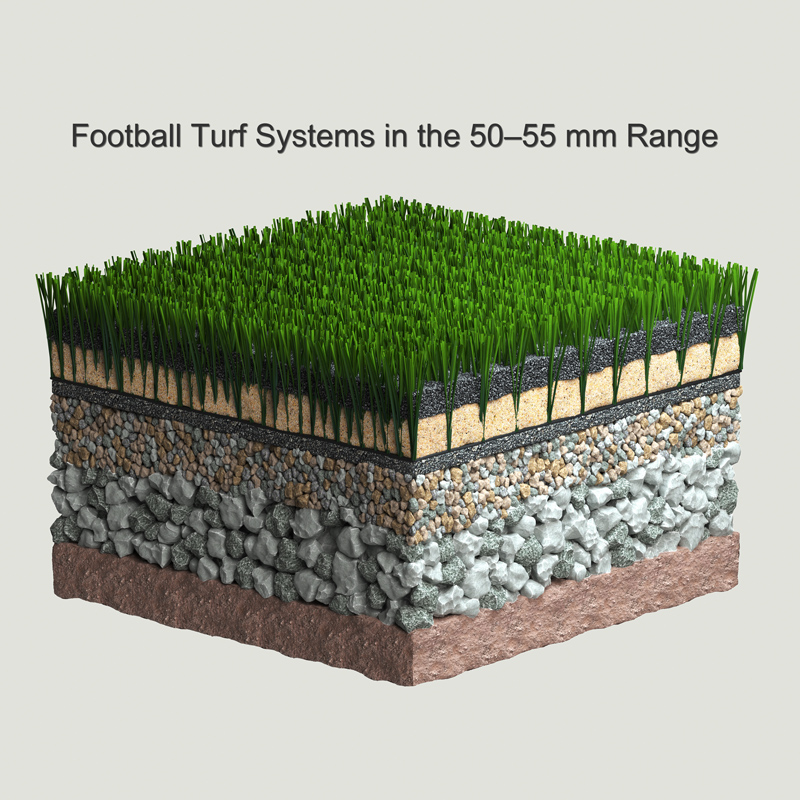
Football turf systems in the 50–55 mm range are widely used across both 7-a-side and 11-a-side football pitches.
At this height, shock absorption is achieved through the combined performance of turf fibers and infill materials. Depending on the overall system configuration, a shock pad may be used or omitted, offering design flexibility while maintaining consistent football playing performance.
- Balanced shock absorption through turf and infill interaction
- Moderate infill depth with stable player traction
- Flexible system design adaptable to different pitch formats
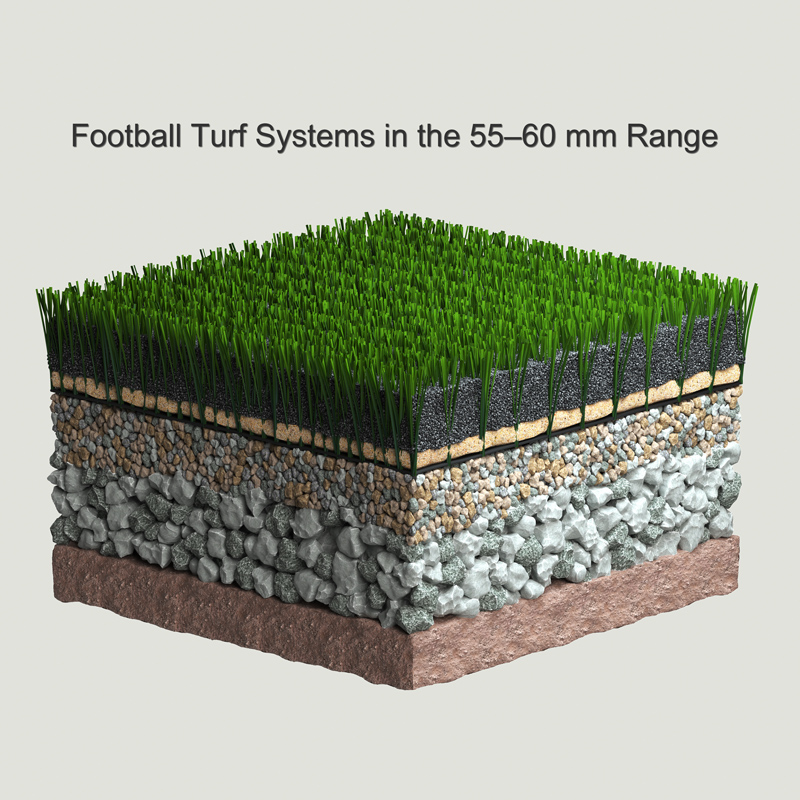
Football turf systems in the 55–60 mm range
Football turf systems with pile heights between 55 and 60 mm are commonly adopted for full-size 11-a-side football pitches and competitive installations.
The increased pile height allows for deeper infill, contributing directly to shock absorption and energy dissipation within the turf layer, resulting in a playing experience close to natural grass while maintaining surface stability and durability under match conditions.
- Strong natural-grass-like playing feel
- Higher infill volumes improve softness and resilience
- Proven performance under professional match conditions
In addition to conventional infilled systems, non-infill turf systems are also used on certain football installations where infill-free solutions are preferred. These systems rely on a shock pad and advanced turf construction—combining straight yarns with double-layered curly yarns—to deliver shock absorption and surface stability without the use of loose infill.
Across these configurations, over 180 CCGrass football turf systems have been laboratory tested and recognized to comply with FIFA standards, covering a wide range of system designs and performance requirements.
Football turf products for 7-a-side and 11-a-side fields
All our football turf products are certified by FIFA and can be configured into complete systems for both 7-a-side and 11-a-side football pitches, supporting different usage intensities, performance expectations, and project budgets.
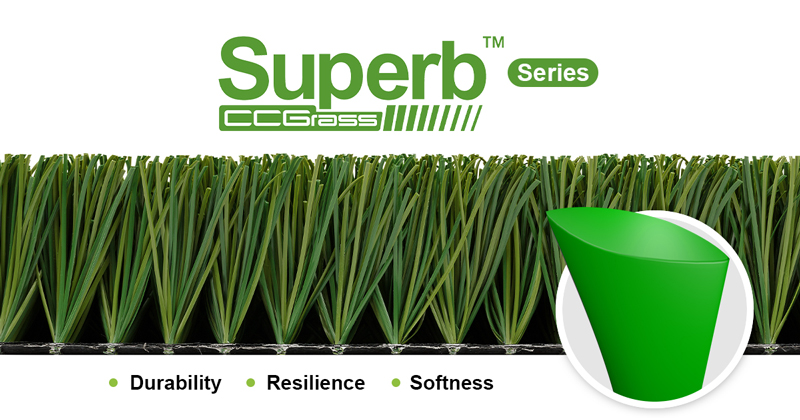
Superb™ – Premium football turf for competitive play
Superb is a high-end football turf solution built with ultra-thick diamond-shaped fibers exceeding 400 μm. The advanced polymer formulation allows the yarns to combine exceptional durability with a softer playing feel, supporting demanding football performance without sacrificing comfort.
Configured within FIFA-certified systems, Superb is typically selected for stadium pitches and top-level football facilities where long-term performance stability and match-quality playability are essential.
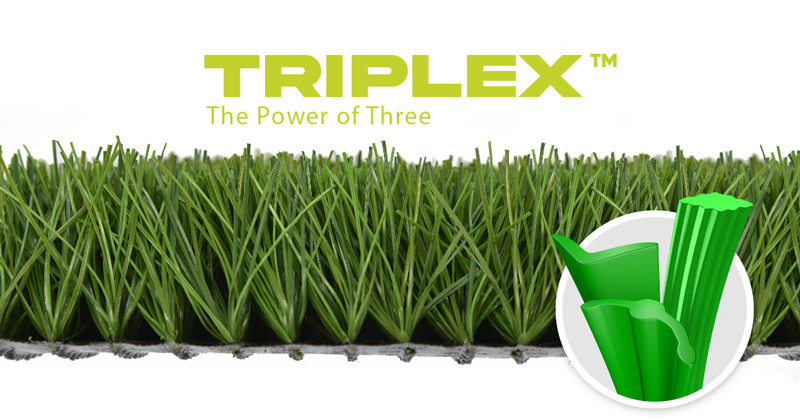
TriPlex™ – Multi-yarn football grass for balanced performance
TriPlex utilizes an innovative three-yarn system combining diamond-, C-, and V-shaped fibers. This multi-structure design enhances surface stability while supporting consistent ball roll and controlled player movement across the pitch.
Widely applied in stadium and academy football projects, TriPlex is suitable for both 7-a-side and 11-a-side systems where balanced durability, comfort, and visual quality under frequent football activity.
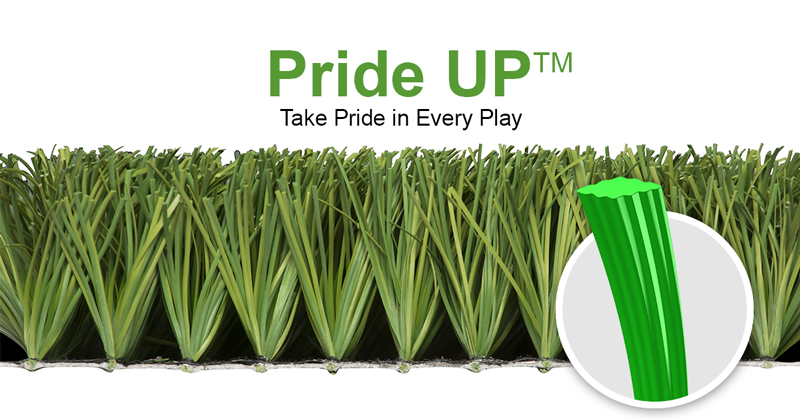
Pride UP™ – Durable football turf for high-use pitches
Pride UP features ribbed diamond-shaped fibers that increase surface contact and help reduce friction during play, supporting improved player comfort while maintaining strong resistance to wear.
Engineered for high-usage environments, Pride UP is commonly applied in football club facilities and professional training centers where durability and consistent playing performance must be maintained over long operational cycles.
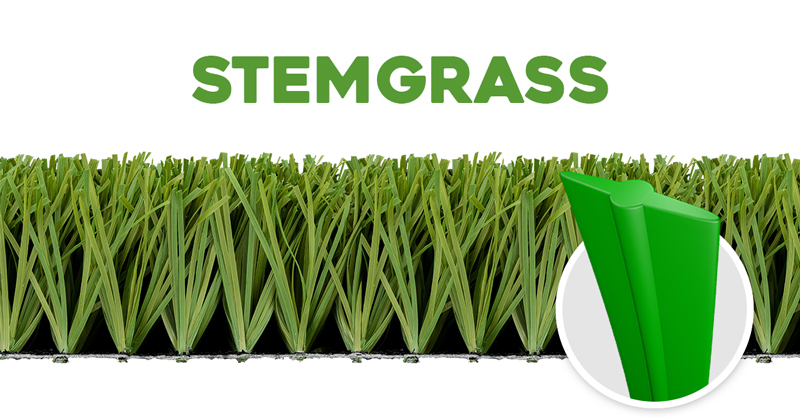
Stemgrass™ – Proven and cost-effective football turf
Stemgrass is a classic football turf solution with extensive application across 7-a-side and 11-a-side pitches worldwide. Each blade features a reinforced central spine, helping the fibers maintain upright recovery while delivering stable ball behavior and dependable footing.
With thousands of completed football installations, Stemgrass remains a widely adopted option for projects seeking proven FIFA-certified performance and cost-effective system reliability.
How are line markings created on artificial football turf?
In standard football installations, pitch markings are formed using dedicated turf strips in a contrasting color, typically white, manufactured to match the main turf in specification and playing characteristics. Integrated during turf installation, these markings offer long-lasting visibility with reduced maintenance. Learn more in our guide on 3 Methods for Sports Field Marking Lines.
Indoor and covered 7-a-side football pitches
Covered and enclosed football facilities often face limitations with natural grass due to restricted sunlight and airflow. Artificial grass is therefore widely adopted, as it delivers stable playing performance and reliable usability throughout the year.
- Consistent surface performance independent of weather conditions
- Extended playing hours in controlled environments
- Lower maintenance requirements than natural grass
- Stable, cushioned systems supporting player safety
This makes artificial grass well suited for urban 7-a-side pitches in halls, domes, and other enclosed facilities where maximizing pitch availability is a priority.
Conclusion
From compact 7-a-side pitches to full-size 11-a-side football fields, synthetic turf systems have proven their ability to deliver consistent performance, durability, and year-round play across a wide range of environments. By aligning pitch design, system configuration, and turf selection with actual usage demands, football facilities can achieve both technical reliability and long-term value.
With decades of experience in football turf, CCGrass provides FIFA-certified solutions for professional, training, and community football projects worldwide. Whether for indoor, small-sided, or full-size pitches, selecting the right system remains essential to creating safe, high-performing football environments.