

Artificial football fields are known for their durability and lower maintenance requirements compared with natural grass. However, low maintenance does not mean maintenance-free.
Without regular care, turf fibers can flatten, infill may become uneven, and the field gradually loses its original playing characteristics. Routine maintenance helps preserve those playing characteristics, extend the field’s service life and keep the surface performing as intended.
In this guide, we’ll explain why football field maintenance matters and cover the essential maintenance practices for artificial turf fields.
In this article:
Why Is Football Field Maintenance Important?
Artificial football turf is designed to provide consistent playing performance throughout its service life. However, every training session, match and weather event gradually changes the condition of the playing surface. FIFA also emphasizes that regular maintenance is essential for preserving the playing performance, safety, aesthetics and longevity of artificial football pitches.
Preserve Playing Performance
The primary purpose of football field maintenance is to preserve the designed playing characteristics of the turf system.
Without routine maintenance, turf fibers gradually flatten, infill becomes unevenly distributed, and different areas of the field may begin to perform differently. This can lead to inconsistent ball roll, uneven ball rebound and localized surface irregularities. Regular maintenance restores surface consistency and helps the field continue to perform as intended.
Maintain a Safe and Consistent Surface
Routine maintenance also helps keep the playing surface in good condition.
Compacted infill, uneven wear or accumulated debris can reduce surface consistency, particularly in high-traffic areas such as the goalmouths and center circle. Regular inspection and maintenance allow these issues to be identified and corrected before they become more significant.
Extend the Service Life of the Field
Artificial football turf is a long-term investment, and routine maintenance plays an important role in protecting that investment.
By restoring turf fibers, maintaining proper infill levels and addressing localized wear early, maintenance slows the rate of surface deterioration and reduces the need for more extensive repairs. A well-maintained field is more likely to deliver consistent performance throughout its expected service life.
Routine Football Field Maintenance
Regular maintenance does not need to be complicated, but it should be carried out consistently. The exact maintenance routine depends on field usage, climate and local conditions. However, the following practices form the foundation of routine football field maintenance.
Groom the Turf Regularly
Grooming is the most important routine maintenance task for an artificial football field.
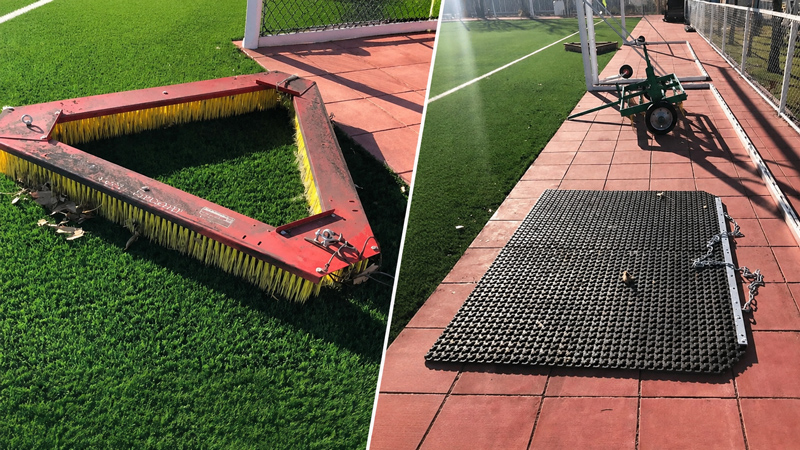
Its primary purpose is to restore flattened turf fibers, redistribute performance infill evenly across the playing surface and move leaves, litter and other loose debris towards the edge of the field for easy removal. Regular grooming helps maintain consistent playing characteristics across the entire pitch.
Routine grooming is typically performed using a turf brush or drag mat, both of which are pulled by a maintenance vehicle. Triangular turf brushes are the most commonly used option, while drag mats serve the same purpose but are used less frequently.
The frequency of grooming should be based on field usage. Football fields with heavier traffic generally require more frequent grooming to maintain consistent playing performance.
Monitor Ball Roll Performance
Ball roll is one of the key performance characteristics evaluated during FIFA football turf testing, making it a practical indicator of overall field condition.
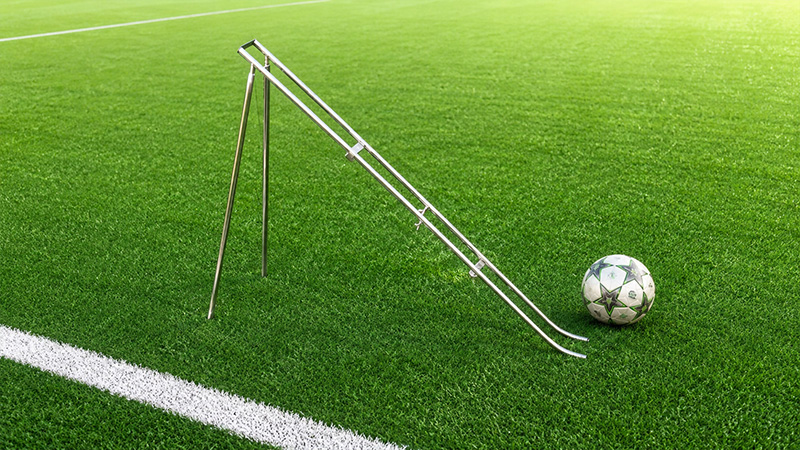
After routine grooming, field managers can perform a simple ball roll check using a standard size 5 football and a ball roll ramp to observe whether the ball behaves consistently across different areas of the field.
- If the ball rolls noticeably farther than expected, the exposed fiber height may be too low, indicating compacted infill or excessive infill.
- If the ball stops too quickly, the exposed fiber height may be too high, suggesting that additional infill may be needed.
These simple observations cannot replace formal FIFA performance testing, but they provide a practical way to make timely maintenance adjustments and help maintain consistent field performance.
Inspect High-Wear Areas
Some areas of a football field experience significantly more traffic than others, particularly the goalmouths, penalty areas and center circle. These high-use zones are more prone to flattened fibers, displaced infill and localized wear.
As part of routine maintenance, these areas should be inspected regularly so that minor issues can be identified and addressed before they affect overall field performance or require more extensive repairs.
Professional Football Field Maintenance
Routine maintenance can usually be carried out by the field owner or facility manager. However, some maintenance tasks require specialized equipment and experienced professionals to help maintain long-term field performance.
Professional maintenance typically includes:
- Infill decompaction to loosen compacted infill and restore shock absorption, drainage and overall playing performance.
- Infill top-ups to maintain the correct exposed fiber height and consistent playing characteristics.
- Deep cleaning, when necessary, to remove accumulated fine debris, dust and other contaminants that routine grooming cannot eliminate.
- Performance inspections to evaluate overall field condition and identify potential issues before they affect playability.
The exact maintenance program should be determined by field usage, environmental conditions and the recommendations of the turf manufacturer. Although these services are typically performed less frequently than routine maintenance, they play an important role in extending the service life of an artificial football pitch and maintaining consistent performance over time.
How Often Should a Football Field Be Maintained?
There is no one-size-fits-all maintenance schedule for artificial football fields. The ideal frequency depends on factors such as field usage, climate, surrounding environment and the recommendations of the turf manufacturer.
As a general guide, the following maintenance intervals are commonly recommended:
| Maintenance Task | Recommended Frequency |
| Groom the turf | Typically weekly; more frequently for heavily used fields |
| Ball roll check | After routine grooming, where practical |
| Inspect high-wear areas | During routine maintenance |
| Infill decompaction | Approximately every 3 months, depending on field condition |
| Infill top-up | Approximately once a year, or as needed |
| Deep cleaning | As needed, depending on contamination and field condition |
| Performance inspection | Periodically, especially for heavily used or competition fields |
Conclusion
Synthetic football fields require far less maintenance than natural grass, but regular care is still essential to keep the surface performing at its best.
Even high-quality football turf relies on proper maintenance to deliver consistent long-term performance. By combining routine maintenance with periodic professional servicing, field owners can preserve playing characteristics, extend the lifespan of the turf and provide a safer, more enjoyable playing experience.
With the right maintenance strategy, an artificial football pitch can continue to deliver reliable performance for many years.