

An artificial football field is much more than synthetic grass laid over the ground. Beneath the playing surface is a carefully designed foundation system that supports the turf, manages water, and helps the field maintain consistent performance over years of use.
The exact construction can vary from one project to another. Ground conditions, drainage requirements, the type of base, and the selected football turf system all influence what is installed beneath the surface. FIFA also emphasizes the importance of properly designed basework, drainage, and sub-base construction for the long-term performance of a football turf installation.
Below, we break down the main components of the system, starting with the ground beneath the pitch.
In this article:
What Is Under Artificial Turf on a Football Field?
A typical artificial football field may include:
- Formation layer
- Drainage system
- Sub-base
- Levelling layer
- Shock pad, where required
- Artificial turf with its infill system
These should not be treated as a single fixed set of layers. Some components can be adapted to suit the site and the overall pitch design.
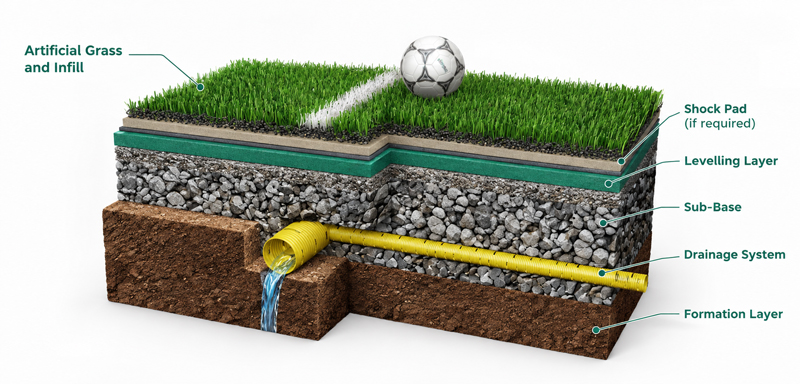
Image adapted from PST Sport
1. Formation Layer
The formation layer is the prepared ground on which the rest of the pitch is constructed.
Before the base is installed, the ground needs to provide a stable platform with the required levels and contours for the playing field. A geotechnical assessment can help determine the physical characteristics and load-bearing capacity of the site, which are important considerations when developing the pitch foundation.
2. Drainage System
Effective drainage is essential for an artificial football field.
Rainwater needs to move through the playing surface and underlying construction and away from the pitch rather than accumulating within the system. A drainage system can include drainage pipes together with permeable materials within the pitch construction, working with the pitch levels and base to direct water away from the field.
Drainage therefore cannot be considered separately from the rest of the foundation. The turf system, pitch falls, drainage arrangement, and underlying construction all need to work together.
3. Sub-Base
The sub-base provides a stable structural layer beneath the football pitch.
For artificial pitches, FIFA describes the sub-base as an approved, permeable, unbound aggregate layer. It provides a stable base for the field of play while also acting as a collection medium for drainage water. A geotextile membrane may separate the sub-base from the formation layer.
The exact specification of the sub-base does not have to be the same for every pitch. Materials, construction, and depth can vary according to the ground conditions, drainage design, and overall pitch system.
FIFA notes that quality basework, including drainage and sub-base construction, is important to the longevity and evenness of a football turf installation.
4. Levelling Layer
The levelling layer provides the prepared surface on which the synthetic turf system is installed.
FIFA identifies two basic approaches for the levelling layer. One uses porous bituminous macadam or asphalt to create an engineered or bound base. The other uses graded aggregate to create an unbound base.
The appropriate option depends on the overall pitch design. In either case, the levelling layer provides a stable, accurately prepared surface for the turf installation.
5. Is a Shock Pad Always Needed?
No. A shock pad is an elastic layer installed beneath the artificial turf to provide additional shock absorption. Whether it is needed depends on the complete turf system, including the turf construction, infill configuration, and required playing characteristics.
For example, football turf systems in the 40–50 mm range are typically combined with a shock pad, while 50–55 mm systems can be configured with or without one. Some 55–60 mm systems can achieve the required shock absorption through the turf and infill configuration alone.
6. Artificial Turf and Infill
The artificial turf is the visible playing surface, but its performance depends on how it works with the infill and the layers beneath it.
Football turf is designed with specific yarn constructions, pile heights, backing systems, and infill configurations to provide the playing characteristics required for different applications. In traditional infilled systems, infill sits between the turf fibres, helping support the fibres and contributing to surface stability and shock absorption.
The infill configuration varies between systems. Many football turf systems use a combination of sand infill and performance infill, while others are designed without loose infill altogether. CCGrass’s LEAP system, for example, uses specially engineered straight and curly yarns to provide fibre support and surface stability without infill.
How Do These Components Work Together?
An artificial football field relies on the interaction between its surface system and underlying foundation. Water needs to drain through the permeable turf system and underlying construction, while the base provides a stable, even platform for play. The turf, infill, and shock pad, where used, also work together to achieve the required playing characteristics.
These components cannot be designed independently. For example, the selected turf and infill configuration can influence whether a shock pad is needed, while ground conditions and drainage requirements affect the design of the base. A suitable pitch design must therefore consider the complete system, taking into account both site conditions and the performance requirements of the finished field.
What Happens When an Artificial Football Field Is Resurfaced?
Resurfacing may be needed when the turf shows widespread wear, fibres become significantly flattened or damaged, seams repeatedly fail, or the playing surface no longer meets performance requirements despite proper maintenance. The timing depends on the field’s condition, usage, and maintenance history rather than age alone.
Resurfacing does not necessarily mean rebuilding the entire field. The existing artificial turf and infill are first removed, allowing the underlying base, drainage system, and shock pad, if present, to be inspected.
A well-constructed base can often remain in place through multiple turf replacement cycles, provided it remains stable and the drainage system continues to perform properly. The shock pad may also be retained when it is still in suitable condition and meets the requirements of the new turf system.
Any damaged areas, unevenness, drainage issues, or materials left from the previous turf installation may need to be repaired or removed before the new turf is installed.
Ultimately, what lies beneath an artificial football field is just as important as the turf itself. From the formation layer and drainage system to the sub-base, levelling layer, and optional shock pad, each component contributes to the stability, drainage, and performance of the finished field.