

Football Field Dimensions & Turf Planning Guide (2026)
Football (soccer) field dimensions are not defined by a single fixed size. They vary depending on the format of play, level of competition, age group, and available site conditions.
For clubs, schools, municipalities, and field developers, understanding these dimensions is more than a rules question—it directly affects turf selection, material quantities, line marking layout, installation accuracy, and long-term field performance.
This guide explains football field dimensions in a clear, practical way. It starts with standard 11-a-side pitches and extends to smaller formats commonly used for training, youth programs, and community fields. Along the way, it highlights how field size influences artificial turf planning, helping you design a pitch that performs reliably in real-world conditions.
In this article:
How Big Is a Football (Soccer) Field?
There is no single universal size for a football field. Instead, official regulations define acceptable dimension ranges that vary by competition level and format.
For a standard 11-a-side match, a football field is typically:
- 90–120 meters (100–130 yards) long
- 45–90 meters (50–100 yards) wide
At the top professional and international level, a 105 × 68 meters (115 × 74 yards) layout is widely used as a reference size.
Smaller formats such as 5-a-side, 7-a-side, and 9-a-side use proportionally reduced field dimensions to suit player numbers, age groups, and available space.
Football field dimensions are expressed as ranges rather than fixed numbers to allow flexibility for different environments, climates, and land constraints while maintaining fair and consistent gameplay.
Standard 11-a-Side Football Field Dimensions
The Laws of the Game, issued by the International Football Association Board (IFAB), define a flexible range of dimensions for 11-a-side football fields rather than a single fixed size. This allows pitches to adapt to different competition levels and site conditions while remaining compliant.
Official Playing Dimensions for 11-a-Side Football Fields (11v11)
| Category | Length | Width | Approx. Area | Typical Use |
| Minimum (Allowed) | 90 m (100 yd) | 45 m (50 yd) | ~4,050 m² | Community & recreational pitches |
| Maximum (Allowed) | 120 m (130 yd) | 90 m (100 yd) | ~10,800 m² | Large stadium layouts |
| Recommended (Commonly Adopted) | 105 m (115 yd) | 68 m (74 yd) | ~7,140 m² | Professional & top-level matches |
How FIFA Quality and FIFA Quality Pro Apply to 11v11 Fields
In addition to the IFAB Laws of the Game, FIFA’s Quality Programme provides practical guidance on how artificial turf pitches are commonly built and certified.
- FIFA Quality systems can be applied across the full IFAB-allowed range: 90–120 m (100–130 yd) long × 45–90 m (50–100 yd) wide.
- FIFA Quality Pro systems are most often used on pitches built within100–110 m (110–120 yd) long and 64–75 m (70–80 yd) wide, reflecting layouts typically adopted for professional and elite competition.
These ranges do not change the official laws of the game, but indicate where high-performance turf systems are most frequently specified in real-world projects.
Key Pitch Markings and Fixed Dimensions
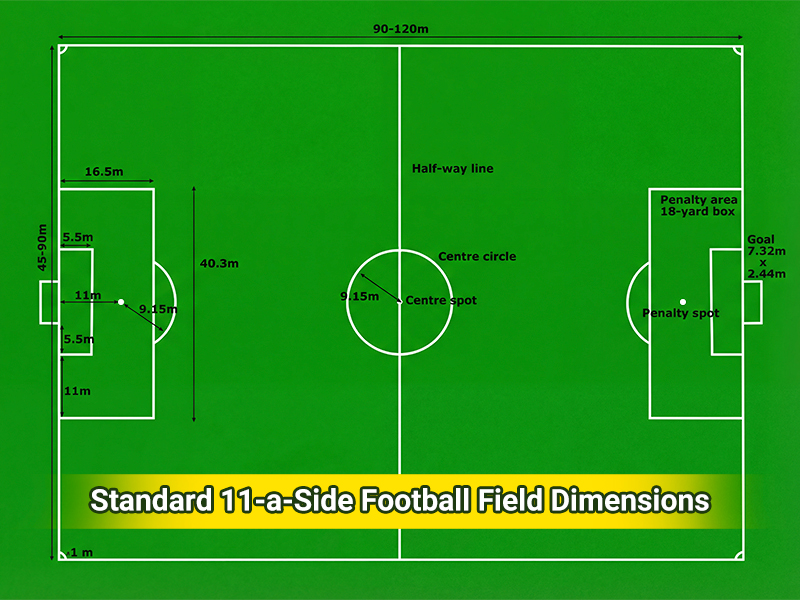
While overall field length and width are flexible within the allowed range, pitch markings and goal dimensions are fixed and must be applied consistently.
| Area | Dimensions (Metres) | Dimensions (Yards) | Notes |
| Goal | 7.32 × 2.44 m | 8 × 24 yd/ft | Standard 11-a-side goal |
| Goal Area | 5.5 × 18.3 m | 6 × 20 yd | “Six-yard box” |
| Penalty Area | 16.5 × 40.3 m | 18 × 44 yd | “18-yard box”; the goalkeeper may handle the ball |
| Penalty Mark | 11 m from the goal line | 12 yd | Penalty spot |
| Penalty Arc | 9.15 m radius | 10 yd radius | Area players must stay outside during a penalty kick |
| Centre Circle | 9.15 m radius | 10 yd radius | Players must stay outside at kick-off |
| Corner Arc | 1 m radius | 1 yd radius | The ball must be placed within this arc for a corner kick |
Small-Sided Football Field Dimensions (5v5, 7v7, 9v9)
Small-sided football formats—including 5v5, 7v7, and 9v9—are widely used across youth development, schools, community programs, and space-limited facilities. Compared with full-size football, these formats prioritize flexibility, higher player involvement, and efficient use of available space.
Design & Markings Note
For small-sided football, overall pitch length and width are the primary planning parameters most commonly defined by leagues, associations, and facility guidelines.
Other markings—such as penalty areas, goal areas, and corner arcs—are not universally standardized across regions or age groups. In practice, many facilities scale these elements proportionally from full-size pitches or adapt them to local rules, age categories, and available space.
Futsal Courts (Indoor)
Futsal is the official indoor five-a-side format governed by FIFA. It is played on hard indoor surfaces using a low-bounce ball, with clearly marked touchlines and no use of walls in official competition.
Official international competition dimensions
- Length: 38–42 m (42–46 yd)
- Width: 20–25 m (22–27 yd)
Non-competition or training layouts
- Can be reduced to 25 × 16 m (27 × 17 yd) where space is limited
Futsal places strong emphasis on technical skill, quick decision-making, and precise passing, and is widely used for elite technical development and indoor competition.
5-a-Side Football Fields (Outdoor)
Outdoor five-a-side football is commonly used for community play, recreational programs, and informal training. Unlike futsal, outdoor 5v5 fields are typically built on artificial turf and allow greater flexibility in layout and markings.
Common planning ranges
- Length: 30–40 m (33–44 yd)
- Width: 20–30 m (22–33 yd)
In real projects, dimensions may vary depending on available space, safety runoff requirements, and whether the pitch is designed as a standalone field or part of a multi-pitch complex.
7-a-Side Football Fields
Seven-a-side football is widely used in youth development and school programs, serving as a transitional format between small-sided games and full-size football. It is typically played on artificial turf or natural grass, using standard footballs and simplified field layouts.
Common planning ranges
- Length: 50–65 m (55–71 yd)
- Width: 35–45 m (38–49 yd)
These dimensions support structured training, age-appropriate competition, and efficient use of available space, while introducing players to positional play and team structure.
9-a-Side Football Fields
Nine-a-side football introduces greater tactical structure and spatial awareness, helping players adapt to positioning, spacing, and game organization before progressing to full-size 11-a-side football. It is commonly used in advanced youth categories and space-limited adult facilities.
Common planning ranges
- Length: 70–80 m (77–87 yd)
- Width: 45–55 m (49–60 yd)
This format balances the speed of small-sided football with the spatial demands of the full game, making it a practical bridge toward full-size pitch play.
Football Pitch Dimensions by Match Format
| Format | Recommended Length | Recommended Width | Approx. Area | Typical Use |
| 11-a-side | 105 m / 115 yd | 68 m / 74 yd | ~7,140 m² | Professional & adult competitive matches |
| 9-a-side | 70–80 m / 77–87 yd | 45–55 m / 49–60 yd | ~3,150–4,400 m² | Youth transition, space-limited adult play |
| 7-a-side | 50–65 m / 55–71 yd | 35–45 m / 38–49 yd | ~1,750–2,925 m² | Youth football, schools, amateur leagues |
| Futsal (indoor) | 38–42 m / 42–46 yd | 20–25 m / 22–27 yd | ~760–1,050 m² | Indoor competition & technical training |
| 5-a-side (outdoor) | 30–40 m / 33–44 yd | 20–30 m / 22–33 yd | ~600–1,200 m² | Community and recreational play |
CCGrass provides professional pitch layout planning and CAD drawings for football fields of all sizes—supporting schools, clubs, and community facilities in translating dimensional requirements into build-ready artificial turf solutions.
Youth & School Football Field Dimensions by Age Group
In youth and school environments, field dimensions are usually defined by age group and player development, not by a fixed competition format.
The tables below summarize commonly referenced recommendations from US Youth Soccer and The Football Association (England), which are widely used as benchmarks in school and community facility planning.
US Youth Soccer – Age-Based Field Size Recommendations
| Age Group | Typical Format | Ball Size | Recommended Length | Recommended Width |
| U6–U8 | 4v4 / 5v5 | Size 3 | 25–35 m (27–38 yd) | 15–25 m (16–27 yd) |
| U9–U10 | 7v7 | Size 4 | 50–65 m (55–71 yd) | 35–45 m (38–49 yd) |
| U11–U12 | 9v9 | Size 4 | 70–80 m (77–87 yd) | 45–55 m (49–60 yd) |
| U13–U14 | 11v11 (reduced) | Size 5 | 90–100 m (100–109 yd) | 55–64 m (60–70 yd) |
| U15+ | 11v11 | Size 5 | 100–120 m (109–130 yd) | 64–75 m (70–82 yd) |
Dimensions shown represent commonly adopted ranges rather than mandatory limits.
The FA (England) – Youth Pitch Size Guidance
| Age Group | Typical Format | Common Length | Common Width |
| U7–U8 | 5v5 | 30–40 m (33–44 yd) | 20–30 m (22–33 yd) |
| U9–U10 | 7v7 | 50–60 m (55–66 yd) | 30–40 m (33–44 yd) |
| U11–U12 | 9v9 | 70–75 m (77–82 yd) | 45–50 m (49–55 yd) |
| U13–U14 | 11v11 (reduced) | 90–100 m (98–109 yd) | 55–64 m (60–70 yd) |
| U15+ | 11v11 (full) | Up to 105 m (115 yd) | Up to 68 m (74 yd) |
Artificial Turf Planning for Football Pitches
Once football pitch dimensions are established, surface planning becomes the next practical step. For facilities with high weekly usage, limited recovery time, or multi-sport programming, artificial turf is often selected to ensure consistent playability and simplify long-term maintenance and scheduling.
The following focuses on how field dimensions translate into real-world artificial turf planning, including area calculations, line markings, turf system selection, and basic site considerations.
Choosing Dimensions for Your Project
While published standards and guidelines provide useful reference points, final pitch dimensions are typically shaped by site conditions and intended use.
When selecting final dimensions, planners typically balance three key factors:
- Available space: overall site boundaries, buffer zones, and surrounding infrastructure
- Budget constraints: total turf area, base construction, and shock pad requirements
- Usage patterns: training-only vs. match play, age groups served, and multi-pitch layouts
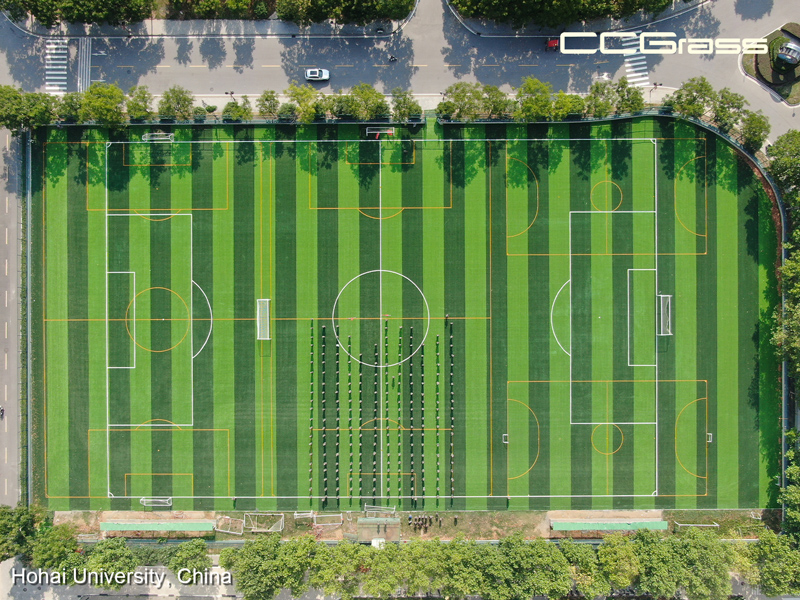
In school and multi-use facilities, youth pitches are often overlaid on a full-size 11-a-side field using transverse markings. This approach allows multiple age groups to share a single artificial turf surface while preserving age-appropriate playing dimensions and maximizing space efficiency.
Calculating Total Turf Area
The total turf quantity is based on the overall footprint of the field, not just the playing area defined by the touchlines.
A typical calculation includes:
- Playing field dimensions
- Perimeter buffer zones (commonly 1.5–2.0 m on all sides)
- Allowance for cutting, seaming, and installation waste (usually 5–10%)
Example (Full-Size Pitch):
- Playing field: 105 × 68 m
- With 2 m buffer on all sides: 109 × 72 m
- Total turf area (including 5% allowance):109 × 72 × 1.05 ≈ 8,240 m²
This figure represents the total artificial turf quantity typically specified for procurement, forming the basis for both green surface turf and inlaid line planning.
Estimating Inlaid Line Turf for Pitch Markings
On artificial football fields, pitch markings are typically created using inlaid white or yellow turf rather than paint. Although these markings usually account for less than 3% of the total surface area, they are planned and calculated separately to ensure accurate prefabrication and installation.
Line turf estimation is based on the total length of all required markings, including:
- Touchlines and goal lines
- Penalty areas and goal areas
- Center line and center circle
- Penalty arcs and corner arcs
- Optional technical or substitution zones
Because line widths are fixed by regulations—most commonly 10 cm or 12 cm—the inlaid turf area can be estimated using the following approach:
Inlaid line turf area = Total line length × Line width × Waste allowance (typically +10%)
Separating green surface turf from inlaid line turf at the planning stage does not increase the total turf quantity ordered, but it helps avoid material mismatches, color inconsistencies, and on-site rework during installation.
Artificial Turf System & Product Selection
An artificial football field is delivered as a complete turf system, typically comprising the turf surface, infill materials, shock-pad layers, and sub-base structure. System selection at the planning stage focuses on defining performance requirements, rather than detailing construction methods.
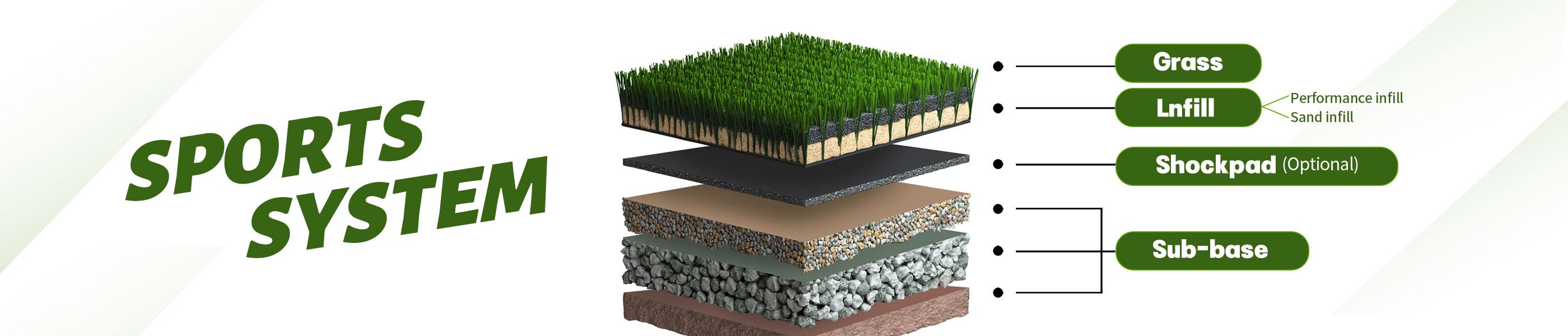
Key considerations when specifying an artificial turf system include:
- Field format and usage intensity (training-focused, school use, community play, or competition)
- Primary user groups (youth development, students, or adult players)
- Single-sport versus multi-sport programming
- Expected maintenance level and lifecycle planning
Surface characteristics such as pile height, fiber type, stitch density, and backing construction influence ball response, player comfort, and dimensional stability. These parameters also affect marking accuracy, especially where inlaid lines and transverse layouts are required.
For a more detailed comparison of system configurations commonly used on different pitch formats, see Artificial Turf for 7-a-Side and 11-a-Side Football Pitches.
Shock Pads, Drainage, and Sub-Base Coordination
While system selection defines performance targets, successful field construction depends on how subsurface components are coordinated on site.
Shock pads, drainage layers, and sub-base construction must work together to support the specified turf system. Shock pads contribute to impact attenuation and long-term consistency, but their thickness and installation method should be matched with the drainage strategy and base profile to avoid uneven settlement or water retention.
Drainage design should reflect local rainfall conditions, soil permeability, and expected usage intensity. Inadequate drainage or poorly coordinated base layers can lead to seam stress, surface deformation, and reduced field lifespan.
Perimeter runoff zones and edge detailing should also be planned in line with pitch dimensions to manage surface water and protect boundary stability. Coordinating these elements early helps ensure that system specifications translate smoothly into reliable on-field performance.
Orientation, Slope, and Site Preparation
Proper site preparation ensures that the designed pitch performs as intended:
- Orientation is typically aligned north–south where possible to minimize sun glare
- Surface slope is generally limited to 0.5–1.0% to support drainage without affecting play
- Base preparation must match both field size and expected usage intensity
Attention to these details ensures that dimensional planning translates smoothly into a durable, playable artificial turf field.
Frequently Asked Questions
How long is a football field?
A standard football field is typically 90–120 meters (100–130 yards) long under the IFAB Laws of the Game.
Professional matches most commonly use a length close to 105 meters (115 yards).
How wide is a soccer field?
A standard soccer field is 45–90 meters (50–100 yards) wide.
At professional level, widths between 64 and 75 meters (70–82 yards) are most common.
How big is a full-size football pitch?
A full-size football pitch does not have one fixed size. Instead, it is built within defined ranges, with certain dimensions more commonly used at professional level.
General size range (IFAB Laws of the Game):
- Length: 90–120 m (100–130 yd)
- Width: 45–90 m (50–100 yd)
Professional and top-level matches:
Most professional pitches fall within 100–110 m (109–120 yd) in length and 64–75 m (70–82 yd) in width.
Key takeaway:
There is no single “official” full-size pitch, but 105 × 68 m has become the most commonly used professional reference worldwide.
What is the size of a FIFA football field?
FIFA does not define a fixed football field size.
Under IFAB Laws of the Game, pitches may range from 90–120 m × 45–90 m, while FIFA Quality Pro fields are most commonly built within 100–110 m × 64–75 m for professional play.
What is the size of a Premier League football pitch?
Premier League pitches are not identical, but most clubs use a layout close to 105 × 68 meters (115 × 74 yards), which aligns with common European professional standards.
What is the size of a UEFA standard pitch?
UEFA commonly recommends a pitch size of 105 × 68 meters (115 × 74 yards) for elite competitions, although slight variations are permitted depending on stadium constraints.
Can one artificial turf field support multiple pitch sizes?
Yes. A single full-size artificial turf field can accommodate multiple layouts—such as 11v11, 9v9, and 7v7—using transverse and inlaid markings, which is common in school and community facilities.
Can CCGrass assist with football field layout and turf planning?
Yes. CCGrass supports football field projects with dimension planning, layout optimization, turf system selection, and multi-pitch configuration guidance, helping ensure compliance with both playing standards and site constraints.
How much does it cost to build a football pitch?
The total cost depends on pitch size, turf system, base construction, and local labor conditions.
Small-sided pitches cost significantly less than full-size fields, while artificial turf requires higher upfront investment but lower long-term maintenance.
Conclusion
A successful football pitch begins with the right alignment between dimensions and intended use, and is realized through professional, system-based planning and construction. Field dimensions are more than boundary lines — they directly shape playing experience, safety performance, and the long-term economics of a football project.
With decades of experience in football turf, CCGrass supports football projects worldwide with FIFA-certified artificial turf systems designed for professional matches, training facilities, and community use.
From small-sided and indoor fields to full-size pitches, we help clients select and build surface solutions that match their space, usage demands, and regulatory requirements—creating durable, high-performing football environments from planning through installation.